







Question: This is an assignment could you please introduce developed and concluded in 10 pages. 1 CASE The Recalcitrant Director at Byte Products, Inc. CORPORATE LEGALITY
This is an assignment could you please introduce developed and concluded in 10 pages.
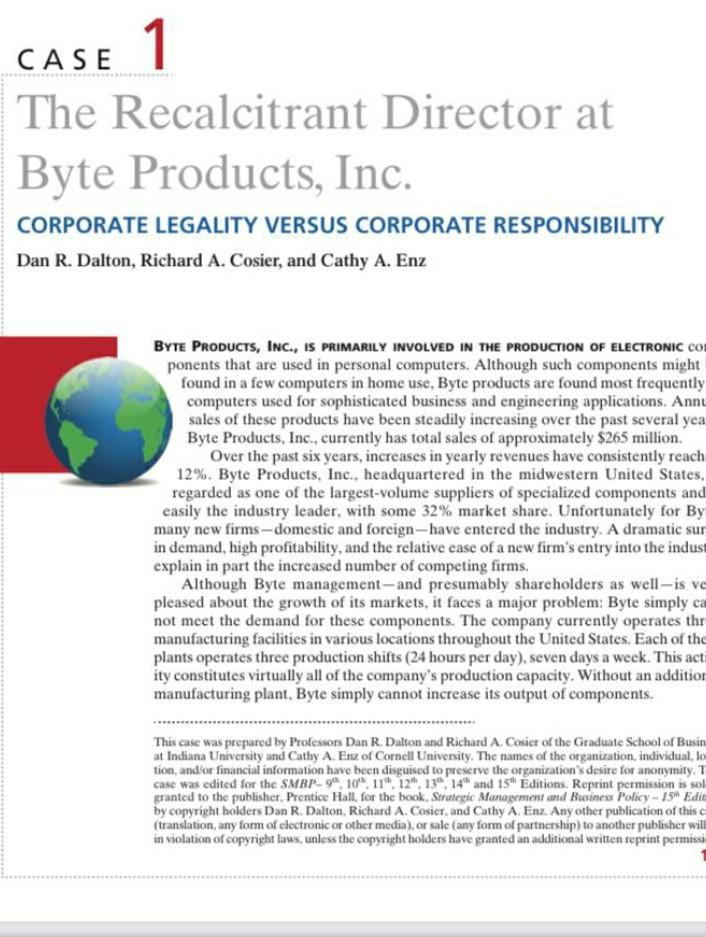
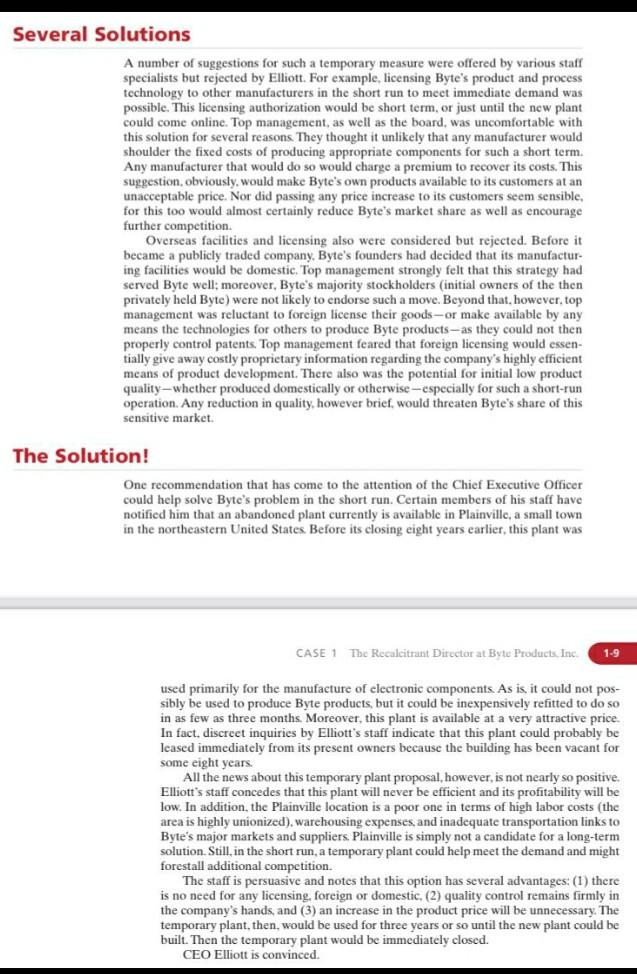
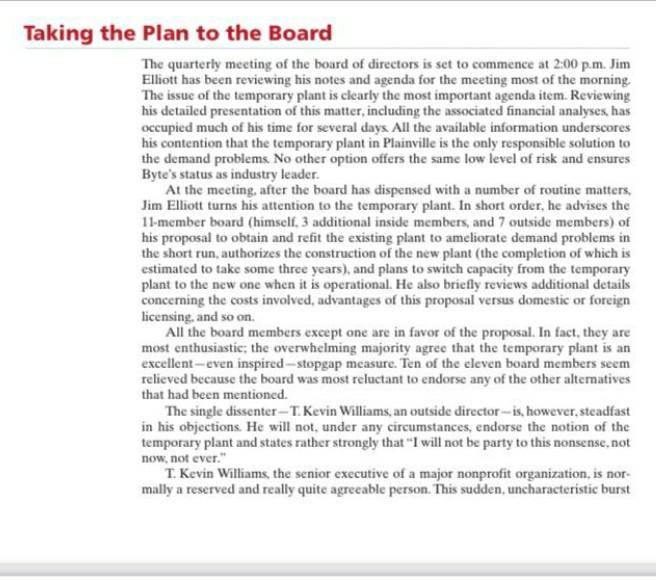
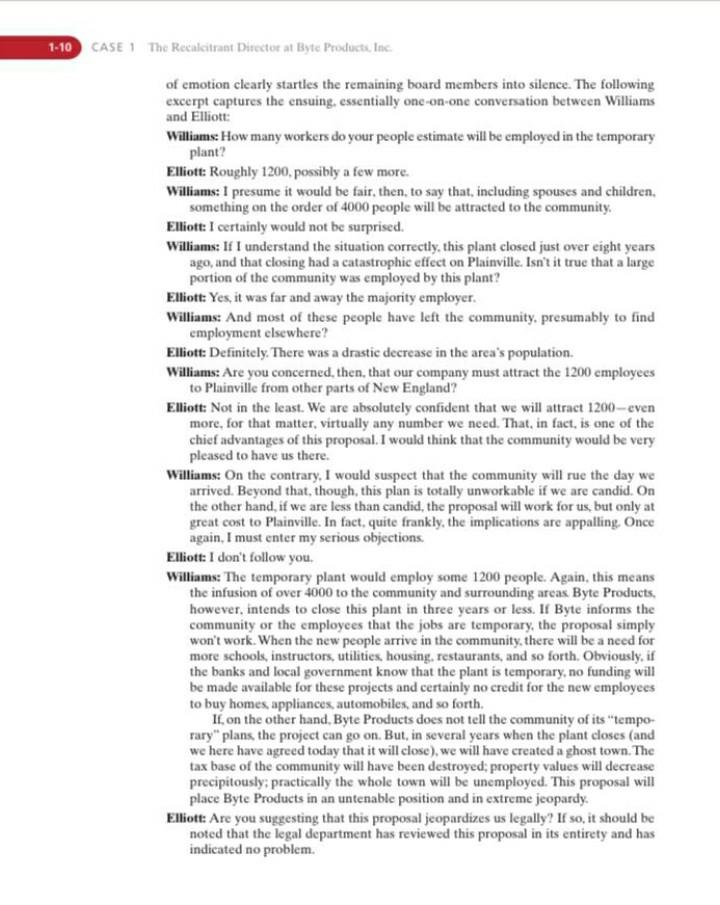
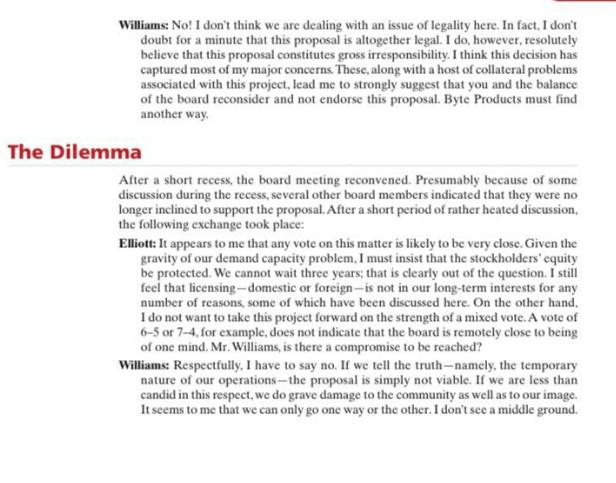
1 CASE The Recalcitrant Director at Byte Products, Inc. CORPORATE LEGALITY VERSUS CORPORATE RESPONSIBILITY Dan R. Dalton, Richard A. Cosier, and Cathy A. Enz BYTE PRODUCTS, INC., IS PRIMARILY INVOLVED IN THE PRODUCTION OF ELECTRONIC CON ponents that are used in personal computers. Although such components might found in a few computers in home use, Byte products are found most frequently computers used for sophisticated business and engineering applications. Ann sales of these products have been steadily increasing over the past several yea Byte Products, Inc., currently has total sales of approximately $265 million. Over the past six years, increases in yearly revenues have consistently reach 12%. Byte Products, Inc., headquartered in the midwestern United States, regarded as one of the largest-volume suppliers of specialized components and easily the industry leader, with some 32% market share. Unfortunately for By many new firms-domestic and foreign- have entered the industry. A dramatic sur in demand, high profitability, and the relative case of a new firm's entry into the indust explain in part the increased number of competing firms Although Byte management - and presumably shareholders as well - is ve pleased about the growth of its markets, it faces a major problem: Byte simply ca not meet the demand for these components. The company currently operates thr manufacturing facilities in various locations throughout the United States. Each of the plants operates three production shifts (24 hours per day), seven days a week. This act ity constitutes virtually all of the company's production capacity. Without an addition manufacturing plant, Byte simply cannot increase its output of components. This case was prepared by Professor Dan R. Dalton and Richard A. Cosier of the Graduate School of Busin at Indiana University and Cathy A. Enz of Cornell University. The names of the organization, individual, lo tion, and/or financial information have been disguised to preserve the organization's desire for anonymity. T case was edited for the SMBP-9, 10, 11, 12, 13, 14 and 15" Editions. Reprint permission is sol granted to the publisher, Prentice Hall, for the book. Strategic Management and Business Policy - 15" Edio by copyright holders Dan R. Dalton, Richard A. Cosier, and Cathy A. En. Any other publication of this (translation, any form of electronic or other media), or sale (any form of partnership) to another publisher will in violation of copyright laws, unless the copyright holders have granted an additional written reprint permissi Several Solutions A number of suggestions for such a temporary measure were offered by various staff specialists but rejected by Elliott. For example, licensing Byte's product and process technology to other manufacturers in the short run to meet immediate demand was possible. This licensing authorization would be short term, or just until the new plant could come online. Top management, as well as the board, was uncomfortable with this solution for several reasons. They thought it unlikely that any manufacturer would shoulder the fixed costs of producing appropriate components for such a short term. Any manufacturer that would do so would charge a premium to recover its costs. This suggestion, obviously, would make Byte's own products available to its customers at an unacceptable price. Nor did passing any price increase to its customers seem sensible, for this too would almost certainly reduce Byte's market share as well as encourage further competition. Overseas facilities and licensing also were considered but rejected. Before it became a publicly traded company, Byte's founders had decided that its manufactur- ing facilities would be domestic. Top management strongly felt that this strategy had served Byte well: moreover, Byte's majority stockholders (initial owners of the then privately held Byte) were not likely to endorse such a move. Beyond that, however, top management was reluctant to foreign license their goods-or make available by any means the technologies for others to produce Byte products-as they could not then properly control patents. Top management feared that foreign licensing would essen- tially give away costly proprietary information regarding the company's highly efficient means of product development. There also was the potential for initial low product quality-whether produced domestically or otherwise - especially for such a short-run operation. Any reduction in quality, however brief, would threaten Byte's share of this sensitive market. The Solution! One recommendation that has come to the attention of the Chief Executive Officer could help solve Byte's problem in the short run. Certain members of his staff have notified him that an abandoned plant currently is available in Plainville, a small town in the northeastern United States. Before its closing eight years earlier, this plant was CASE 1 The Recalcitrant Director at Byte Products Inc. 1-9 used primarily for the manufacture of clectronic components. As is, it could not pos- sibly be used to produce Byte products, but it could be inexpensively refitted to do so in as few as three months. Moreover, this plant is available at a very attractive price. In fact, discreet inquiries by Elliott's staff indicate that this plant could probably be leased immediately from its present owners because the building has been vacant for some eight years. All the news about this temporary plant proposal, however, is not nearly so positive. Elliott's staff concedes that this plant will never be efficient and its profitability will be low. In addition, the Plainville location is a poor one in terms of high labor costs (the area is highly unionized), warehousing expenses, and inadequate transportation links to Byte's major markets and suppliers. Plainville is simply not a candidate for a long-term solution Still, in the short run, a temporary plant could help meet the demand and might forestall additional competition. The staff is persuasive and notes that this option has several advantages: (1) there is no need for any licensing, foreign or domestic, (2) quality control remains firmly in the company's hands, and (3) an increase in the product price will be unnecessary. The temporary plant, then, would be used for three years or so until the new plant could be built. Then the temporary plant would be immediately closed. CEO Elliott is convinced Taking the Plan to the Board The quarterly meeting of the board of directors is set to commence at 2:00p.m. Jim Elliott has been reviewing his notes and agenda for the meeting most of the morning, The issue of the temporary plant is clearly the most important agenda item. Reviewing his detailed presentation of this matter, including the associated financial analyses, has occupied much of his time for several days All the available information underscores his contention that the temporary plant in Plainville is the only responsible solution to the demand problems. No other option offers the same low level of risk and ensures Byte's status as industry leader. At the meeting, after the board has dispensed with a number of routine matters Jim Elliott turns his attention to the temporary plant. In short order, he advises the 11-member board (himself. 3 additional inside members, and 7 outside members) of his proposal to obtain and refit the existing plant to ameliorate demand problems in the short run, authorizes the construction of the new plant (the completion of which is estimated to take some three years), and plans to switch capacity from the temporary plant to the new one when it is operational. He also briefly reviews additional details concerning the costs involved, advantages of this proposal versus domestic or foreign licensing, and so on. All the board members except one are in favor of the proposal. In fact, they are most enthusiastic: the overwhelming majority agree that the temporary plant is an excellent-even inspired-stopgap measure. Ten of the eleven board members seem relieved because the board was most reluctant to endorse any of the other alternatives that had been mentioned The single dissenter - Kevin Williams, an outside director - is, however, steadfast in his objections. He will not, under any circumstances, endorse the notion of the temporary plant and states rather strongly that I will not be party to this nonsense, not now, not ever." T. Kevin Williams, the senior executive of a major nonprofit organization, is nor- mally a reserved and really quite agreeable person. This sudden, uncharacteristic burst 1-10 CASE 1 The Recalcitrant Director at Byte Products, Inc. of emotion clearly startles the remaining board members into silence. The following excerpt captures the ensuing, essentially one-on-one conversation between Williams and Elliott WilliamsHow many workers do your people estimate will be employed in the temporary plant? Elliott: Roughly 1200, possibly a few more. Williams: I presume it would be fair, then, to say that, including spouses and children. something on the order of 4000 people will be attracted to the community Elliott: I certainly would not be surprised. Williams: If I understand the situation correctly, this plant closed just over eight years ago, and that closing had a catastrophic effect on Plainville. Isn't it true that a large portion of the community was employed by this plant? Elliott: Yes, it was far and away the majority employer. Williams: And most of these people have left the community, presumably to find employment elsewhere? Elliott: Definitely. There was a drastic decrease in the area's population. Williams: Are you concerned, then that our company must attract the 1200 employees to Plainville from other parts of New England? Elliott: Not in the least. We are absolutely confident that we will attract 1200-even more, for that matter, virtually any number we need. That, in fact, is one of the chief advantages of this proposal. I would think that the community would be very pleased to have us there. Williams: On the contrary, I would suspect that the community will rue the day we arrived. Beyond that, though, this plan is totally unworkable if we are candid. On the other hand, if we are less than candid, the proposal will work for us, but only at great cost to Plainville. In fact, quite frankly, the implications are appalling Once again, I must enter my serious objections Elliott: I don't follow you. Williams: The temporary plant would employ some 1200 people. Again, this means the infusion of over 4000 to the community and surrounding areas Byte Products, however, intends to close this plant in three years or less. If Byte informs the community or the employees that the jobs are temporary, the proposal simply won't work. When the new people arrive in the community, there will be a need for more schools, instructors, utilities, housing, restaurants, and so forth. Obviously, if the banks and local government know that the plant is temporary, no funding will be made available for these projects and certainly no credit for the new employees to buy homes, appliances, automobiles, and so forth. If on the other hand, Byte Products does not tell the community of its "tempo- rary" plans the project can go on. But in several years when the plant closes (and we here have agreed today that it will close), we will have created a ghost town. The tax base of the community will have been destroyed; property values will decrease precipitously, practically the whole town will be unemployed. This proposal will place Byte Products in an untenable position and in extreme jeopardy. Elliott: Are you suggesting that this proposal jeopardizes us legally? If so, it should be noted that the legal department has reviewed this proposal in its entirety and has indicated no problem Williams: No! I don't think we are dealing with an issue of legality here. In fact, I don't doubt for a minute that this proposal is altogether legal. I do, however, resolutely believe that this proposal constitutes gross irresponsibility. I think this decision has captured most of my major concerns. These, along with a host of collateral problems associated with this project, lead me to strongly suggest that you and the balance of the board reconsider and not endorse this proposal . Byte Products must find another way The Dilemma After a short recess, the board meeting reconvened. Presumably because of some discussion during the recess several other board members indicated that they were no longer inclined to support the proposal. After a short period of rather heated discussion, the following exchange took place: Elliott: It appears to me that any vote on this matter is likely to be very close. Given the gravity of our demand capacity problem. I must insist that the stockholders' equity be protected. We cannot wait three years, that is clearly out of the question. I still feel that licensing-domestic or foreign-is not in our long-term interests for any number of reasons, some of which have been discussed here. On the other hand, I do not want to take this project forward on the strength of a mixed vote. A vote of 6-5 or 7-4, for example, does not indicate that the board is remotely close to being of one mind, Mr. Williams, is there a compromise to be reached? Williams Respectfully, I have to say no. If we tell the truth-namely, the temporary nature of our operations-the proposal is simply not viable. If we are less than candid in this respect, we do grave damage to the community as well as to our image. It seems to me that we can only go one way or the other. I don't see a middle groundStep by Step Solution
There are 3 Steps involved in it
1 Expert Approved Answer
Step: 1 Unlock

Question Has Been Solved by an Expert!
Get step-by-step solutions from verified subject matter experts
Step: 2 Unlock
Step: 3 Unlock
 Study Help