Question: This is an Debate. The group posted there Attack which is provided below. can you respone and a closing argument to WHY you say 'YES
This is an Debate. The group posted there Attack which is provided below.
can you respone and a closing argument to WHY you say 'YES Corporations have a responsibilty to society beyond maximinzing profit'
THANKYOU
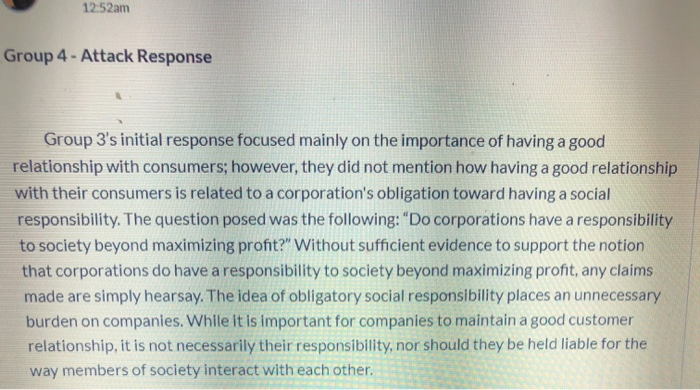
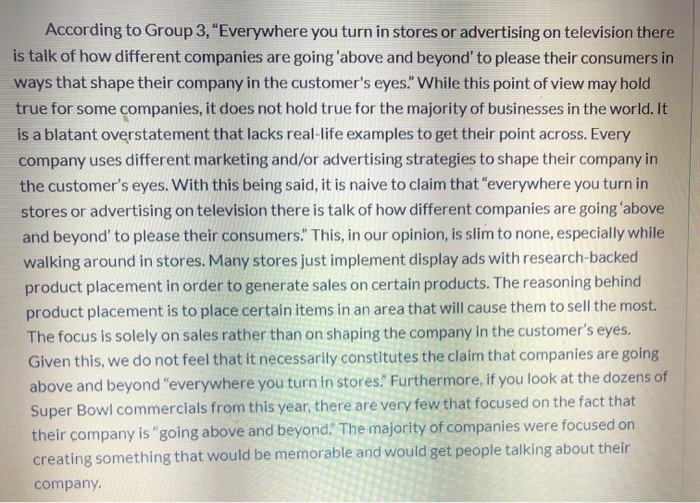
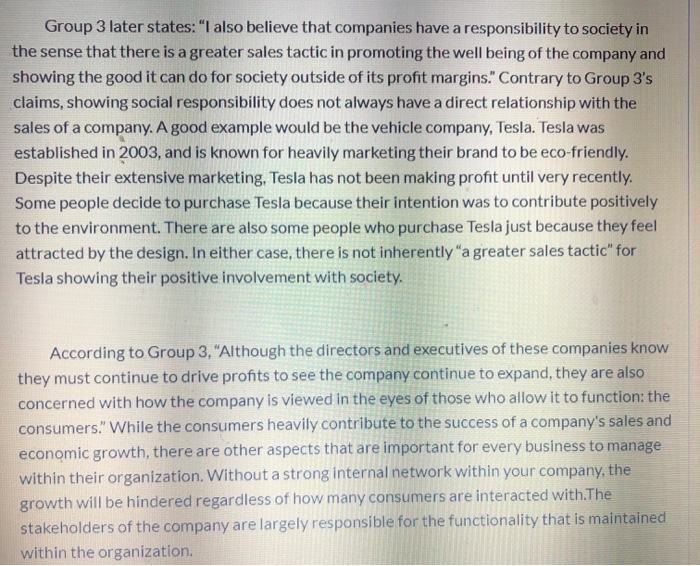
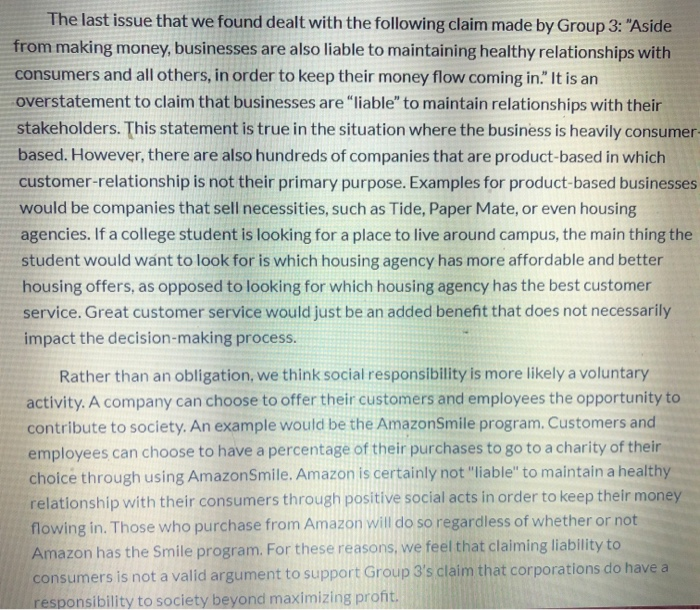
12:52am Group 4 - Attack Response Group 3's initial response focused mainly on the importance of having a good relationship with consumers; however, they did not mention how having a good relationship with their consumers is related to a corporation's obligation toward having a social responsibility. The question posed was the following: "Do corporations have a responsibility to society beyond maximizing profit?" Without sufficient evidence to support the notion that corporations do have a responsibility to society beyond maximizing profit, any claims made are simply hearsay. The idea of obligatory social responsibility places an unnecessary burden on companies. While it is important for companies to maintain a good customer relationship, it is not necessarily their responsibility, nor should they be held liable for the way members of society interact with each other. According to Group 3, "Everywhere you turn in stores or advertising on television there is talk of how different companies are going'above and beyond' to please their consumers in ways that shape their company in the customer's eyes." While this point of view may hold true for some companies, it does not hold true for the majority of businesses in the world. It is a blatant overstatement that lacks real-life examples to get their point across. Every company uses different marketing and/or advertising strategies to shape their company in the customer's eyes. With this being said, it is naive to claim that "everywhere you turn in stores or advertising on television there is talk of how different companies are going'above and beyond' to please their consumers." This, in our opinion, is slim to none, especially while walking around in stores. Many stores just implement display ads with research-backed product placement in order to generate sales on certain products. The reasoning behind product placement is to place certain items in an area that will cause them to sell the most. The focus is solely on sales rather than on shaping the company in the customer's eyes. Given this, we do not feel that it necessarily constitutes the claim that companies are going above and beyond "everywhere you turn in stores." Furthermore, if you look at the dozens of Super Bowl commercials from this year, there are very few that focused on the fact that their company is "going above and beyond." The majority of companies were focused on creating something that would be memorable and would get people talking about their company Group 3 later states: "I also believe that companies have a responsibility to society in the sense that there is a greater sales tactic in promoting the well being of the company and showing the good it can do for society outside of its profit margins." Contrary to Group 3's claims, showing social responsibility does not always have a direct relationship with the sales of a company. A good example would be the vehicle company, Tesla. Tesla was established in 2003, and is known for heavily marketing their brand to be eco-friendly. Despite their extensive marketing, Tesla has not been making profit until very recently. Some people decide to purchase Tesla because their intention was to contribute positively to the environment. There are also some people who purchase Tesla just because they feel attracted by the design. In either case, there is not inherently "a greater sales tactic" for Tesla showing their positive involvement with society. According to Group 3, "Although the directors and executives of these companies know they must continue to drive profits to see the company continue to expand, they are also concerned with how the company is viewed in the eyes of those who allow it to function: the consumers." While the consumers heavily contribute to the success of a company's sales and economic growth, there are other aspects that are important for every business to manage within their organization. Without a strong internal network within your company, the growth will be hindered regardless of how many consumers are interacted with.The stakeholders of the company are largely responsible for the functionality that is maintained within the organization. The last issue that we found dealt with the following claim made by Group 3: "Aside from making money, businesses are also liable to maintaining healthy relationships with consumers and all others, in order to keep their money flow coming in." It is an overstatement to claim that businesses are "liable" to maintain relationships with their stakeholders. This statement is true in the situation where the business is heavily consumer based. However, there are also hundreds of companies that are product-based in which customer-relationship is not their primary purpose. Examples for product-based businesses would be companies that sell necessities, such as Tide, Paper Mate, or even housing agencies. If a college student is looking for a place to live around campus, the main thing the student would want to look for is which housing agency has more affordable and better housing offers, as opposed to looking for which housing agency has the best customer service. Great customer service would just be an added benefit that does not necessarily impact the decision-making process. Rather than an obligation, we think social responsibility is more likely a voluntary activity. A company can choose to offer their customers and employees the opportunity to contribute to society. An example would be the AmazonSmile program. Customers and employees can choose to have a percentage of their purchases to go to a charity of their choice through using Amazon Smile. Amazon is certainly not liable" to maintain a healthy relationship with their consumers through positive social acts in order to keep their money flowing in. Those who purchase from Amazon will do so regardless of whether or not Amazon has the Smile program. For these reasons, we feel that claiming liability to consumers is not a valid argument to support Group 3's claim that corporations do have a responsibility to society beyond maximizing profit









 Study Help