







Question: This is Analysis. Please don't forget to justify for every part. Problem 6: True or false? Justify Your answer. a) If M is the maximum
This is Analysis.
Please don't forget to justify for every part.
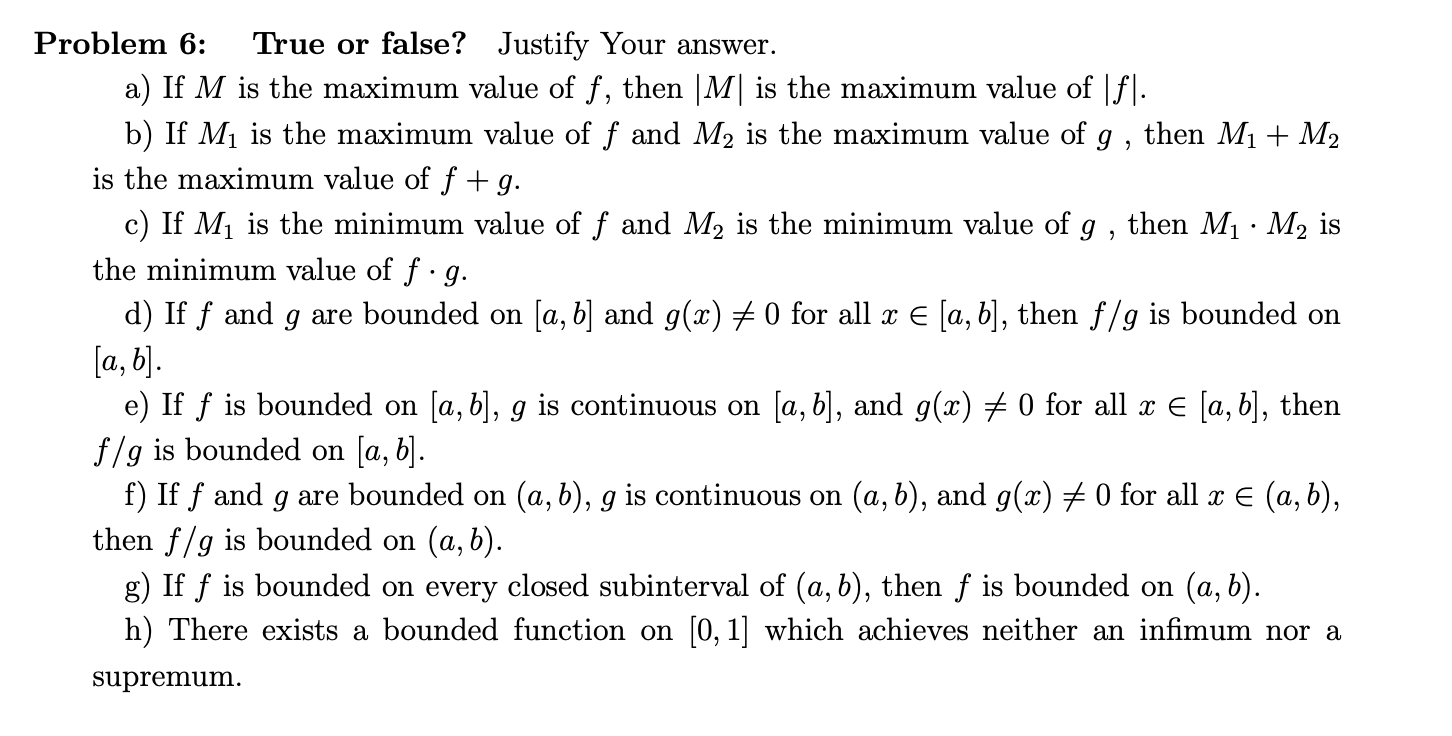
Problem 6: True or false? Justify Your answer. a) If M is the maximum value of f, then |M| is the maximum value of | f | b) If M1 is the maximum value of f and M2 is the maximum value of g , then M1 + M2 is the maximum value of f + g. c) If M1 is the minimum value of f and M2 is the minimum value of g , then M1 - M2 is the minimum value of f - g. d) If f and g are bounded on [a, b] and g(:c) 75 0 for all m 6 [(1,1)], then f / g is bounded on [41, b]. e) If f is bounded on [(1,3)], g is continuous on [(1,1)], and 9(a) 3% 0 for all :r: 6 [a,b], then f / g is bounded on [(1, b]. f) If f and g are bounded on (a, b), g is continuous on (a, b), and 9(3) 75 0 for all a: E (a, b), then f / g is bounded on (a, b). g) If f is bounded on every closed subinterval of ((1,3)), then f is bounded on (a, b). h) There exists a bounded function on [0, 1] which achieves neither an inmum nor a supremum
Step by Step Solution
There are 3 Steps involved in it

Get step-by-step solutions from verified subject matter experts
 Study Help