







Question: This is assembly mips program ask to complete the function and follow the output instructions. please complete function in mips code and you can use
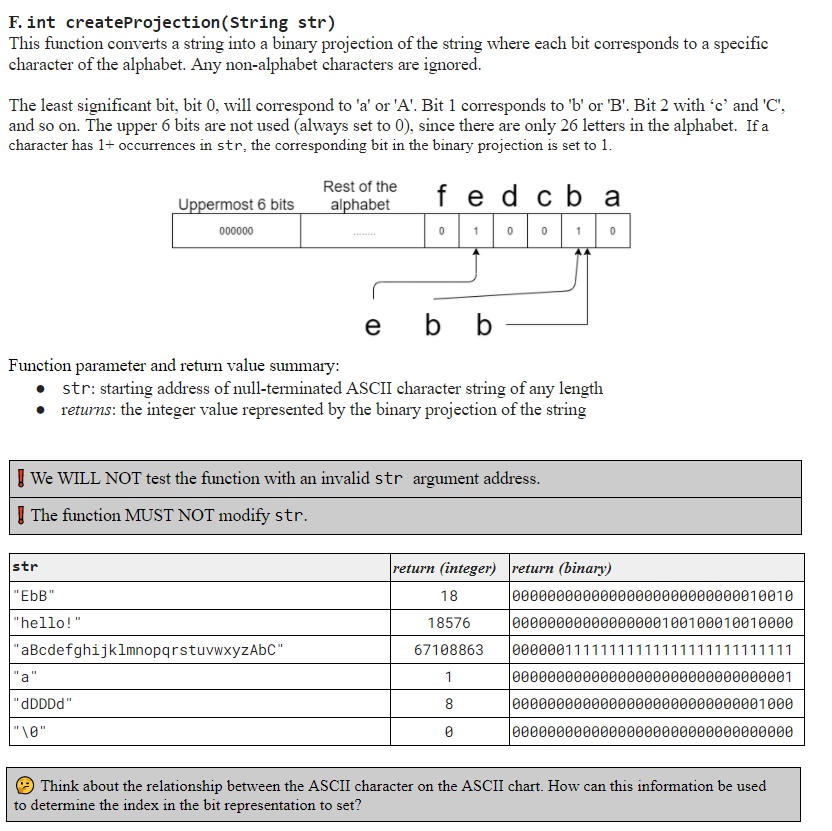
This is assembly mips program ask to complete the function and follow the output instructions. please complete function in mips code and you can use any main function to test.
F. int createProjection(String str) This function converts a string into a binary projection of the string where each bit corresponds to a specific character of the alphabet. Any non-alphabet characters are ignored. The least significant bit, bit 0, will correspond to 'a' or 'A'. Bit 1 corresponds to 'b' or 'B'. Bit 2 with 'c' and 'C', and so on. The upper 6 bits are not used (always set to 0), since there are only 26 letters in the alphabet. Ifa character has 1+ occurrences in str, the corresponding bit in the binary projection is set to 1. Rest of the alphabet Uppermost 6 bits 000000 fe dcba 0 0 0 1 e b b Function parameter and return value summary: str: starting address of null-terminated ASCII character string of any length returns: the integer value represented by the binary projection of the string | We WILL NOT test the function with an invalid str argument address. | The function MUST NOT modify str. str "EB" "hello!" "aBcdefghijklmnopqrstuvwxyzABC" "a return (integer) return (binary) 18 00000000000000000000000000010010 18576 00000000000000000100100010010000 67108863 00000011111111111111111111111111 1 00000000000000000000000000000001 8 00000000000000000000000000001000 0 00000000000000000000000000000000 "DDDDd" "10" Think about the relationship between the ASCII character on the ASCII chart. How can this information be used to determine the index in the bit representation to set
Step by Step Solution
There are 3 Steps involved in it

Get step-by-step solutions from verified subject matter experts
 Study Help