







Question: This is Business Information System, please help 1. To decide whether a binary relationship is 1:1,1:M or M:M, we rely on A. Maximum cardinality B.
This is Business Information System, please help 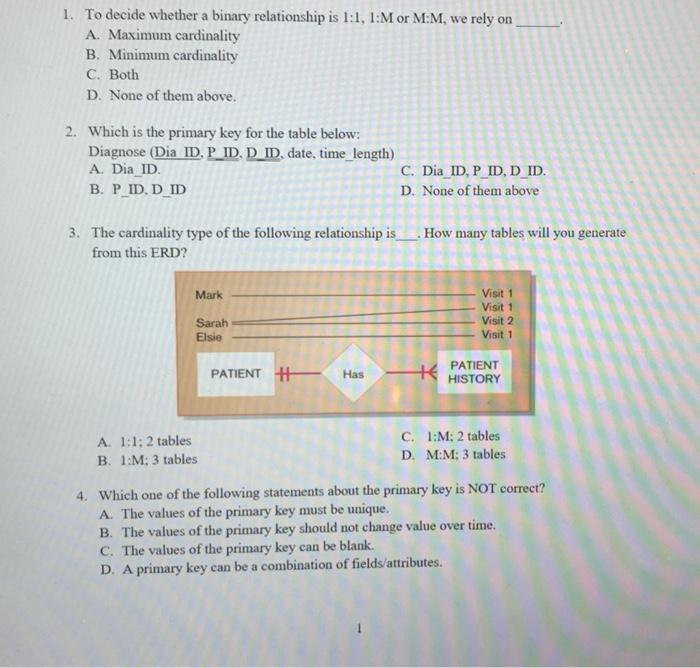
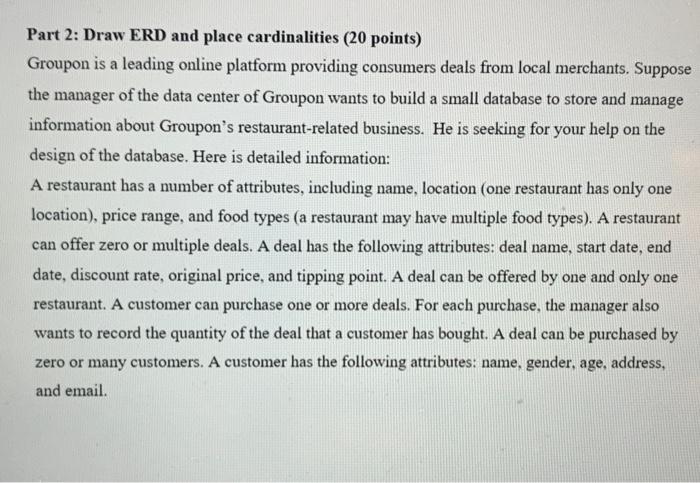
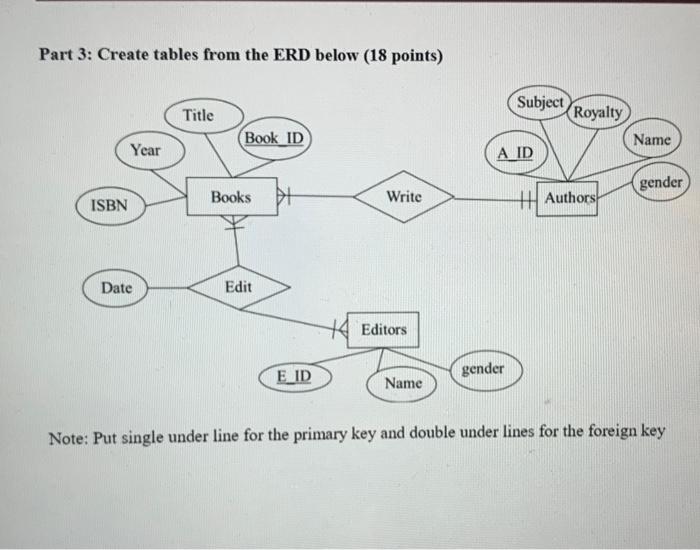
1. To decide whether a binary relationship is 1:1,1:M or M:M, we rely on A. Maximum cardinality B. Minimum cardinality C. Both D. None of them above. 2. Which is the primary key for the table below: Diagnose (Dia ID, P_ID. D_ID, date, time_length) A. Dia_ID. C. Dia_ID, P_ID,D_ID. B. P.ID, D.ID D. None of them above 3. The cardinality type of the following relationship is . How many tables will you generate from this ERD? A. 1:1;2 tables C. 1:M: 2 tables B. 1:M:3 tables D. M:M: 3 tables 4. Which one of the following statements about the primary key is NOT correct? A. The values of the primary key must be unique. B. The values of the primary key should not change value over time. C. The values of the primary key can be blank. D. A primary key can be a combination of fields/attributes. Part 2: Draw ERD and place cardinalities ( 20 points) Groupon is a leading online platform providing consumers deals from local merchants. Suppose the manager of the data center of Groupon wants to build a small database to store and manage information about Groupon's restaurant-related business. He is seeking for your help on the design of the database. Here is detailed information: A restaurant has a number of attributes, including name, location (one restaurant has only one location), price range, and food types (a restaurant may have multiple food types). A restaurant can offer zero or multiple deals. A deal has the following attributes: deal name, start date, end date, discount rate, original price, and tipping point. A deal can be offered by one and only one restaurant. A customer can purchase one or more deals. For each purchase, the manager also wants to record the quantity of the deal that a customer has bought. A deal can be purchased by zero or many customers. A customer has the following attributes: name, gender, age, address, and email. Part 3: Create tables from the ERD below (18 points) Note: Put single under line for the primary key and double under lines for the foreign key
Step by Step Solution
There are 3 Steps involved in it
1 Expert Approved Answer
Step: 1 Unlock

Question Has Been Solved by an Expert!
Get step-by-step solutions from verified subject matter experts
Step: 2 Unlock
Step: 3 Unlock
 Study Help