







Question: This is database systems. please follow direction. Draw an EER diagram to represent the following situation: When appropriate, model an associative entity. A real estate
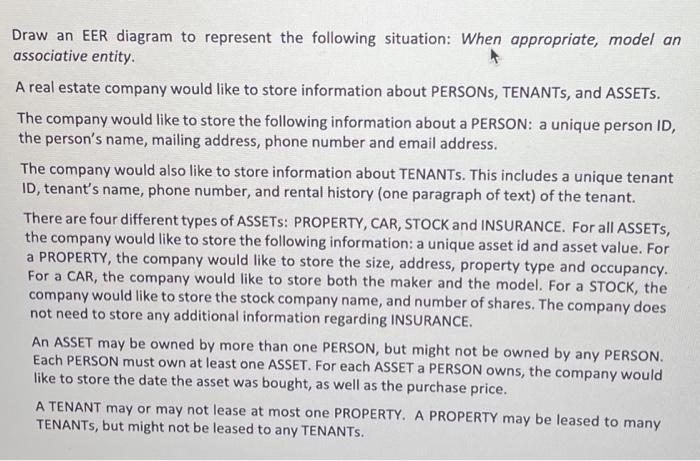
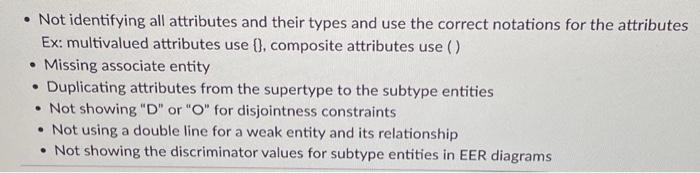
Draw an EER diagram to represent the following situation: When appropriate, model an associative entity. A real estate company would like to store information about PERSONs, TENANTs, and ASSETs. The company would like to store the following information about a PERSON: a unique person ID, the person's name, mailing address, phone number and email address. The company would also like to store information about TENANTs. This includes a unique tenant ID, tenant's name, phone number, and rental history (one paragraph of text) of the tenant. There are four different types of ASSETS: PROPERTY, CAR, STOCK and INSURANCE. For all ASSETS, the company would like to store the following information: a unique asset id and asset value. For a PROPERTY, the company would like to store the size, address, property type and occupancy. For a CAR, the company would like to store both the maker and the model. For a STOCK, the company would like to store the stock company name, and number of shares. The company does not need to store any additional information regarding INSURANCE. An ASSET may be owned by more than one PERSON, but might not be owned by any PERSON. Each PERSON must own at least one ASSET. For each ASSET a PERSON owns, the company would like to store the date the asset was bought, as well as the purchase price. A TENANT may or may not lease at most one PROPERTY. A PROPERTY may be leased to many TENANTs, but might not be leased to any TENANTs. - Not identifying all attributes and their types and use the correct notations for the attributes Ex: multivalued attributes use \{\}, composite attributes use () - Missing associate entity - Duplicating attributes from the supertype to the subtype entities - Not showing " D " or "O" for disjointness constraints - Not using a double line for a weak entity and its relationship - Not showing the discriminator values for subtype entities in EER diagrams
Step by Step Solution
There are 3 Steps involved in it

Get step-by-step solutions from verified subject matter experts
 Study Help