







Question: This is Discrete Methods (no coding). ONLY NEED HELP WITH PARTS D, E, F = 3. Imagine you are developing a game, and the game
This is Discrete Methods (no coding). ONLY NEED HELP WITH PARTS D, E, F
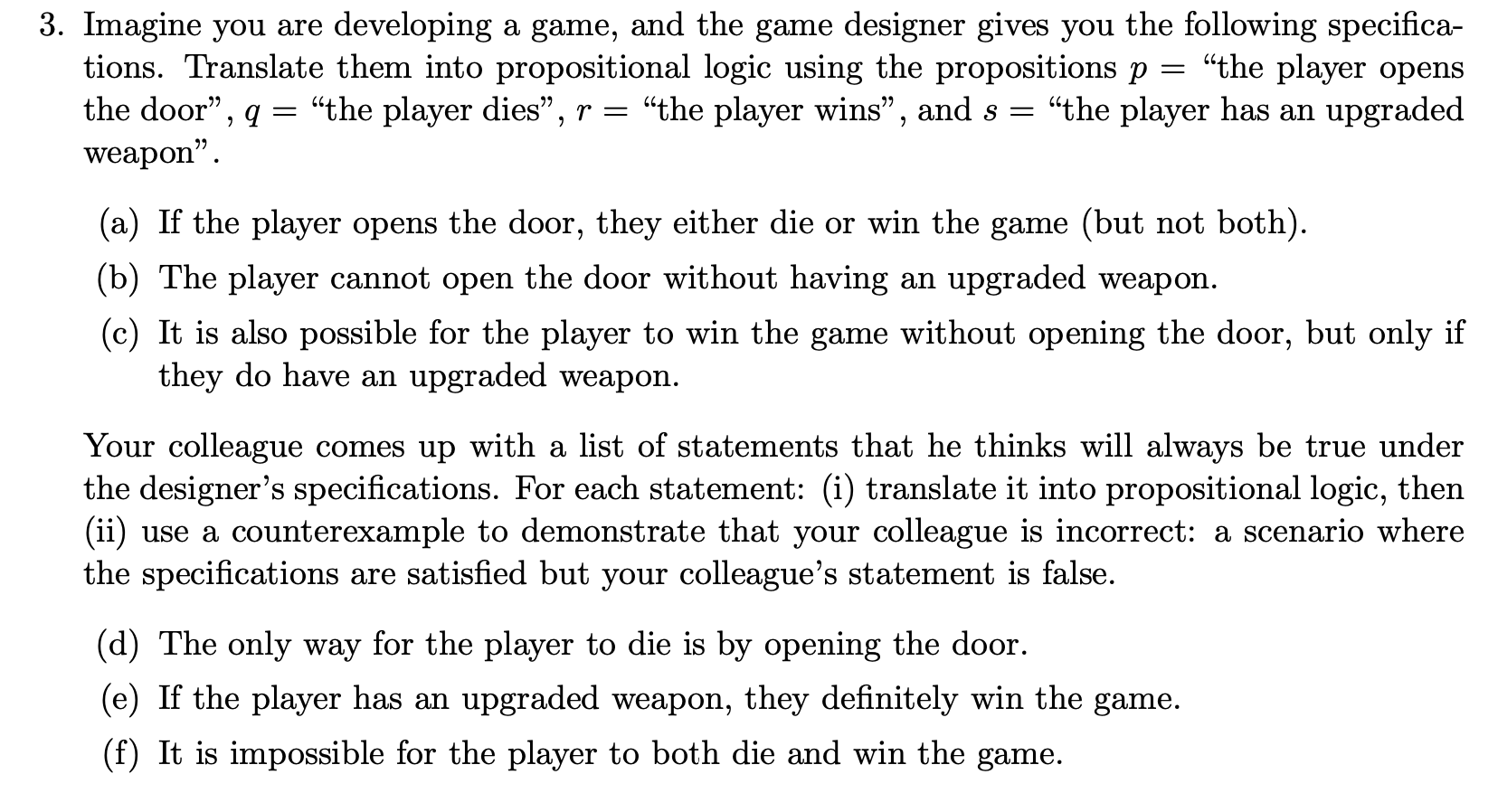
= 3. Imagine you are developing a game, and the game designer gives you the following specifica- tions. Translate them into propositional logic using the propositions p = "the player opens the door, a the player dies, r = the player wins, and s = the player has an upgraded weapon. = (a) If the player opens the door, they either die or win the game (but not both). (b) The player cannot open the door without having an upgraded weapon. (c) It is also possible for the player to win the game without opening the door, but only if they do have an upgraded weapon. Your colleague comes up with a list of statements that he thinks will always be true under the designer's specifications. For each statement: (i) translate it into propositional logic, then (ii) use a counterexample to demonstrate that your colleague is incorrect: a scenario where the specifications are satisfied but your colleague's statement is false. (d) The only way for the player to die is by opening the door. (e) If the player has an upgraded weapon, they definitely win the game. (f) It is impossible for the player to both die and win the game
Step by Step Solution
There are 3 Steps involved in it

Get step-by-step solutions from verified subject matter experts
 Study Help