







Question: This is electrical Engineering. State definition extensions For Lab 8, controller 1 had four states: sIdle, sRightPlayerServes, sMoveLeft, and sEndLeft. Here we will outline what
This is electrical Engineering.
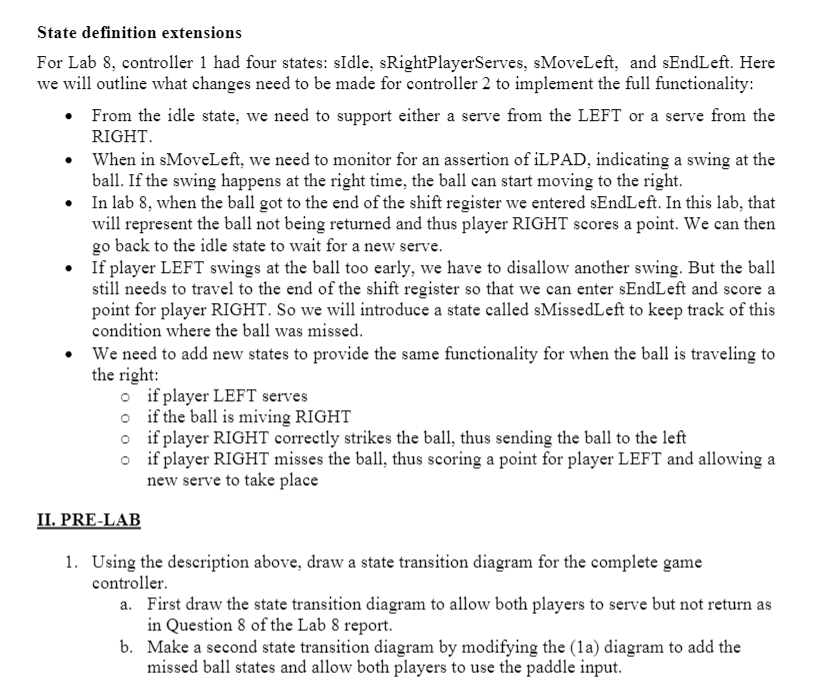
State definition extensions For Lab 8, controller 1 had four states: sIdle, sRightPlayerServes, sMoveLeft, and sEndLeft. Here we will outline what changes need to be made for controller 2 to implement the full functionality: From the idle state, we need to support either a serve from the LEFT or a serve from the RIGHT When in sMoveLeft, we need to monitor for an assertion of iLPAD, indicating a swing at the ball. If the swing happens at the right time, the ball can start moving to the right. In lab 8, when the ball got to the end of the shift register we entered sEndLeft. In this lab, that will represent the ball not being returned and thus player RIGHT scores a point. We can then go back to the idle state to wait for a new serve. If player LEFT swings at the ball too early, we have to disallow another swing. But the ball still needs to travel to the end of the shift register so that we can enter sEndLeft and score a point for player RIGHT. So we will introduce a state called sMissedLeft to keep track of this condition where the ball was missed. We need to add new states to provide the same functionality for when the ball is traveling to the right: o if player LEFT serves o if the ball is miving RIGHT o if player RIGHT correctly strikes the ball, thus sending the ball to the left o if player RIGHT misses the ball, thus scoring a point for player LEFT and allowing a new serve to take place II. PRE-LAB 1. Using the description above, draw a state transition diagram for the complete game controller. a. First draw the state transition diagram to allow both players to serve but not return as in Question 8 of the Lab 8 report. b. Make a second state transition diagram by modifying the (1a) diagram to add the missed ball states and allow both players to use the paddle input. State definition extensions For Lab 8, controller 1 had four states: sIdle, sRightPlayerServes, sMoveLeft, and sEndLeft. Here we will outline what changes need to be made for controller 2 to implement the full functionality: From the idle state, we need to support either a serve from the LEFT or a serve from the RIGHT When in sMoveLeft, we need to monitor for an assertion of iLPAD, indicating a swing at the ball. If the swing happens at the right time, the ball can start moving to the right. In lab 8, when the ball got to the end of the shift register we entered sEndLeft. In this lab, that will represent the ball not being returned and thus player RIGHT scores a point. We can then go back to the idle state to wait for a new serve. If player LEFT swings at the ball too early, we have to disallow another swing. But the ball still needs to travel to the end of the shift register so that we can enter sEndLeft and score a point for player RIGHT. So we will introduce a state called sMissedLeft to keep track of this condition where the ball was missed. We need to add new states to provide the same functionality for when the ball is traveling to the right: o if player LEFT serves o if the ball is miving RIGHT o if player RIGHT correctly strikes the ball, thus sending the ball to the left o if player RIGHT misses the ball, thus scoring a point for player LEFT and allowing a new serve to take place II. PRE-LAB 1. Using the description above, draw a state transition diagram for the complete game controller. a. First draw the state transition diagram to allow both players to serve but not return as in Question 8 of the Lab 8 report. b. Make a second state transition diagram by modifying the (1a) diagram to add the missed ball states and allow both players to use the paddle input
Step by Step Solution
There are 3 Steps involved in it

Get step-by-step solutions from verified subject matter experts
 Study Help