







Question: This is for a data base class, please help me. Thank you! 6:58 PM metrostate.learn.minnstate.edu T-Mobile Going from High Level ERD to Relational Database. High
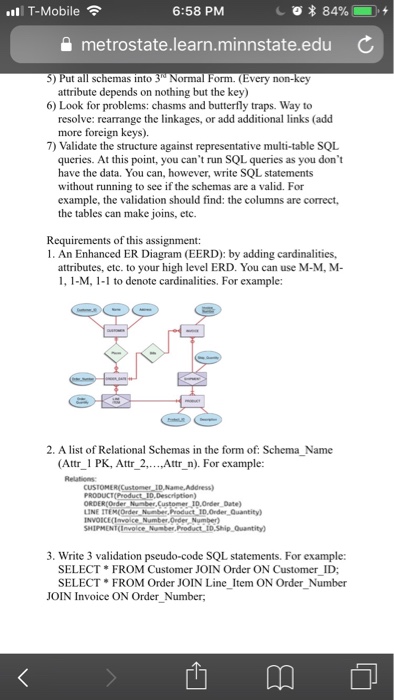
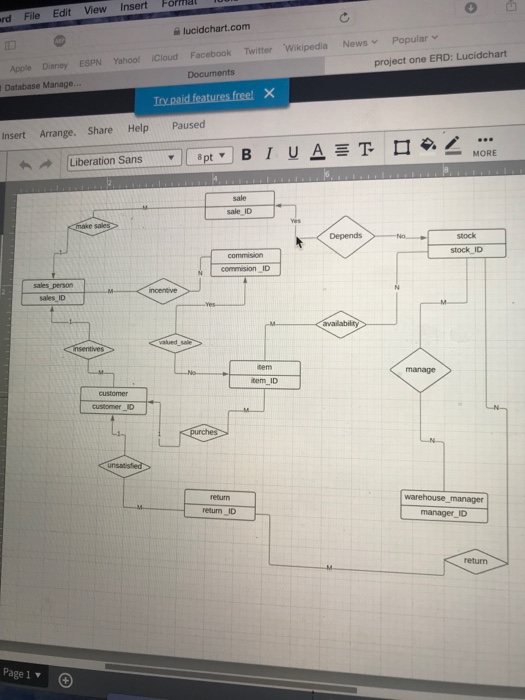
6:58 PM metrostate.learn.minnstate.edu T-Mobile Going from High Level ERD to Relational Database. High Level/Conceptual ERD: this level captures what the customer requested. It has entities and relationships. It is not implementable as a relational database. Detail Level/Enhanced ERD: by adding cardinalities, attributes, primary keys, foreign keys to High Level/Conceptual ERD, it makes conversion to relational schema much easier. Relational Schemas: these are ready to hand to the database administrator (DBA) to be turned into real tables. It can be mapped one-to-one to tables and foreign keys in a relational database. Once the High ERD is finished, and approved by the customer then turn it into relational schemas in the following steps: 1) Mark cardinalities (M-M, 1-M, M-1, 1-1) on ERD. Add all relevant attributes to each entity 2) Convert M-M relationships to entity schemas and relationship schemas. Convert 1-M/M-1 relationships by making 1 side entity's primary key as the forging key in M side. For 1-1 relationships: imagine one side as M side and convert accordingly. Sometimes the two entities in 1-1 relationships probably should be combined, unless there is a reason not to. 3) Put all schemas into 1st Normal Form: Break composite attributes into individual undividable attributes. . Create another schema for multi-valued attributes 4) Put all schemas into 2nd Normal Form. (Every non-key 5) Put all schemas into 3 Normal Form. (Every non-key 6) Look for problems: chasms and butterfly traps. Way to attribute depends on the whole key) attribute depends on nothing but the key) resolve: rearrange the linkages, or add additional links (add more foreign keys). 7) Validate the structure against representative multi-table SQL queries. At this point, you can't run SQL queries as you don't have the data. You can, however, write SQL statements without running to see if the schemas are a valid. For example, the validation should find: the columns are correct, the tables can make joins, etc. Requirements of this assignment: 1. An Enhanced ER Diagram (EERD): by adding cardinalities, attributes, etc. to your high level ERD. You can use M-M, M 1, 1-M, 1-1 to denote cardinalities. For example
Step by Step Solution
There are 3 Steps involved in it

Get step-by-step solutions from verified subject matter experts
 Study Help