







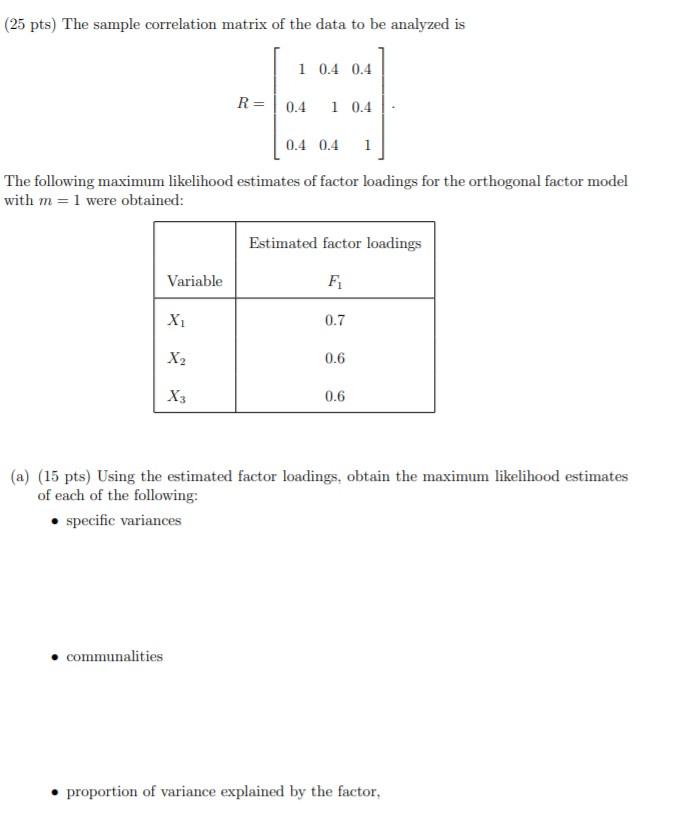
Question: this is from multivariate statistical analysis. (25 pts) The sample correlation matrix of the data to be analyzed is 1 0.4 0.4 R= 0.4 10.4
this is from multivariate statistical analysis.
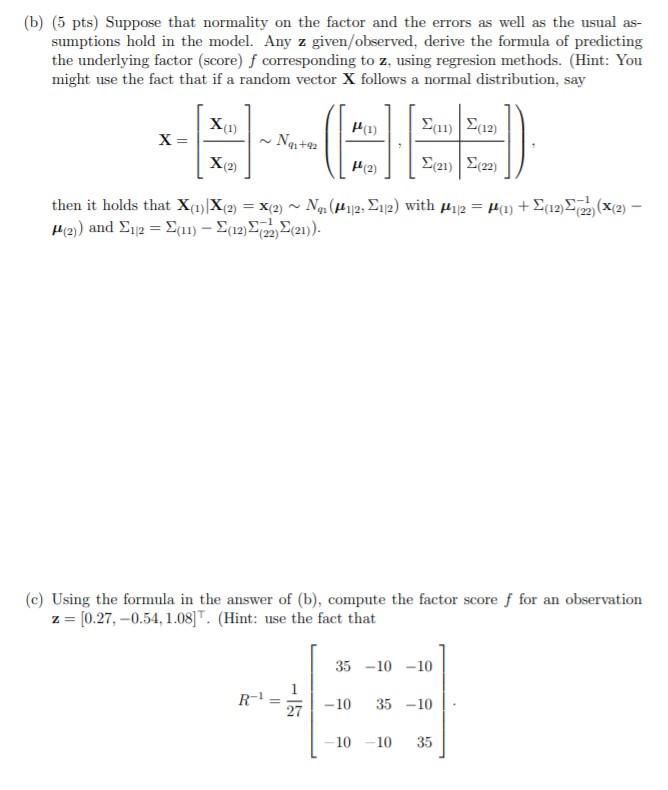
(25 pts) The sample correlation matrix of the data to be analyzed is 1 0.4 0.4 R= 0.4 10.4 0.4 0.4 1 The following maximum likelihood estimates of factor loadings for the orthogonal factor model with m=1 were obtained: Estimated factor loadings Variable F 0.7 X2 0.6 X3 0.6 (a) (15 pts) Using the estimated factor loadings, obtain the maximum likelihood estimates of each of the following: specific variances communalities proportion of variance explained by the factor, (b) (5 pts) Suppose that normality on the factor and the errors as well as the usual as- sumptions hold in the model. Any z given observed, derive the formula of predicting the underlying factor (score) f corresponding to z, using regresion methods. (Hint: You might use the fact that if a random vector X follows a normal distribution, say X 1 1) (11) 9(12) X= Naita X2 2) 521) E (22) then it holds that X1) X 2) = X(2) ~ NG: (1412, 9112) with 1/2 = (1) + (12) 52(X(2) - (2)) and S12 = (11) - (12) 225 (21)). (c) Using the formula in the answer of (b), compute the factor score f for an observation z = [0.27,-0.54, 1.08] T. (Hint: use the fact that 35 -10-10 R- 27 -10 35 -10 10 -10 35 (25 pts) The sample correlation matrix of the data to be analyzed is 1 0.4 0.4 R= 0.4 10.4 0.4 0.4 1 The following maximum likelihood estimates of factor loadings for the orthogonal factor model with m=1 were obtained: Estimated factor loadings Variable F 0.7 X2 0.6 X3 0.6 (a) (15 pts) Using the estimated factor loadings, obtain the maximum likelihood estimates of each of the following: specific variances communalities proportion of variance explained by the factor, (b) (5 pts) Suppose that normality on the factor and the errors as well as the usual as- sumptions hold in the model. Any z given observed, derive the formula of predicting the underlying factor (score) f corresponding to z, using regresion methods. (Hint: You might use the fact that if a random vector X follows a normal distribution, say X 1 1) (11) 9(12) X= Naita X2 2) 521) E (22) then it holds that X1) X 2) = X(2) ~ NG: (1412, 9112) with 1/2 = (1) + (12) 52(X(2) - (2)) and S12 = (11) - (12) 225 (21)). (c) Using the formula in the answer of (b), compute the factor score f for an observation z = [0.27,-0.54, 1.08] T. (Hint: use the fact that 35 -10-10 R- 27 -10 35 -10 10 -10 35Step by Step Solution
There are 3 Steps involved in it
1 Expert Approved Answer
Step: 1 Unlock

Question Has Been Solved by an Expert!
Get step-by-step solutions from verified subject matter experts
Step: 2 Unlock
Step: 3 Unlock
 Study Help