



Question: this is from my fluid mechanics class! fyi A remarkable amount of energy is available from the salinity-gradient energy between sea water and fresh water.
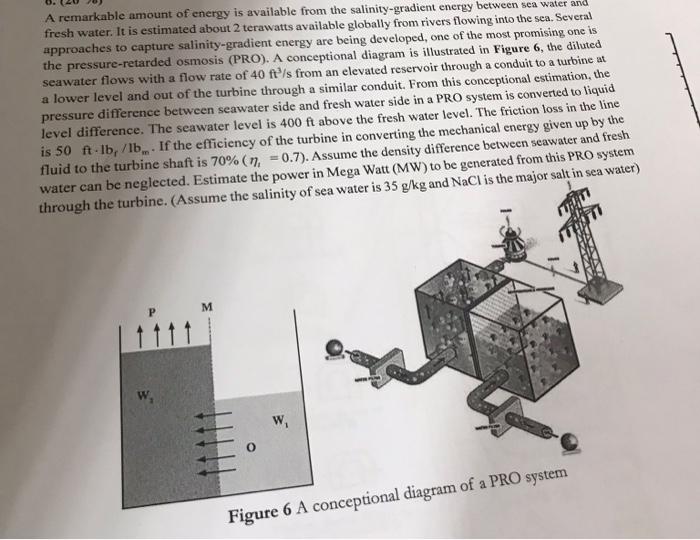
A remarkable amount of energy is available from the salinity-gradient energy between sea water and fresh water. It is estimated about 2 terawatts available globally from rivers flowing into the sea. Several approaches to capture salinity-gradient energy are being developed, one of the most promising one is the pressure-retarded osmosis (PRO). A conceptional diagram is illustrated in Figure 6 , the diluted seawater flows with a flow rate of 40ft3/s from an elevated reservoir through a conduit to a turbine at a lower level and out of the turbine through a similar conduit. From this conceptional estimation. the pressure difference between seawater side and fresh water side in a PRO system is converted to liquid level difference. The seawater level is 400ft above the fresh water level. The friction loss in the line is 50ft1bf/1bm. If the efficiency of the turbine in converting the mechanical energy given up by the fluid to the turbine shaft is 70%(1=0.7). Assume the density difference between seawater and fresh water can be neglected. Estimate the power in Mega Watt (MW) to be generated from this PRO system throus
Step by Step Solution
There are 3 Steps involved in it

Get step-by-step solutions from verified subject matter experts