







Question: This is from my intro to python class. They should be very simple. Thank you. 1 Even vs Odd Write a function named even_vs_odd (num_list)
This is from my intro to python class. They should be very simple. Thank you.
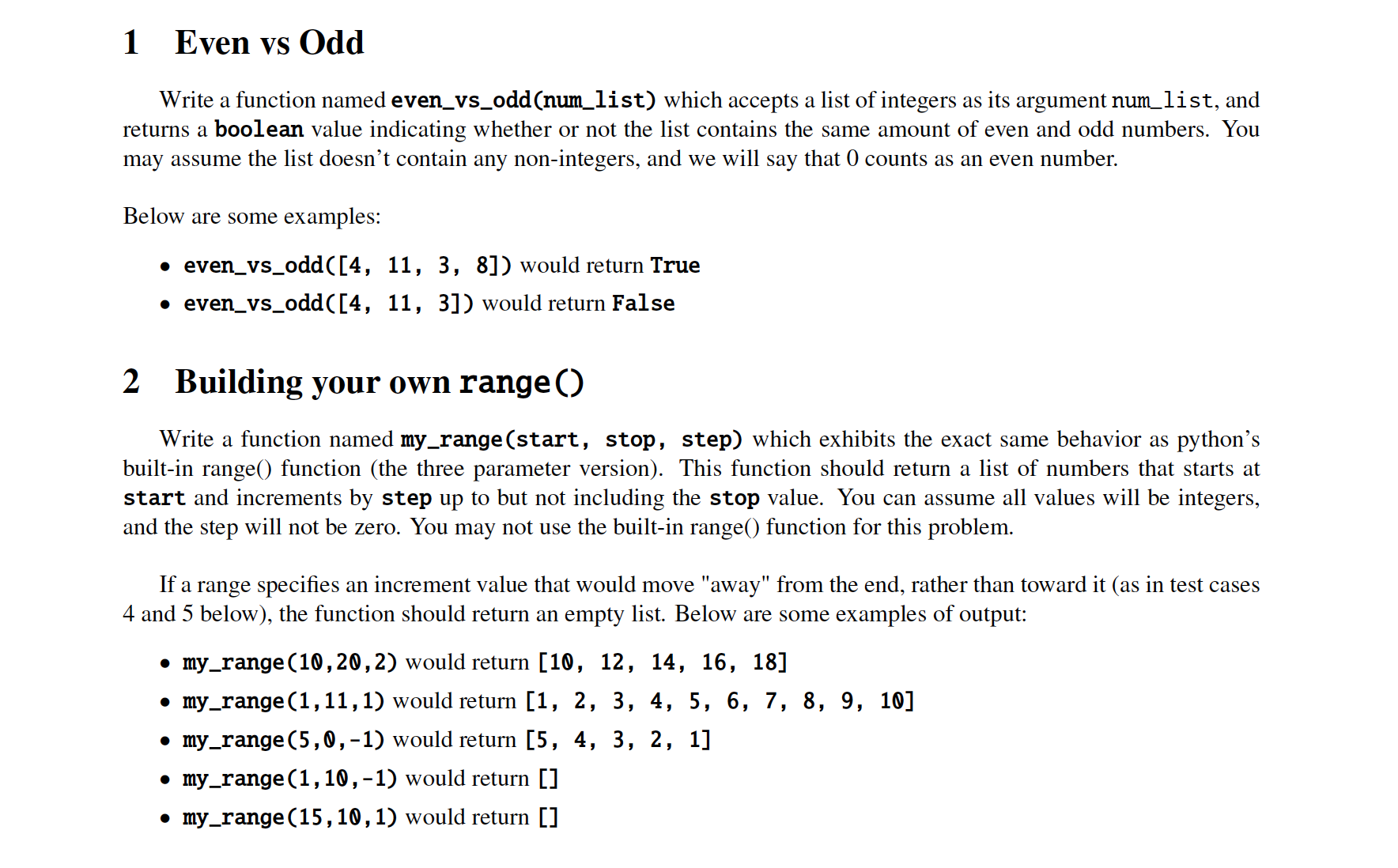
1 Even vs Odd Write a function named even_vs_odd (num_list) which accepts a list of integers as its argument num_list, and returns a boolean value indicating whether or not the list contains the same amount of even and odd numbers. You may assume the list doesn't contain any non-integers, and we will say that 0 counts as an even number. Below are some examples: . even_vs_odd( [4, 11, 3, 8]) would return True . even_vs_odd([4, 11, 3]) would return False 2 Building your own range () Write a function named my_range (start, stop, step) which exhibits the exact same behavior as python's built-in range() function (the three parameter version). This function should return a list of numbers that starts at start and increments by step up to but not including the stop value. You can assume all values will be integers, and the step will not be zero. You may not use the built-in range() function for this problem. If a range specifies an increment value that would move "away" from the end, rather than toward it (as in test cases 4 and 5 below), the function should return an empty list. Below are some examples of output: . my_range (10, 20, 2) would return [10, 12, 14, 16, 18] . my_range (1, 11, 1) would return [1, 2, 3, 4, 5, 6, 7, 8, 9, 10] . my_range (5, 0, -1) would return [5, 4, 3, 2, 1] . my_range (1, 10, -1) would return . my_range (15, 10, 1) would return
Step by Step Solution
There are 3 Steps involved in it

Get step-by-step solutions from verified subject matter experts
 Study Help