







Question: This is in javascript 3. Prefix Expression Evaluation 3.1. Problem Description Mathematical expressions usually use infix notation in which the operator is in between the
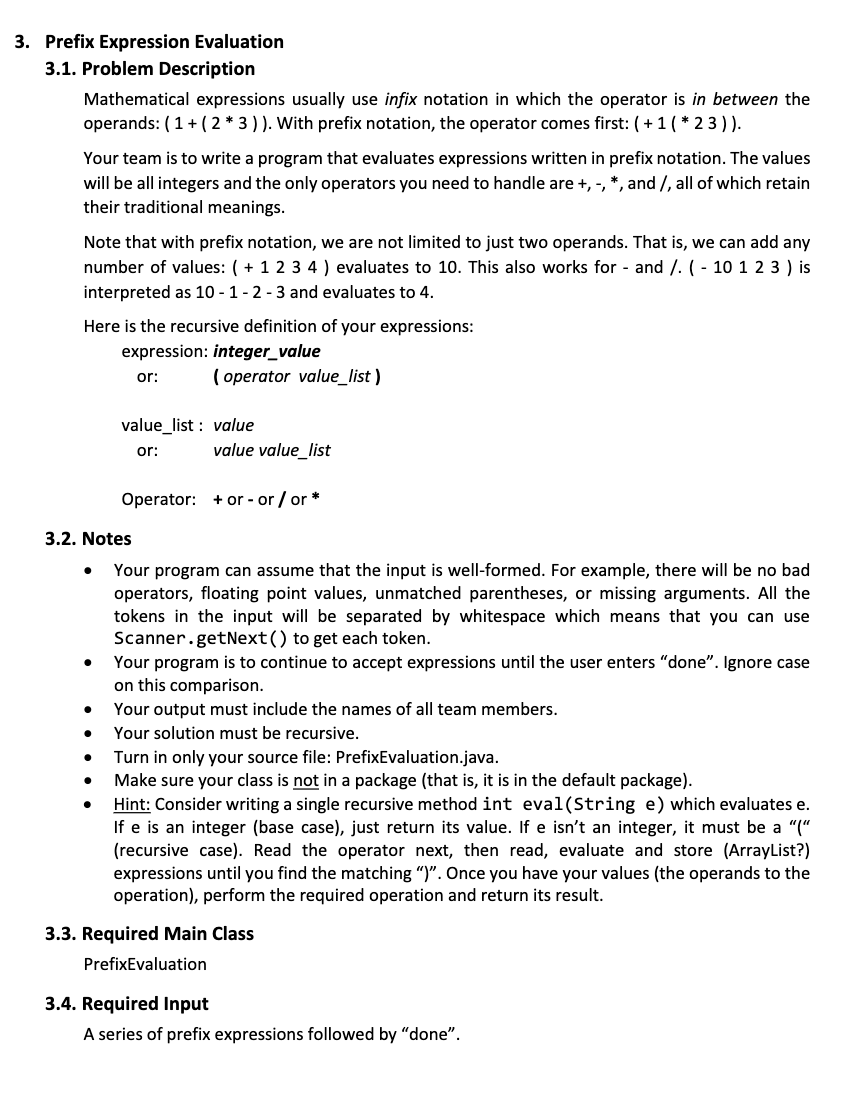
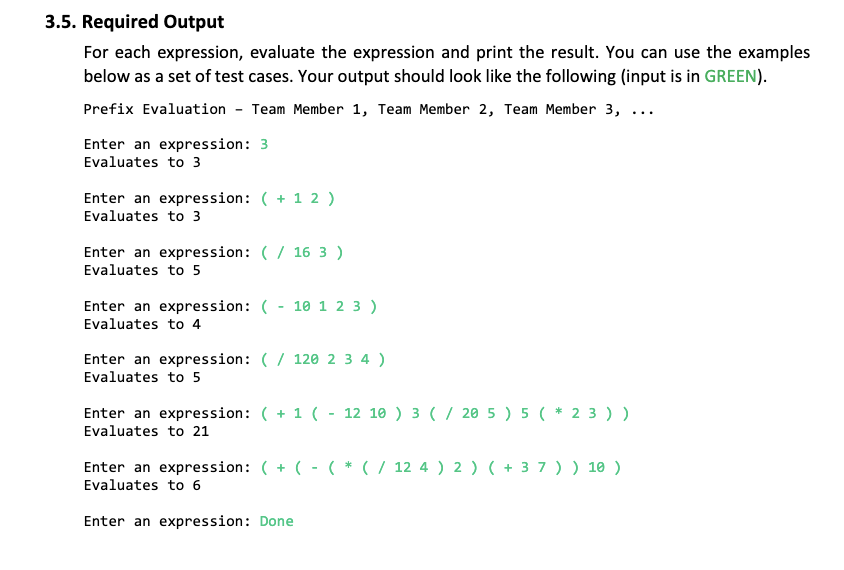
3. Prefix Expression Evaluation 3.1. Problem Description Mathematical expressions usually use infix notation in which the operator is in between the operands:(1+(2*3)). With prefix notation, the operator comes first: (+1(*23)). Your team is to write a program that evaluates expressions written in prefix notation. The values will be all integers and the only operators you need to handle are +, - *, and /, all of which retain their traditional meanings. Note that with prefix notation, we are not limited to just two operands. That is, we can add any number of values: ( + 1 2 3 4 ) evaluates to 10. This also works for - and /. ( - 10 1 2 3 ) is interpreted as 10 - 1-2-3 and evaluates to 4. Here is the recursive definition of your expressions: expression: integer_value or: (operator value_list) value_list : value or: value value_list Operator: + or - or/or* 3.2. Notes Your program can assume that the input is well-formed. For example, there will be no bad operators, floating point values, unmatched parentheses, or missing arguments. All the tokens in the input will be separated by whitespace which means that you can use Scanner.getNext() to get each token. Your program is to continue to accept expressions until the user enters "done". Ignore case on this comparison. Your output must include the names of all team members. Your solution must be recursive. Turn in only your source file: PrefixEvaluation.java. Make sure your class is not in a package (that is, it is in the default package). Hint: Consider writing a single recursive method int eval(String e) which evaluates e. If e is an integer (base case), just return its value. If e isn't an integer, it must be a "/" (recursive case). Read the operator next, then read, evaluate and store (ArrayList?) expressions until you find the matching ")". Once you have your values (the operands to the operation), perform the required operation and return its result. 3.3. Required Main Class PrefixEvaluation 3.4. Required Input A series of prefix expressions followed by "done". 3.5. Required Output For each expression, evaluate the expression and print the result. You can use the examples below as a set of test cases. Your output should look like the following (input is in GREEN). Prefix Evaluation - Team Member 1, Team Member 2, Team Member 3, .. Enter an expression: 3 Evaluates to 3 Enter an expression: ( + 1 2) Evaluates to 3 Enter an expression: (/ 16 3 ) Evaluates to 5 Enter an expression: ( - 10 1 23) Evaluates to 4 Enter an expression: ( / 120 2 3 4 ) Evaluates to 5 Enter an expression: ( + 1 ( - 12 10 ) 3 ( / 20 5 ) 5 ( * 2 3)) Evaluates to 21 Enter an expression: ( + (-(* ( / 12 4 ) 2) ( + 37 ) ) 10 ) Evaluates to 6 Enter an expression: Done 3. Prefix Expression Evaluation 3.1. Problem Description Mathematical expressions usually use infix notation in which the operator is in between the operands:(1+(2*3)). With prefix notation, the operator comes first: (+1(*23)). Your team is to write a program that evaluates expressions written in prefix notation. The values will be all integers and the only operators you need to handle are +, - *, and /, all of which retain their traditional meanings. Note that with prefix notation, we are not limited to just two operands. That is, we can add any number of values: ( + 1 2 3 4 ) evaluates to 10. This also works for - and /. ( - 10 1 2 3 ) is interpreted as 10 - 1-2-3 and evaluates to 4. Here is the recursive definition of your expressions: expression: integer_value or: (operator value_list) value_list : value or: value value_list Operator: + or - or/or* 3.2. Notes Your program can assume that the input is well-formed. For example, there will be no bad operators, floating point values, unmatched parentheses, or missing arguments. All the tokens in the input will be separated by whitespace which means that you can use Scanner.getNext() to get each token. Your program is to continue to accept expressions until the user enters "done". Ignore case on this comparison. Your output must include the names of all team members. Your solution must be recursive. Turn in only your source file: PrefixEvaluation.java. Make sure your class is not in a package (that is, it is in the default package). Hint: Consider writing a single recursive method int eval(String e) which evaluates e. If e is an integer (base case), just return its value. If e isn't an integer, it must be a "/" (recursive case). Read the operator next, then read, evaluate and store (ArrayList?) expressions until you find the matching ")". Once you have your values (the operands to the operation), perform the required operation and return its result. 3.3. Required Main Class PrefixEvaluation 3.4. Required Input A series of prefix expressions followed by "done". 3.5. Required Output For each expression, evaluate the expression and print the result. You can use the examples below as a set of test cases. Your output should look like the following (input is in GREEN). Prefix Evaluation - Team Member 1, Team Member 2, Team Member 3, .. Enter an expression: 3 Evaluates to 3 Enter an expression: ( + 1 2) Evaluates to 3 Enter an expression: (/ 16 3 ) Evaluates to 5 Enter an expression: ( - 10 1 23) Evaluates to 4 Enter an expression: ( / 120 2 3 4 ) Evaluates to 5 Enter an expression: ( + 1 ( - 12 10 ) 3 ( / 20 5 ) 5 ( * 2 3)) Evaluates to 21 Enter an expression: ( + (-(* ( / 12 4 ) 2) ( + 37 ) ) 10 ) Evaluates to 6 Enter an expression: Done
Step by Step Solution
There are 3 Steps involved in it

Get step-by-step solutions from verified subject matter experts
 Study Help