







Question: this is in python using sage math 9.2 Exercise 1 Change the Needleman-Wunsch implementation below to the Smith-Waterman algorithm (ie from global to local alignment),
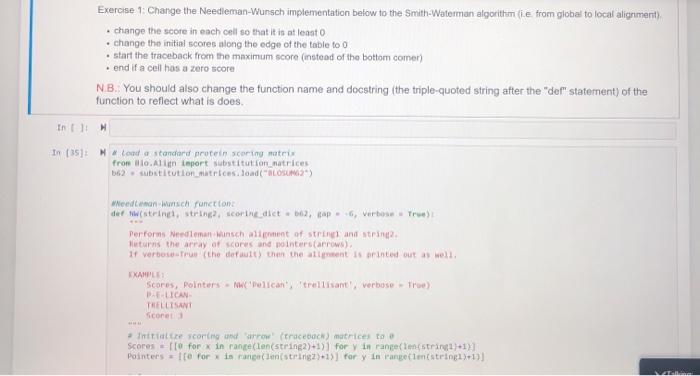
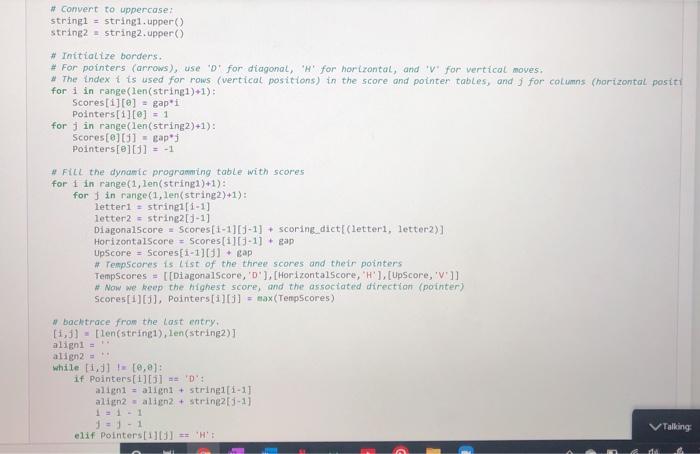
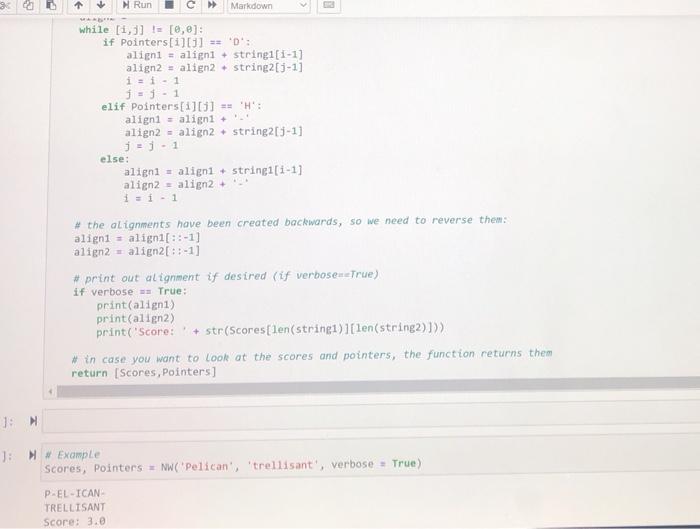
Exercise 1 Change the Needleman-Wunsch implementation below to the Smith-Waterman algorithm (ie from global to local alignment), change the score in each cell so that it is at least change the initial scores along the edge of the table to . start the traceback from the maximum score (instead of the bottom comer) end if a cell has a zero score N.B. You should also change the function name and docstring the triple-quoted string after the "def" statement) of the function to reflect what is does. In H In 1st Malonda standard protein scoring mateix from lllo. Allin Leport substitutionnatrices 162 substitution matrices.load("LOSUN2) Weedlena Warsch function de wstrine, string scrie dict. 62KAP, Verbos True Performs Needleman Winschalent of string and string turns the array of scores and pointers (arrows) If verboses True (the defaulty then the attent is inted out as well EXAMPLE Score, Pointers - Pelicantrellisant verbose - Troe) PELICAN THELLISANT Scones a her scoring and arrow Traceback) matrices to Scores o for x in range(len(string2)+1)] for yIn ranpetencstring1+12 Pointer's -1 for xin rangecasting)+1)] for y In rangelontsteingl)-1)] # Convert to uppercase stringi stringi. upper() string2 - string2. upper() # Initialize borders. # For pointers (arrows), use for diagonal) 'H' for horizontal, and for vertical moves. # The index 1 ts used for rows (vertical positions) in the score and pointer tables, and for columns (horizontal positi for i in range(len(string1)+1): Scores[i][e] - gap 1 Pointers[i][@] = 1 for j in range (len(string2)+1): Scores[] = gap Pointers[ e1 = -1 # Fill the dynamic programming table with scores for 1 in range(1, len(string)+1): for } in range(1, len(string2)+1): letteri = strinei[i-1] letter2 = string(1-1) Diagonalscore = Scores[i-1][3-1] + scoring_dict(letteri, letter2)] Horizontal Score = Scores[i][-1] - gap UpScore = Scores[i-1][1] . cap # Tempscores is list of the three scores and their pointers TempScores [(DiagonalScore, 'b'],[Horizontal core, 'H' (Upscore, 'V'] * Now we keep the highest score, and the associated direction (pointer) Scores[1[], Pointers[103] = max(Tempscores) backtrace from the last entry, [1,1] - Den(string), len(string) align=" align2 = while 1.dll (0,0): if Pointers [103] D: aligni = alieni + string1[i-1] align2 = align2 + string(1-1) 1 = 1-1 Talking elif Pointers [103H 9 C M Run Markdown while [i,j] != [0,0]: if Pointers[i][j] == 'D': alignl = aligni + string1[1-1] align2 = align2 + string2j-1] i.i.1 B = -1 elif Pointers [1][3] = 'H': aligni = aligni ! align2 = align2 + string[J-1] jEj-1 else: aligni = aligni + stringi[i-1] align2 = align2 =i-1 # the alignments have been created backwards, so we need to reverse them: aligni + align1[::-1] align2 = align2[::-1] # print out alignment if desired (if verbosen-True) if verbose - True: print(aligni) print(align2) print('Score: + str(Scores[len(stringi) [len(string2)]>> # in case you want to look at the scores and pointers, the function returns them return (Scores, Pointers] J: J: Example Scores, Pointers = N(Pelicant, trellisant', verbose = True) P-EL-ICAN TRELLISANT Score: 3.0 Exercise 1 Change the Needleman-Wunsch implementation below to the Smith-Waterman algorithm (ie from global to local alignment), change the score in each cell so that it is at least change the initial scores along the edge of the table to . start the traceback from the maximum score (instead of the bottom comer) end if a cell has a zero score N.B. You should also change the function name and docstring the triple-quoted string after the "def" statement) of the function to reflect what is does. In H In 1st Malonda standard protein scoring mateix from lllo. Allin Leport substitutionnatrices 162 substitution matrices.load("LOSUN2) Weedlena Warsch function de wstrine, string scrie dict. 62KAP, Verbos True Performs Needleman Winschalent of string and string turns the array of scores and pointers (arrows) If verboses True (the defaulty then the attent is inted out as well EXAMPLE Score, Pointers - Pelicantrellisant verbose - Troe) PELICAN THELLISANT Scones a her scoring and arrow Traceback) matrices to Scores o for x in range(len(string2)+1)] for yIn ranpetencstring1+12 Pointer's -1 for xin rangecasting)+1)] for y In rangelontsteingl)-1)] # Convert to uppercase stringi stringi. upper() string2 - string2. upper() # Initialize borders. # For pointers (arrows), use for diagonal) 'H' for horizontal, and for vertical moves. # The index 1 ts used for rows (vertical positions) in the score and pointer tables, and for columns (horizontal positi for i in range(len(string1)+1): Scores[i][e] - gap 1 Pointers[i][@] = 1 for j in range (len(string2)+1): Scores[] = gap Pointers[ e1 = -1 # Fill the dynamic programming table with scores for 1 in range(1, len(string)+1): for } in range(1, len(string2)+1): letteri = strinei[i-1] letter2 = string(1-1) Diagonalscore = Scores[i-1][3-1] + scoring_dict(letteri, letter2)] Horizontal Score = Scores[i][-1] - gap UpScore = Scores[i-1][1] . cap # Tempscores is list of the three scores and their pointers TempScores [(DiagonalScore, 'b'],[Horizontal core, 'H' (Upscore, 'V'] * Now we keep the highest score, and the associated direction (pointer) Scores[1[], Pointers[103] = max(Tempscores) backtrace from the last entry, [1,1] - Den(string), len(string) align=" align2 = while 1.dll (0,0): if Pointers [103] D: aligni = alieni + string1[i-1] align2 = align2 + string(1-1) 1 = 1-1 Talking elif Pointers [103H 9 C M Run Markdown while [i,j] != [0,0]: if Pointers[i][j] == 'D': alignl = aligni + string1[1-1] align2 = align2 + string2j-1] i.i.1 B = -1 elif Pointers [1][3] = 'H': aligni = aligni ! align2 = align2 + string[J-1] jEj-1 else: aligni = aligni + stringi[i-1] align2 = align2 =i-1 # the alignments have been created backwards, so we need to reverse them: aligni + align1[::-1] align2 = align2[::-1] # print out alignment if desired (if verbosen-True) if verbose - True: print(aligni) print(align2) print('Score: + str(Scores[len(stringi) [len(string2)]>> # in case you want to look at the scores and pointers, the function returns them return (Scores, Pointers] J: J: Example Scores, Pointers = N(Pelicant, trellisant', verbose = True) P-EL-ICAN TRELLISANT Score: 3.0
Step by Step Solution
There are 3 Steps involved in it

Get step-by-step solutions from verified subject matter experts
 Study Help