







Question: This is java, please follow my request and use netbeans. Thank you. A3 15. 2D Array Operations Write a program that creates a two-dimensional array
This is java, please follow my request and use netbeans. Thank you.
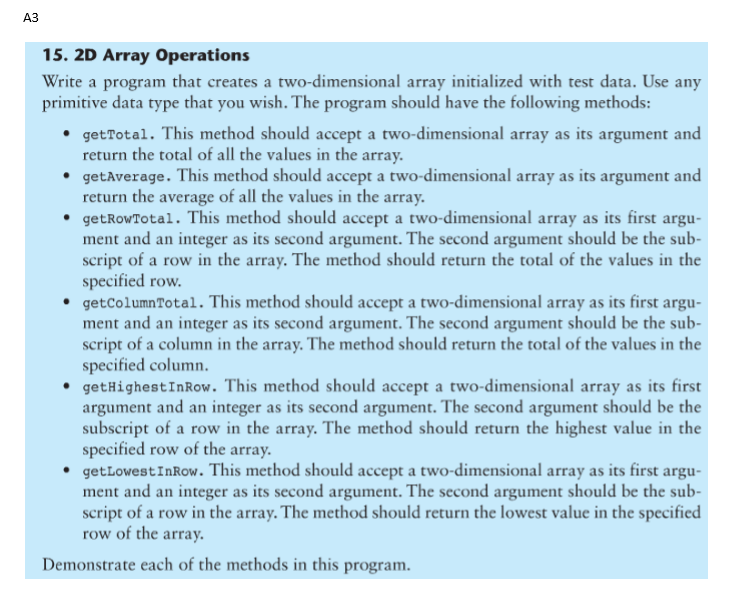
A3 15. 2D Array Operations Write a program that creates a two-dimensional array initialized with test data. Use any primitive data type that you wish. The program should have the following methods: getTotal. This method should accept a two-dimensional array as its argument and return the total of all the values in the array. .getAverage. This method should accept a two-dimensional array as its argument and return the average of all the values in the array. getRowTotal. This method should accept a two-dimensional array as its first argu- ment and an integer as its second argument. The second argument should be the sub- script of a row in the array. The method should return the total of the values in the specified row. getColumnTotal. This method should accept a two-dimensional array as its first argu- ment and an integer as its second argument. The second argument should be the sub- script of a column in the array. The method should return the total of the values in the specified column. getHighest InRow. This method should accept a two-dimensional array as its first argument and an integer as its second argument. The second argument should be the subscript of a row in the array. The method should return the highest value in the specified row of the array. getLowest InRow. This method should accept a two-dimensional array as its first argu- ment and an integer as its second argument. The second argument should be the sub- script of a row in the array. The method should return the lowest value in the specified row of the array. Demonstrate each of the methods in this program
Step by Step Solution
There are 3 Steps involved in it

Get step-by-step solutions from verified subject matter experts
 Study Help