







Question: this is just one problem please help! We observe the air movement of a ballistic body at several times. We collect data of the altitude
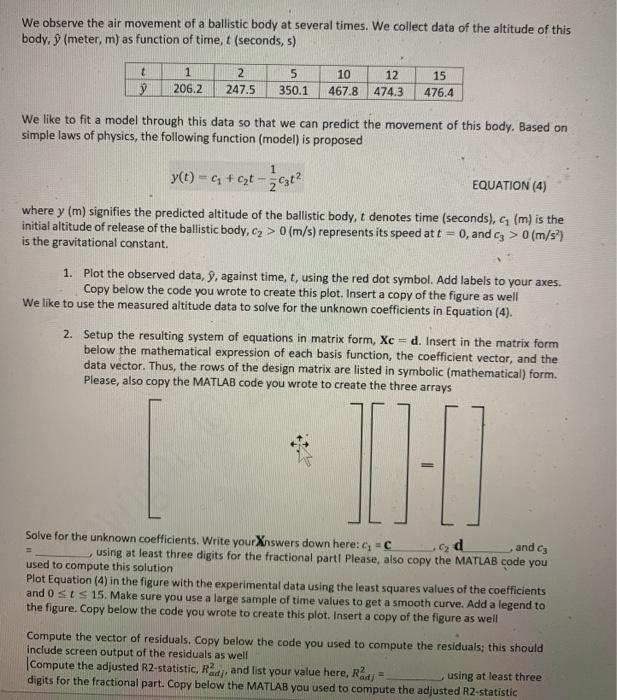
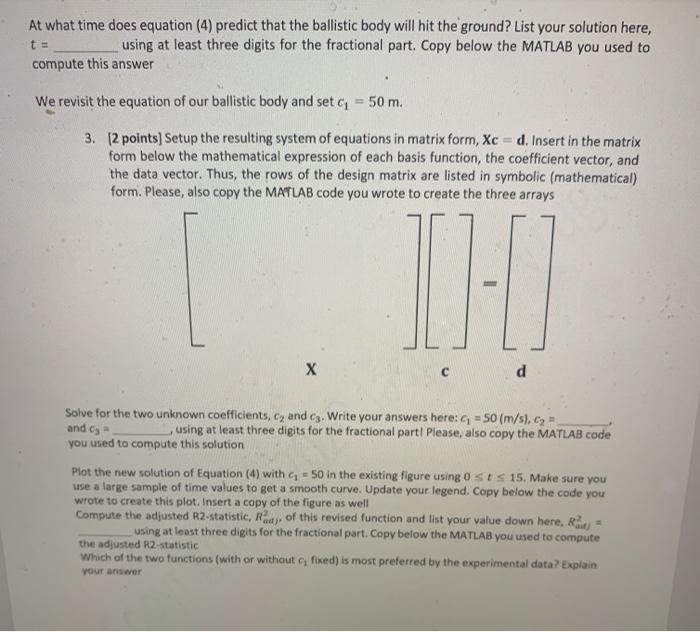
We observe the air movement of a ballistic body at several times. We collect data of the altitude of this body. 9 (meter, m) as function of time, (seconds, s) t y 1 206.2 2 247.5 5 350.1 10 467.8 12 474.3 15 476.4 We like to fit a model through this data so that we can predict the movement of this body. Based on simple laws of physics, the following function (model) is proposed 1 y(t) = Cat 2t EQUATION (4) where y (m) signifies the predicted altitude of the ballistic body, t denotes time (seconds), G (m) is the initial altitude of release of the ballistic body, cz > 0(m/s) represents its speed at t = 0, and cz > 0(m/s) is the gravitational constant. 1. Plot the observed data, y, against time, t, using the red dot symbol. Add labels to your axes. Copy below the code you wrote to create this plot. Insert a copy of the figure as well We like to use the measured altitude data to solve for the unknown coefficients in Equation (4). 2. Setup the resulting system of equations in matrix form, Xe - d. Insert in the matrix form below the mathematical expression of each basis function, the coefficient vector, and the data vector. Thus, the rows of the design matrix are listed in symbolic (mathematical) form. Please, also copy the MATLAB code you wrote to create the three arrays THI Solve for the unknown coefficients. Write yourXnswers down here: C and ca using at least three digits for the fractional partl Please, also copy the MATLAB code you used to compute this solution Plot Equation (4) in the figure with the experimental data using the least squares values of the coefficients and 0 st s 15. Make sure you use a large sample of time values to get a smooth curve. Add a legend to the figure. Copy below the code you wrote to create this plot. Insert a copy of the figure as well Compute the vector of residuals. Copy below the code you used to compute the residuals; this should include screen output of the residuals as well Compute the adjusted R2-statistic, Radj, and list your value here, Rad; = using at least three digits for the fractional part. Copy below the MATLAB you used to compute the adjusted R2-statistic At what time does equation (4) predict that the ballistic body will hit the ground? List your solution here, using at least three digits for the fractional part. Copy below the MATLAB you used to compute this answer We revisit the equation of our ballistic body and set ( = 50 m. 3. (2 points) Setup the resulting system of equations in matrix form, Xc = d.Insert in the matrix form below the mathematical expression of each basis function, the coefficient vector, and the data vector. Thus, the rows of the design matrix are listed in symbolic (mathematical) form. Please, also copy the MATLAB code you wrote to create the three arrays THO X d Solve for the two unknown coefficients, Cy and C3. Write your answers here: -50(m/s), Cy - and c- using at least three digits for the fractional part! Please, also copy the MATLAB code you used to compute this solution Plot the new solution of Equation (4) with = 50 in the existing figure using 0 st s 15. Make sure you use a large sample of time values to get a smooth curve. Update your legend. Copy below the code you wrote to create this plot. Insert a copy of the figure as well Compute the adjusted R2-statistic, Rea of this revised function and list your value down here, R) = using at least three digits for the fractional part. Copy below the MATLAB you used to compute the adjusted R2-statistic Which of the two functions (with or without fixed) is most preferred by the experimental data? Explain your answer We observe the air movement of a ballistic body at several times. We collect data of the altitude of this body. 9 (meter, m) as function of time, (seconds, s) t y 1 206.2 2 247.5 5 350.1 10 467.8 12 474.3 15 476.4 We like to fit a model through this data so that we can predict the movement of this body. Based on simple laws of physics, the following function (model) is proposed 1 y(t) = Cat 2t EQUATION (4) where y (m) signifies the predicted altitude of the ballistic body, t denotes time (seconds), G (m) is the initial altitude of release of the ballistic body, cz > 0(m/s) represents its speed at t = 0, and cz > 0(m/s) is the gravitational constant. 1. Plot the observed data, y, against time, t, using the red dot symbol. Add labels to your axes. Copy below the code you wrote to create this plot. Insert a copy of the figure as well We like to use the measured altitude data to solve for the unknown coefficients in Equation (4). 2. Setup the resulting system of equations in matrix form, Xe - d. Insert in the matrix form below the mathematical expression of each basis function, the coefficient vector, and the data vector. Thus, the rows of the design matrix are listed in symbolic (mathematical) form. Please, also copy the MATLAB code you wrote to create the three arrays THI Solve for the unknown coefficients. Write yourXnswers down here: C and ca using at least three digits for the fractional partl Please, also copy the MATLAB code you used to compute this solution Plot Equation (4) in the figure with the experimental data using the least squares values of the coefficients and 0 st s 15. Make sure you use a large sample of time values to get a smooth curve. Add a legend to the figure. Copy below the code you wrote to create this plot. Insert a copy of the figure as well Compute the vector of residuals. Copy below the code you used to compute the residuals; this should include screen output of the residuals as well Compute the adjusted R2-statistic, Radj, and list your value here, Rad; = using at least three digits for the fractional part. Copy below the MATLAB you used to compute the adjusted R2-statistic At what time does equation (4) predict that the ballistic body will hit the ground? List your solution here, using at least three digits for the fractional part. Copy below the MATLAB you used to compute this answer We revisit the equation of our ballistic body and set ( = 50 m. 3. (2 points) Setup the resulting system of equations in matrix form, Xc = d.Insert in the matrix form below the mathematical expression of each basis function, the coefficient vector, and the data vector. Thus, the rows of the design matrix are listed in symbolic (mathematical) form. Please, also copy the MATLAB code you wrote to create the three arrays THO X d Solve for the two unknown coefficients, Cy and C3. Write your answers here: -50(m/s), Cy - and c- using at least three digits for the fractional part! Please, also copy the MATLAB code you used to compute this solution Plot the new solution of Equation (4) with = 50 in the existing figure using 0 st s 15. Make sure you use a large sample of time values to get a smooth curve. Update your legend. Copy below the code you wrote to create this plot. Insert a copy of the figure as well Compute the adjusted R2-statistic, Rea of this revised function and list your value down here, R) = using at least three digits for the fractional part. Copy below the MATLAB you used to compute the adjusted R2-statistic Which of the two functions (with or without fixed) is most preferred by the experimental data? Explain your
Step by Step Solution
There are 3 Steps involved in it

Get step-by-step solutions from verified subject matter experts
 Study Help