





Question: this is my question. thanks Question 2 (2+2+3) + (4) + (3+3+3) = 20 marks) a) Let A be the set {a, b, c, d'}.

this is my question. thanks
this is my question. thanks Question 2 (2+2+3) +
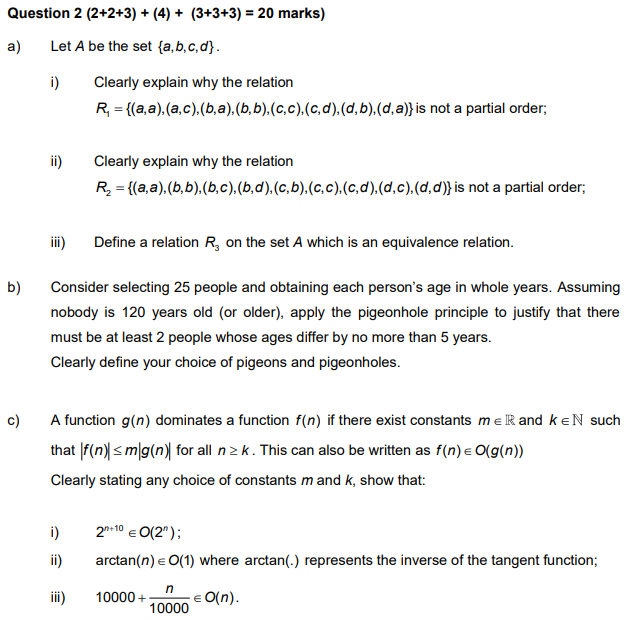
Question 2 (2+2+3) + (4) + (3+3+3) = 20 marks) a) Let A be the set {a, b, c, d'}. i) Clearly explain why the relation R, = {(a,a),(a,c),(b,a),(b,b),(c,c),(c,d),(d, b),(d, a)} is not a partial order; ii) Clearly explain why the relation R2 = {(a,a),(b,b),(b,c),(b,d),(c, b),(c,c),(c,d),(d,c).(d, d)} is not a partial order; iii) Define a relation R, on the set A which is an equivalence relation. b) Consider selecting 25 people and obtaining each person's age in whole years. Assuming nobody is 120 years old (or older), apply the pigeonhole principle to justify that there must be at least 2 people whose ages differ by no more than 5 years. Clearly define your choice of pigeons and pigeonholes. c) A function g(n) dominates a function f(n) if there exist constants me R and k EN such that If(n)| smg(n)| for all n 2 k . This can also be written as f(n) = O(g(n)) Clearly stating any choice of constants m and k, show that: 207+10 E O(2" ); arctan(n)

Step by Step Solution

There are 3 Steps involved in it

1 Expert Approved Answer
Step: 1 Unlock blur-text-image

Question Has Been Solved by an Expert!

Get step-by-step solutions from verified subject matter experts

Step: 2 Unlock
Step: 3 Unlock

Students Have Also Explored These Related Mathematics Questions!