







Question: this is question with multiple choice. It will be on file please Question 35 In the United States, individual income mobility (that is, the degree
this is question with multiple choice. It will be on file please
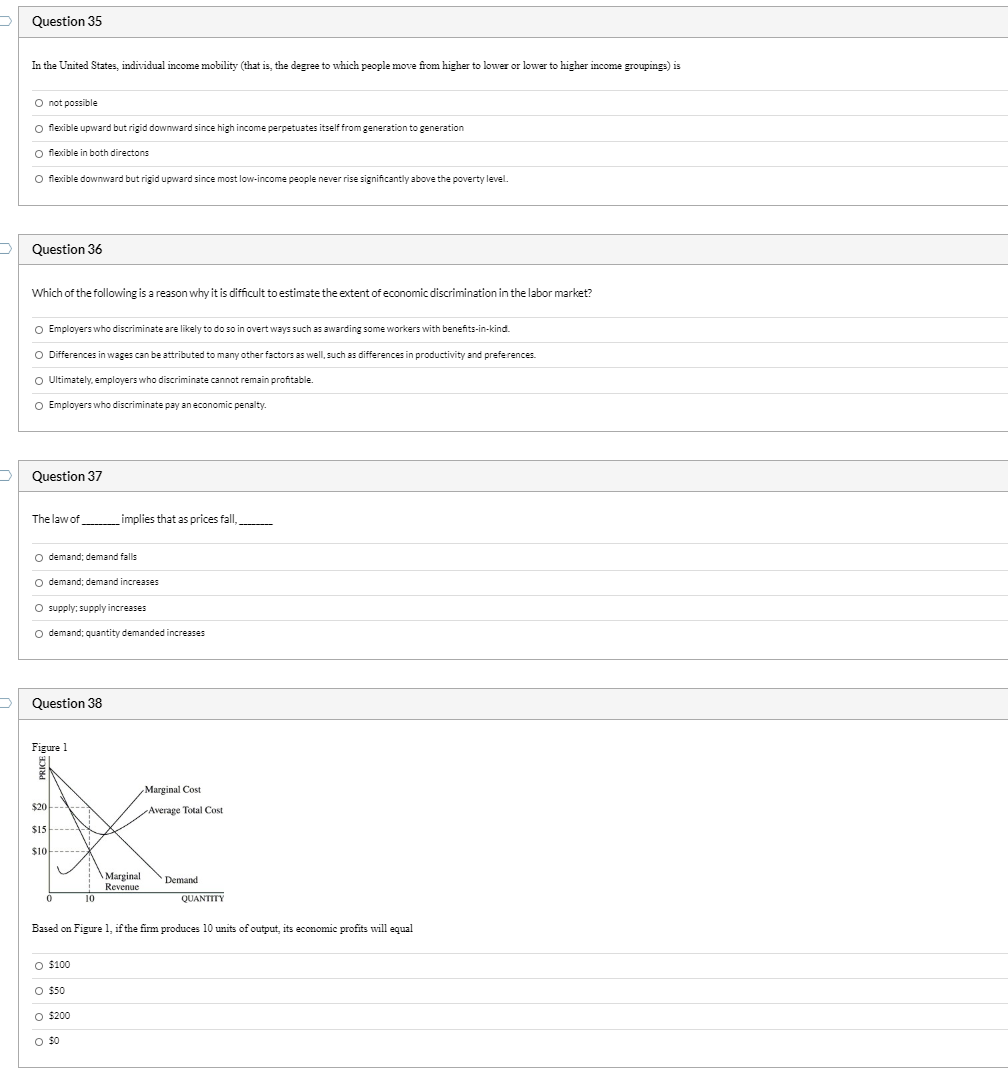
Question 35 In the United States, individual income mobility (that is, the degree to which people move from higher to lower or lower to higher income groupings) is O not possible O flexible upward but rigid downward since high income perpetuates itself from generation to generation O flexible in both directone O flexible downward but rigid upward since most low-income people never rise significantly above the poverty level. Question 36 Which of the following is a reason why it is difficult to estimate the extent of economic discrimination in the labor market? O Employers who discriminate are likely to do so in overt ways such as awarding some workers with benefits-in-kind. O Differences in wages can be attributed to many other factors as well, such as differences in productivity and preferences. O Ultimately. employers who discriminate cannot remain profitable. Employers who discriminate pay an economic penalty. Question 37 The law of_ implies that as prices fall O demand; demand falls O demand; demand increases O supply: supply increases O demand; quantity demanded increases Question 38 Figure 1 Marginal Cost $20 Average Total Cost $15 $10 \\Marginal 10 Revenue `Demand QUANTITY Based on Figure 1, if the firm produces 10 units of output, its economic profits will equal O $100 $50 O $200 O $0
Step by Step Solution
There are 3 Steps involved in it

Get step-by-step solutions from verified subject matter experts
 Study Help