







Question: This is REAL ANALYSIS. Please only answer if you are 100% certain of the correct answer. Also please explain the answer step by step and
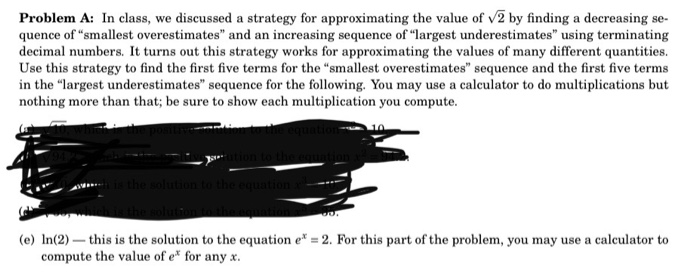
Problem A: In class, we discussed a strategy for approximating the value of 2 by finding a decreasing se- quence of "smallest overestimates and an increasing sequence of "largest underestimates using terminating decimal numbers. It turns out this strategy works for approximating the values of many different quantities. Use this strategy to find the first five terms for the smallest overestimates" sequence and the first five terms in the largest underestimates sequence for the following. You may use a calculator to do multiplications but nothing more than that; be sure to show each multiplication you compute. solution to the equation (e) In(2) - this is the solution to the equation e' = 2. For this part of the problem, you may use a calculator to compute the value of e* for any x. Problem A: In class, we discussed a strategy for approximating the value of 2 by finding a decreasing se- quence of "smallest overestimates and an increasing sequence of "largest underestimates using terminating decimal numbers. It turns out this strategy works for approximating the values of many different quantities. Use this strategy to find the first five terms for the smallest overestimates" sequence and the first five terms in the largest underestimates sequence for the following. You may use a calculator to do multiplications but nothing more than that; be sure to show each multiplication you compute. solution to the equation (e) In(2) - this is the solution to the equation e' = 2. For this part of the problem, you may use a calculator to compute the value of e* for any x
Step by Step Solution
There are 3 Steps involved in it

Get step-by-step solutions from verified subject matter experts
 Study Help