







Question: This is single question on two screenshots, please solve anyone, its reservior or petroleum engineering question Question 2.1 An oil reservoir was discovered in early
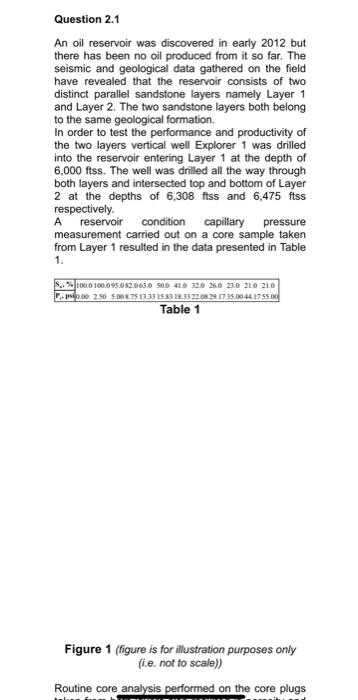
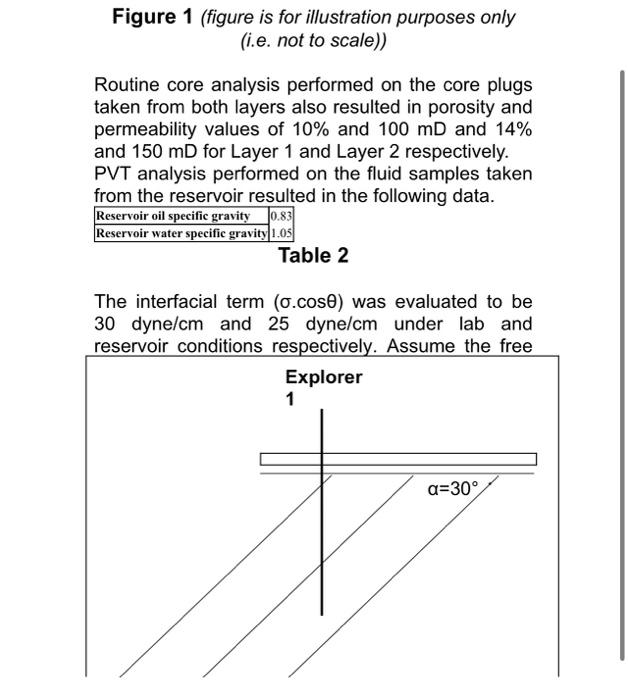
Question 2.1 An oil reservoir was discovered in early 2012 but there has been no oil produced from it so far. The seismic and geological data gathered on the field have revealed that the reservoir consists of two distinct parallel sandstone layers namely Layer 1 and Layer 2. The two sandstone layers both belong to the same geological formation In order to test the performance and productivity of the two layers vertical well Explorer 1 was drilled into the reservoir entering Layer 1 at the depth of 6,000 ftss. The well was drilled all the way through both layers and intersected top and bottom of Layer 2 at the depths of 6,308 ftss and 6,475 ftss respectively. reservoir condition capillary pressure measurement carried out on a core sample taken from Layer 1 resulted in the data presented in Table 1. S. 100.000,095.02.0630 SLO 320 26.0 23.0 210 210 P.pip.00 250 0.75133315831333220 29 1735.00 44,175500 Table 1 Figure 1 (figure is for illustration purposes only fi.e. not to scale)) Routine core analysis performed on the core plugs Figure 1 (figure is for illustration purposes only (i.e. not to scale)) Routine core analysis performed on the core plugs taken from both layers also resulted in porosity and permeability values of 10% and 100 mD and 14% and 150 mD for Layer 1 and Layer 2 respectively. PVT analysis performed on the fluid samples taken from the reservoir resulted in the following data. Reservoir oil specific gravity 0.83 Reservoir water specific gravity 1.05 Table 2 The interfacial term (o.cos) was evaluated to be 30 dyne/cm and 25 dyne/cm under lab and reservoir conditions respectively. Assume the free Explorer 1 a=30
Step by Step Solution
There are 3 Steps involved in it

Get step-by-step solutions from verified subject matter experts
 Study Help