







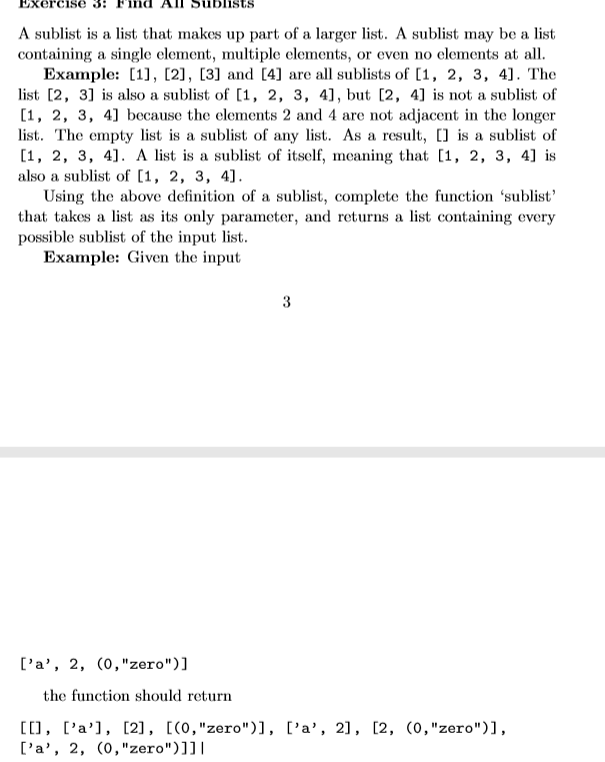
Question: this is test code, please use python to solve Exercise A sublist is a list that makes up part of a larger list. A sublist

this is test code, please use python to solve
![or even no elements at all. Example: [1], [2], [3] and [4]](https://dsd5zvtm8ll6.cloudfront.net/si.experts.images/questions/2024/09/66f30eab0687d_03466f30eaaa87bc.jpg)
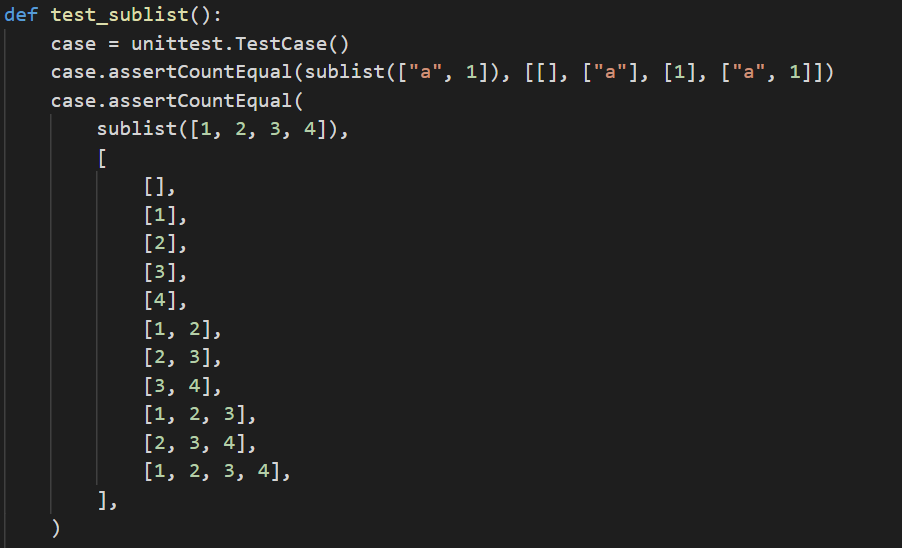
Exercise A sublist is a list that makes up part of a larger list. A sublist may be a list containing a single element, multiple elements, or even no elements at all. Example: [1], [2], [3] and [4] are all sublists of (1, 2, 3, 4]. The list [2, 3] is also a sublist of [1, 2, 3, 4], but [2, 4] is not a sublist of [1, 2, 3, 4] because the elements 2 and 4 are not adjacent in the longer list. The empty list is a sublist of any list. As a result, [] is a sublist of [1, 2, 3, 4]. A list is a sublist of itself, meaning that [1, 2, 3, 4] is also a sublist of [1, 2, 3, 4]. Using the above definition of a sublist, complete the function 'sublist' that takes a list as its only parameter, and returns a list containing every possible sublist of the input list. Example: Given the input 3 ['a', 2, (0, "zero")] the function should return [[], ['a'], [2], [(0,"zero")], ['a', 2], [2, (0,"zero")], ['a', 2, (0, "zero")]] || The order of the elements of the list returned is not important. However, the order of the elements inside of each list should reflect the order in the original list. For example, ['a', 2] is correct, while [2, 'a') is not. def test_sublist(): case = unittest. TestCase() case. assertCountEqual(sublist(["a", 1]), [[], ["a"], [1], ["a", 1]]) case. assertCountEqual( sublist([1, 2, 3, 4]), [ [], [1], [2], [3], [4], [1, 2], [2, 3], [3, 4], [1, 2, 3], [2, 3, 4], [1, 2, 3, 4], ], ) case. assertCountEqual( sublist(["a", 2, (0, "zero")]), [ [], ["a"], [2], [(0, "zero")], ["a", 2], [2, (0, "zero")], ["a", 2, (0, "zero")], ], )
Step by Step Solution
There are 3 Steps involved in it

Get step-by-step solutions from verified subject matter experts
 Study Help