Question: this is the case and have to answer this question. Discuss the vote by the United Kingdom to leave the European Union. What led to
this is the case and have to answer this question.
Discuss the vote by the United Kingdom to leave the European Union. What led to the decision? Were there any benefits to remaining in the bloc? Why did the country vote to leave? 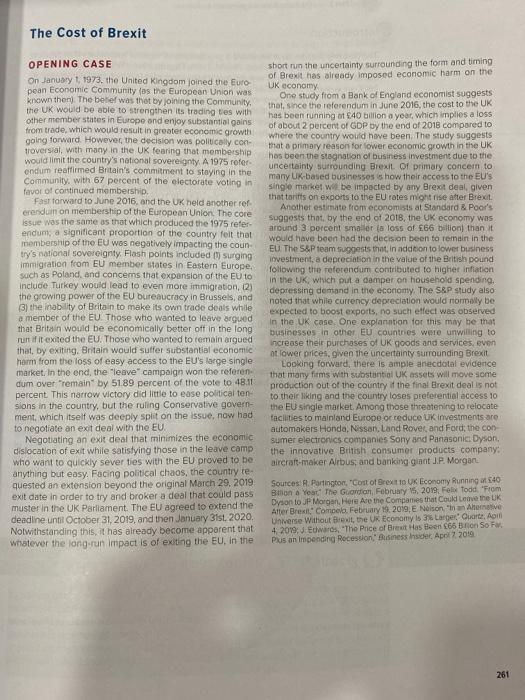
can you please answer it in bullet points!!!!
The Cost of Brexit OPENING CASE On January 1, 1973. the United Kingdom joined the Euro pean Economic Community fos the Eutopean Union was known then. The belief was that by joining the Community, the UK would be able to strengthen its trading ties with other member states in Europe and enjoy substantial gains from trade, which would result in greater economic growth going forward. However the decision was politically con troversial, with many in the UK fearing that membership would limit the country's national sovereignty A 1975 rofer endum reaffirmed Britain's commitment to staying in the Community, with 67 percent of the electorate voting in favor of continued membership Fast forward to June 2016, and the UK held another ref erendum on membership of the European Union. The core issue was the same as that which produced the 1975 refer endum, a significant proportion of the country felt that membership of the EU was negatively impacting the coun try's national sovereignty, Flash points included (l) surging immigration from EU member states in Eastern Europe, such as Poland, and concerns that expansion of the EU to include Turkey would lead to even more immigration, (2) the growing power of the EU bureaucracy in Brussels, and (3) the inability of Britain to make its own trade deals while a member of the EU. Those who wanted to leave argued that Britain would be economically better off in the long run if it excited the EU. Those who wanted to remain argued that, by exiting. Brtain would suffer substantial economic harm from the loss of easy access to the EU's large single market. In the end, the leave compaign won the referen dum over "remain" by 51.89 percent of the vote to 48.11 percent. This narrow victory did little to ease political ten sions in the country, but the ruling Conservative govern- ment, which itself was deeply split on the issue, now had to negotiate an exit deal with the EU. Negotiating an exit deal that minimizes the economic dislocation of exit while satisfying those in the leave como who want to quickly sever ties with the EU proved to be anything but easy. Facing political chaos, the country re. quested an extension beyond the original March 29, 2019 exit date in order to try and broker a deal that could pass muster in the UK Parliament. The EU agreed to extend the deadline until October 31, 2019, and then January 31st, 2020, Notwithstanding this, it has already become apparent that Whatever the long run impact is of exiting the EU, in the short run the uncertainty surrounding the form and timing of Brexit has already imposed economic harm on the UK economy One study from a Bank of England economist suggests that since the referendum in June 2016, the cost to the UK has been running of $40 billion a year, which implies a loss of about 2 percent of GDP by the end of 2018 compared to where the country would have been the study suggests that a primary reason for lower economic growth in the UK has been the stagnation of business investment due to the uncertainty surrounding Brexit of primary concern to many UK-based businesses show their access to the EU's single market w be limpacted by any Brexit deal, given that tritts on exports to the EU rates might rise after Brexit. Another estimate from economists at Standard & Poor's Suggests that by the end of 2018, the UK economy was around 3 percent sma lor la loss of 66 billion than would have been had the decision been to remain in the EU The S&P team suggests that, in addition to lower business Investment, a depreciation in the value of the British pound following the referendum contributed to higher inflation in the UK, which put a camper on household spending depressing demand in the economy. The S&P study also noted that while currency depreciation would normally be expected to boost exports, no such effect was observed in the UK case. One explanation for this may be that businesses in other EU countries were unwilling to increase their purchases of UK goods and services, even at lower prices. given the uncertainty surrounding Brexit Looking forward, there is ample anecdotal evidence that many firms with substantial UK assets will move some production out of the country of the final Brexit deal is not to their liking and the country loses preferential access 10 the EU single market. Among those threatening to relocate facilities to mainland Europe or reduce UK Investments are automakers Honda, Nissan, Land Rover, and Ford: the con sumer electronics companies Sony and Panasonic Dyson the innovative British consumer products company aircraft-maker Airbus, and banking giant J.P. Morgan Sources R. Partington, Cost of Brexet to UK Economy Running 40 Bon a Yeat The Guardian February 15, 2019: Folie Todd From Dyson to JP Morgan Here Are the Companies that Could Love the UK Alter Brexit" Compelo. February 19, 2019, E Noison in an Ahme Universe Without Brexit, the UK Economy is 36 Larger Quarte. Am 4. 2019: Edwards, "The Price of Best Has Been 65 Bron So Far Plus an impending Rocession Business Insider Apr 22019 261









 Study Help