Question: This is the case study. Please answer the discussion questions without copy&pasting from another source. DISCUSSION QUESTIONS. 1. Apple sells stylish and functional computers as
This is the case study. Please answer the discussion questions without copy&pasting from another source.
DISCUSSION QUESTIONS.
1. Apple sells stylish and functional computers as well as a variety of electronic devices, and it operates retail stores. Describe the forces for change that best help Apple keep its creative edge, and explain why.
2. Describe change strategies employed by Apple throughout its history. Consider its relationships with Microsoft and Adobe. What model of change leadership do you feel Steve Jobs embodied, and why?
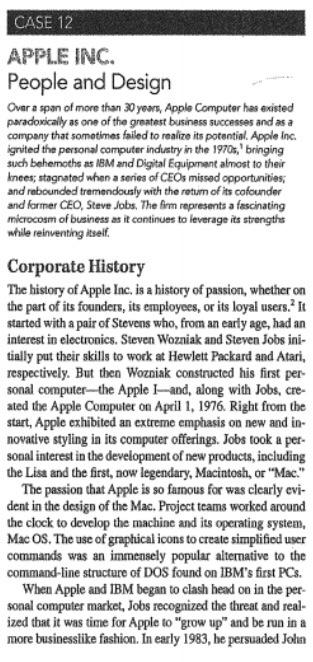
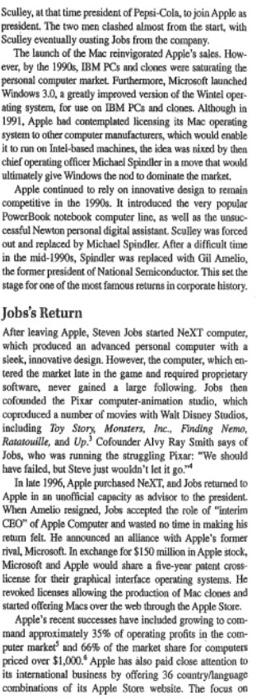
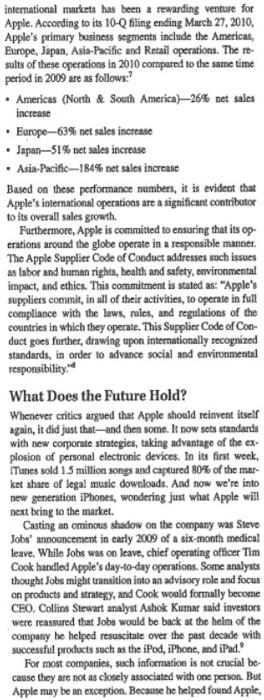
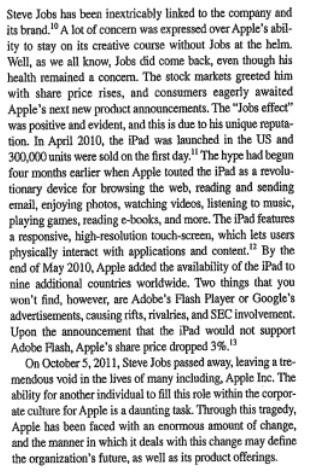
CASE 12 APPLE INC. People and Design Over a span of more than 30 years, Apple Computer has existed paradoxically as one of the greatest business successes and as a company that sometimes failed to realize its potential. Apple Inc. igruted the personal computer industry in the 1970s, bringing such behemoths as 16M and Digital Equipment almost to their knees; stagnated when a series of CEOs missed opportunities and rebounded tremendously with the return of its cofounder and former CEO, Steve Jobs. The firm represents a fascinating microcosm of business as it continues to leverage its strengths while reinventing itself Corporate History The history of Apple Inc. is a history of passion, whether on the part of its founders, its employees, or its loyal users. It started with a pair of Stevens who, from an early age, had an interest in electronics. Steven Wozniak and Steven Jobs ini- tially put their skills to work at Hewlett Packard and Atari, respectively. But then Wozniak constructed his first per- sonal computer--the Apple land, along with Jobs, cre- ated the Apple Computer on April 1, 1976. Right from the start, Apple exhibited an extreme emphasis on new and in- novative styling in its computer offerings. Jobs took a per- sonal interest in the development of new products, including the Lisa and the first, now legendary, Macintosh, or "Mac." The passion that Apple is so famous for was clearly evi- dent in the design of the Mac. Project teams worked around the clock to develop the machine and its operating system, Mac OS. The use of graphical icons to create simplified user commands was an immensely popular alternative to the command-line structure of DOS found on IBM's first PCs. When Apple and IBM began to clash head on in the per- sonal computer market, Jobs recognized the threat and real- ized that it was time for Apple to "grow up" and be run in a more businesslike fashion. In early 1983, be persuadel John Sculley, at that time president of Pepsi-Cola, to join Apple as president. The two men clashed almost from the start, with Sculley eventually custing Jobs from the company. The launch of the Mac reinvigorated Apple's sales. How ever, by the 1990s, IBM PCs and clones were saturating the personal computer market. Furthermore, Microsoft launched Windows 3.0, a greatly improved version of the Winteloper ating system, for use on IBM PCs and clones. Although in 1991. Apple had contemplated licensing its Mac operating systen to other computer manufacturers, which would enable it to run on Intel-based machines, the idea was nixed by then chief operating officer Michael Spindler in a move that would ultimately give Windows the nod to dominate the market, Apple continued to rely on innovative design to remain competitive in the 1990s. It introduced the very popular PowerBook notebook computer linc, as well as the unsuc- cessful Newton personal digital assistant Sculley was forced out and replaced by Michael Spindler. After a difficult timo in the mid-1990s. Spindler was replaced with Gil Amelio, the former president of National Semiconductor. This set the stage for one of the most farnous returns in corporate history. Jobs's Return After leaving Apple, Steven Jobs started NeXT computer, which produced an advanced personal computer with a sleek, innovative design. However, the computer, which en- tered the market late in the game and required proprietary software, never gained a large following Jobs then cofounded the Pixar computer-animation studio, which coproduced a number of movies with Walt Disney Studios, including Toy Story Monsters, Inc. Finding Nemo, Ratatouille, and Up. Cofounder Alvy Ray Smith says of Jobs, who was running the struggling Pixar: "We should have failed, but Steve just wouldn't let it go. In late 1996, Apple purchased NeXT, and Jobs returned to Apple in an unofficial capacity as advisor to the president. When Amelio resigned, Jobs accepted the role of "interim CBO" of Apple Computer and wasted no time in making his retum felt. He announced an alliance with Apple's former rival, Microsoft. In exchange for $150 million in Apple stock, Microsoft and Apple would share a five-year patent cross license for their graphical interface operating systems. He revoked licenses allowing the production of Mac clones and started offering Macs over the web through the Apple Store Apple's recent successes have included growing to com mand approximately 35% of operating profits in the com- puter market and 66% of the market share for computers priced over $1,000. Apple has also paid close attention to its international business by offering 36 country/language combinations of its Apple Store website. The focus on international markets has been a rewarding venture for Apple. According to its 10-Q filing ending March 27,2010, Apple's primary business segments include the Americas, Europe, Japan, Asia-Pacific and Retail operations. The re- sults of these operations in 2010 compared to the same time period in 2009 are as follows: Americas (North & South America) -26% net sales increase Earope-63% net sales increase Japan-51% net sales increase Asia-Pacific--184% net sales increase Based on these performance numbers, it is evident that Apple's international operations are a significant contributor to its overall sales growth. Furthermore, Apple is committed to ensuring that its op erations around the globe operate in a responsible manner. The Apple Supplier Code of Conduct addresses such issues as labor and human rights, health and safety, environmental impact, and ethics. This commitment is stated as: "Apple's suppliers commit, in all of their activities, to operate in full compliance with the laws, rules, and regulations of the countries in which they operate. This Supplier Code of Con- duct goes further, drawing upon internationally recognized standards, in order to advance social and environmental responsibility: What Does the Future Hold? Whenever critics argued that Apple should reinvent itself again, it did just that and then some. It now sets standards with new corporate strategies, taking advantage of the ex- plosion of personal electronic devices. In its first week, iTunes sold 1.5 million songs and captured 80% of the mar- ket share of legal music downloads. And now we're into new generation iPhones, wondering just what Apple will next bring to the market. Casting an ominous shadow on the company was Steve Jobs' announcement in carly 2009 of a six-month medical leave. While Jobs was on leave, chief operating officer Tim Cook handled Apple's day-to-day operations. Some analysts thought Jobs might transition into an advisory role and focus on products and strategy and Cook would formally become CEO. Collins Stewart analyst Ashok Kumar said investors were reassured that Jobs would be back at the helm of the company he helped resuscitate over the past decade with successful products such as the iPod, iPhone, and iPad. For most companies, such information is not crucial be cause they are not as closely associated with one person. But Apple may be an exception. Because he helped found Apple, Steve Jobs has been inextricably linked to the company and its brand. A lot of concern was expressed over Apple's abil ity to stay on its creative course without Jobs at the helm. Well, as we all know, Jobs did come back, even though his health remained a concern. The stock markets greeted him with share price rises, and consumers eagerly awaited Apple's next new product announcements. The "Jobs effect" was positive and evident, and this is due to his unique reputa- tion. In April 2010, the iPad was launched in the US and 300,000 units were sold on the first day." The hype had begun four months earlier when Apple touted the iPad as a revolu- tionary device for browsing the web, reading and sending email, enjoying photos, watching videos, listening to music, playing games, reading e-books, and more. The iPad features a responsive, high-resolution touch-screen, which lets users physically interact with applications and content." By the end of May 2010 Apple added the availability of the iPad to nine additional countries worldwide. Two things that you won't find, however, are Adobe's Flash Player or Google's advertisements, causing rifts, rivalries, and SEC involvement. Upon the announcement that the iPad would not support Adobe Flash, Apple's share price dropped 3%." On October 5, 2011, Steve Jobs passed away, leaving a tre mendous void in the lives of many including Apple Inc. The ability for another individual to fill this role within the corpor- ale culture for Apple is a daunting task. Through this tragedy, Apple has been faced with an enormous amount of change, and the manner in which it deals with this change may define the organization's future, as well as its product offerings









 Study Help