







Question: this is the only one question please answer all MCQS Write only the alphabet (A,B,C,D or E) the corresponds to the correct option in each
this is the only one question please answer all MCQS
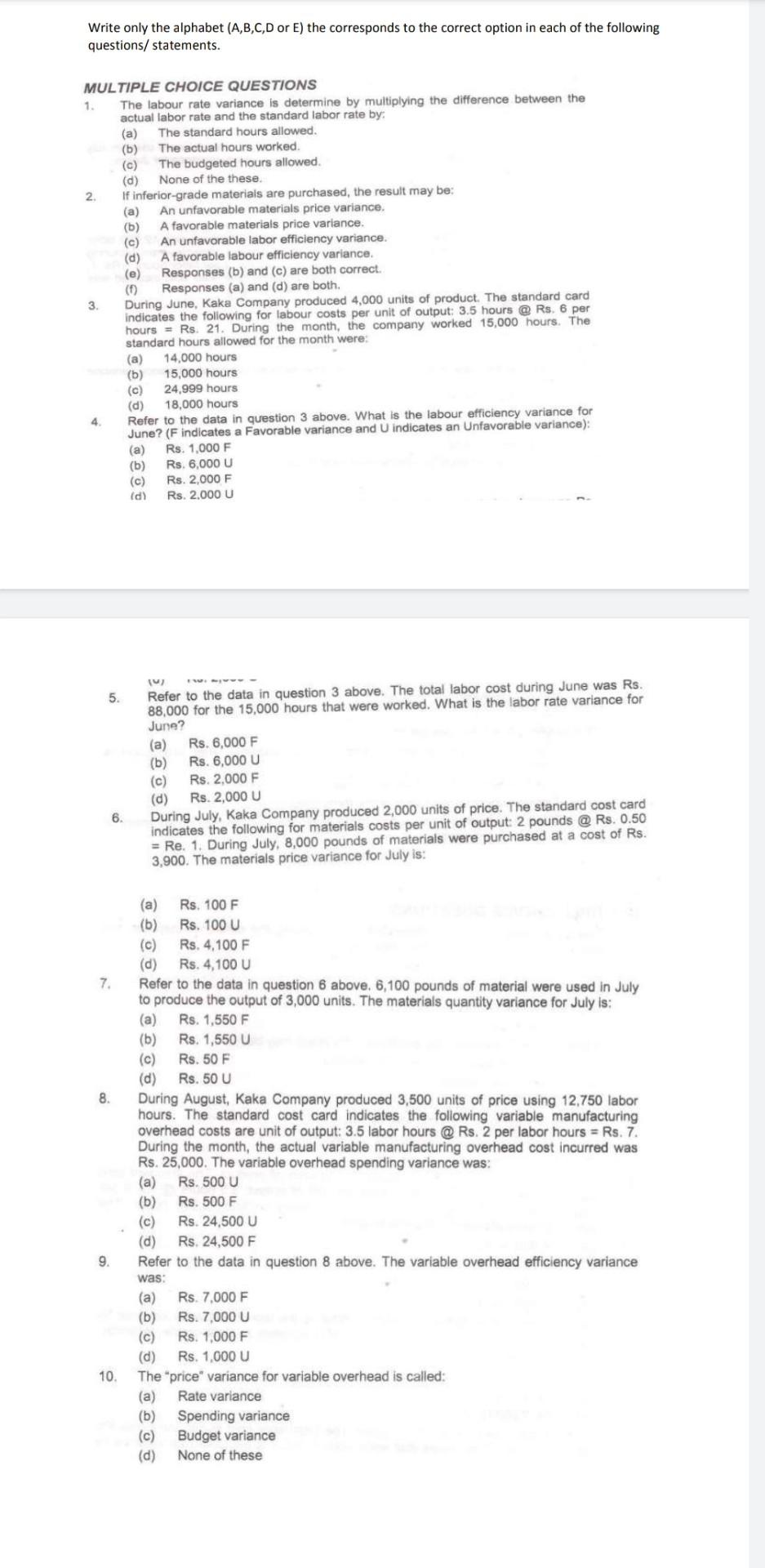
Write only the alphabet (A,B,C,D or E) the corresponds to the correct option in each of the following questions/ statements. MULTIPLE CHOICE QUESTIONS 1. The labour rate variance is determine by multiplying the difference between the actual labor rate and the standard labor rate by: (a) The standard hours allowed. (6) The actual hours worked (c) The budgeted hours allowed. (d) None of the these. 2 If inferior-grade materials are purchased, the result may be: (a) An unfavorable materials price variance, (b) A favorable materials price variance. (c) An unfavorable labor efficiency variance. (d) A favorable labour efficiency variance. Responses (b) and (c) are both correct. (0) Responses (a) and (d) are both 3. During June, Kaka Company produced 4,000 units of product. The standard card indicates the following for labour costs per unit of output: 3.5 hours @ Rs. 6 per hours = Rs. 21. During the month, the company worked 15,000 hours. The standard hours allowed for the month were: (a) 14,000 hours (b) 15,000 hours (C) 24,999 hours (d) 18,000 hours 4. Refer to the data in question 3 above. What is the labour efficiency variance for June? (F indicates a Favorable variance and indicates an Unfavorable variance) (a) Rs. 1.000 F (b) Rs. 6,000 U (c) Rs. 2,000 F id) Rs. 2.000 U 5. Refer to the data in question 3 above. The total labor cost during June was Rs. 88,000 for the 15,000 hours that were worked. What is the labor rate variance for June? (a) Rs. 6,000 F (b) Rs. 6,000 U (C) Rs. 2.000 F (d) Rs. 2,000 U During July, Kaka Company produced 2,000 units of price. The standard cost card indicates the following for materials costs per unit of output: 2 pounds @ Rs. 0.50 = Re. 1. During July, 8,000 pounds of materials were purchased at a cost of Rs. 3,900. The materials price variance for July is: 6. 7. 8. (a) Rs. 100 F (b) Rs. 100 U (c) Rs. 4,100 F (d) Rs. 4,100 u Refer to the data in question 6 above. 6,100 pounds of material were used in July to produce the output of 3,000 units. The materials quantity variance for July is: (a) Rs. 1,550 F (b) Rs. 1,550 U (c) Rs. 50 F (d) Rs. 50 U During August, Kaka Company produced 3,500 units of price using 12,750 labor hours. The standard cost card indicates the following variable manufacturing overhead costs are unit of output: 3.5 labor hours @ Rs. 2 per labor hours = Rs. 7. During the month, the actual variable manufacturing overhead cost incurred was Rs. 25,000. The variable overhead spending variance was (a) Rs. 500 U (b) Rs. 500 F (c) Rs. 24,500 U (d) Rs. 24,500 F Refer to the data in question 8 above. The variable overhead efficiency variance was: (a) Rs. 7.000 F (b) Rs. 7,000 U (c) Rs. 1,000 F (d) Rs. 1,000 U The "price" variance for variable overhead is called: (a) Rate variance (6) Spending variance (c) Budget variance (d) None of these 9. 10
Step by Step Solution
There are 3 Steps involved in it

Get step-by-step solutions from verified subject matter experts
 Study Help