Question: This is the only question I have below: 3. Develop a SWOT analysis for GE. Management in Action General Electric's Evolving Strategy General Electric (GE)
This is the only question I have below:
3. Develop a SWOT analysis for GE.
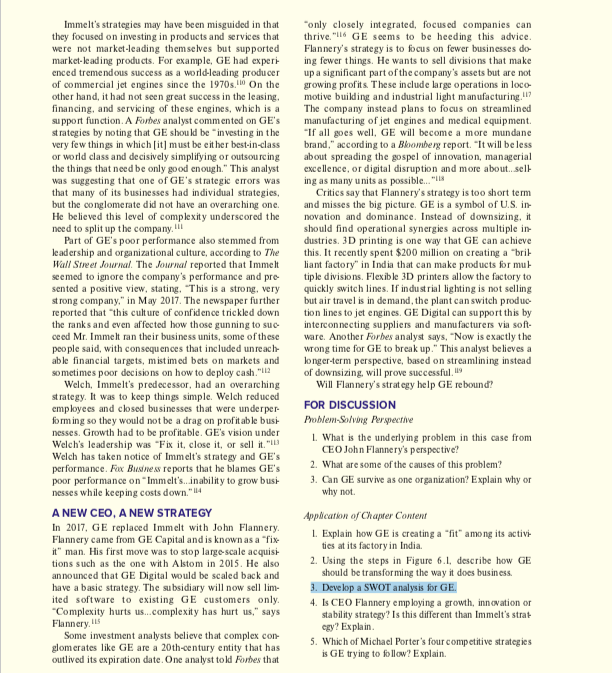
Management in Action General Electric's Evolving Strategy General Electric (GE) is one of the largest companies in the world. It has almost 300,000 employees and op erates in more than 170 countries. The multinational conglomerate traces its roots to the 19th century and is responsible for technology that has revolutionized daily life. GE has invented or commercialized a wide variety of products, starting with light bulbs in 1892 and transi tioning to radio, television, and even jet engines. The organization also ventured into financial services and oil and gas. GE was led by CEO Jack Welch from 1981 to 2001. The company's market value increased by 4,000 percent during Welch's tenure. It had a value of over $ 396 billion in 2002 when Welch retired and Jeffrey Immelt took over as CEO. Sadly, the financially successful firm Immelt inherited did not last GE's market value dropped to $261 billion by 2015.101 The organization lost another 46 percent of its value between 2017 and 2018. This $120 billion loss oc- curred while the stock market was up 41 percent. Poor financial performance caused the company to cut its dividend in halfin late 2017, which led analysts to lower their estimates of GE's earnings.102 An analyst at Deutsche Bank told CNBC he believed GE could be re moved from the Dow Jones Industrial average, even though it was an original member of the 30-company index over 120 years ago. Let's examine the corpo rate strategies underlying GE's decline. purchasing Amersham, a British medical company, for $10 billion in 2003. Amersham specialized in making contrast agents that were injected into the body before medical scanning. GE Medical Systems was already the leading maker of imaging machines, 104 and Immelt's plan was to double down on what he believed was a growing industry by manufacturing both medical equip- ment and its supporting products. Immelt simultaneously started to sell off low-growth divisions. For example, he sold GE's life and mortgage insurance business in 2005 and then sold GE Plastics to a Saudi Arabian chemical company for $11.6 billion in 2007.05 This sale was quite controversial because GE Plastics had been a reliable source of revenue for the organization since the 1970s. Immelt wanted to in vest funds from these sales into high-growth markets such as software Immelt established GE Digital in 2011. The hope was that this division would develop a software lan- guage that could handle information transfer between next-generation industrial machines. Bloomberg re- ported that Immelt wanted to make GE a "top 10 soft- ware company."106 GE invested $4 billion in this effort but faced technical problems and delays with its soft- ware platform. These issues hurt GE's reputation in a fast-moving digital market." GE then purchased French gas company Alstom for over $10 billion in 2015. At the time of the purchase Immelt said, "The completion of the Alstom power and grid acquisition is another significant step in GE's transformation." This investment in a natural gas company occurred at the same time renewable energy was lifting off and oil and gas prices were dropping, The result was a $3 billion reduction in GE's cash GE'S STRATEGY UNDER JEFF IMMELT Immelt's grand strategy was to acquire or develop high- growth businesses instead of relying on GE's traditional businesses like lighting and plastics. He started by flow. 109 Immelt's strategies may have been misguided in that they focused on investing in products and services that were not market leading themselves but supported market-leading products. For example, GE had experi enced tremendous success as a world-leading producer of commercial jet engines since the 1970s. On the other hand, it had not seen great success in the leasing, financing, and servicing of these engines, which is a support function. A Forbes analyst commented on GE's strategies by noting that GE should be investing in the very few things in which it must be either best-in-class or world class and decisively simplifying or outsourcing the things that need be only good enough." This analyst was suggesting that one of GE's strategic errors was that many of its businesses had individual strategies, but the conglomerate did not have an overarching one. He believed this level of complexity underscored the need to split up the company. Il Part of GE's poor performance also stemmed from leadership and organizational culture, according to the Wall Street Journal. The Journal reported that Immelt seemed to ignore the company's performance and pro sented a positive view, stating. This is a strong, very strong company," in May 2017. The newspaper further reported that this culture of confidence trickled down the ranks and even affected how those gunning to suo ceed Mr. Immelt ran their business units, some of these people said, with consequences that included unreach able financial targets, mist imod bets on markets and sometimes poor decisions on how to deploy cash "112 Welch, Immelt's predecessor, had an overarching strategy. It was to keep things simple. Welch reduced employees and closed businesses that were underper forming so they would not be a dragon profitable busi- nesses. Growth had to be profitable. GE's vision under Welch's leadership was "Fix it, close it, or sell it." Welch has taken notice of Immelt's strategy and GE's performance. Fox Business reports that he blames GE's poor performance on Immelt's..inability to grow busi nesses while keeping costs down." A NEW CEO, A NEW STRATEGY In 2017, GE replaced Immelt with John Flannery. Flannery came from GE Capital and is known as a "fixe it" man. His first move was to stop large-scale acquisi tions such as the one with Alstom in 2015. He also announced that GE Digital would be scaled back and have a basic strategy. The subsidiary will now sell lim- ited software to existing GE customers only. "Complexity hurts us...complexity has hurt us," says Flannery Some investment analysts believe that complex con glomerates like GE are a 20th-century entity that has outlived its expiration date. One analyst told Forbes that *only closely integrated, focused companies can thrive. "16 GE seems to be heeding this advice. Flannery's strategy is to focus on fewer businesses do ing fewer things. He wants to sell divisions that make up a significant part of the company's assets but are not growing profits. These include large operations in loco motive building and industrial light manufacturing." The company instead plans to focus on streamlined manufacturing of jet engines and medical equipment "If all goes well, GE will become a more mundane brand," according to a Bloomberg report. "It will be less about spreading the gospel of innovation, managerial excellence, or digital disruption and more about sell ing as many units as possible..." Critics say that Flannery's strategy is too short term and misses the big picture. GE is a symbol of U.S.in novation and dominance. Instead of downsizing, it should find operational synergies across multiple in dustries 3D printing is one way that GE can achieve this. It recently spent $200 million on creating a "bril liant factory in India that can make products for mul tiple divisions. Flexible 3D printers allow the factory to quickly switch lines. If industrial lighting is not selling but air travel is in demand, the plant can switch produc tion lines to jet engines. GE Digital can support this by interconnecting suppliers and manufacturers via soft ware. Another Forbes analyst says, "Now is exactly the wrong time for GE to break up." This analyst believes a longer-term perspective, based on streamlining instead of downsizing, will prove successful Will Flannery's strategy help GE rebound? FOR DISCUSSION Problem Solving Perpective 1. What is the underlying problem in this case from CEO John Flannery's perspective! 2. What are some of the causes of this problem! 3. Can GE survive as one organization? Explain why or why not Application of Chapter Content 1. Explain how GE is creating a "fit" among its activi ties at its factory in India 2. Using the steps in Figure 6.1, describe how GE should be transforming the way it does business. 3. Develop a SWOT analysis for GE. 4. Is CEO Flannery employing a growth, innovation or stability strategy? Is this different than Immelt's strat cgy? Explain 5. Which of Michael Porter's four competitive strategies is GE trying to follow? Explain









 Study Help