







Question: This is the problem. Example will be provided. Consider the following scenario then complete the exercises below: AirBird is a domestic airline company that is
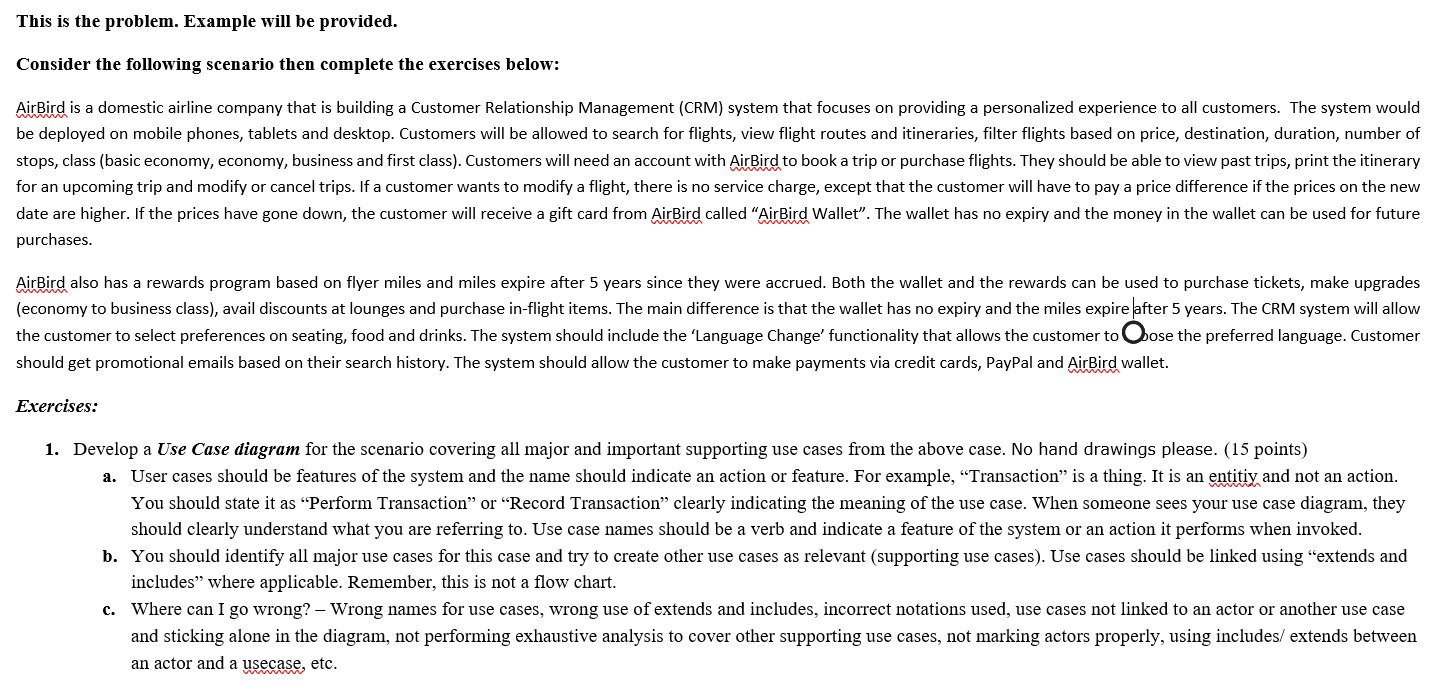
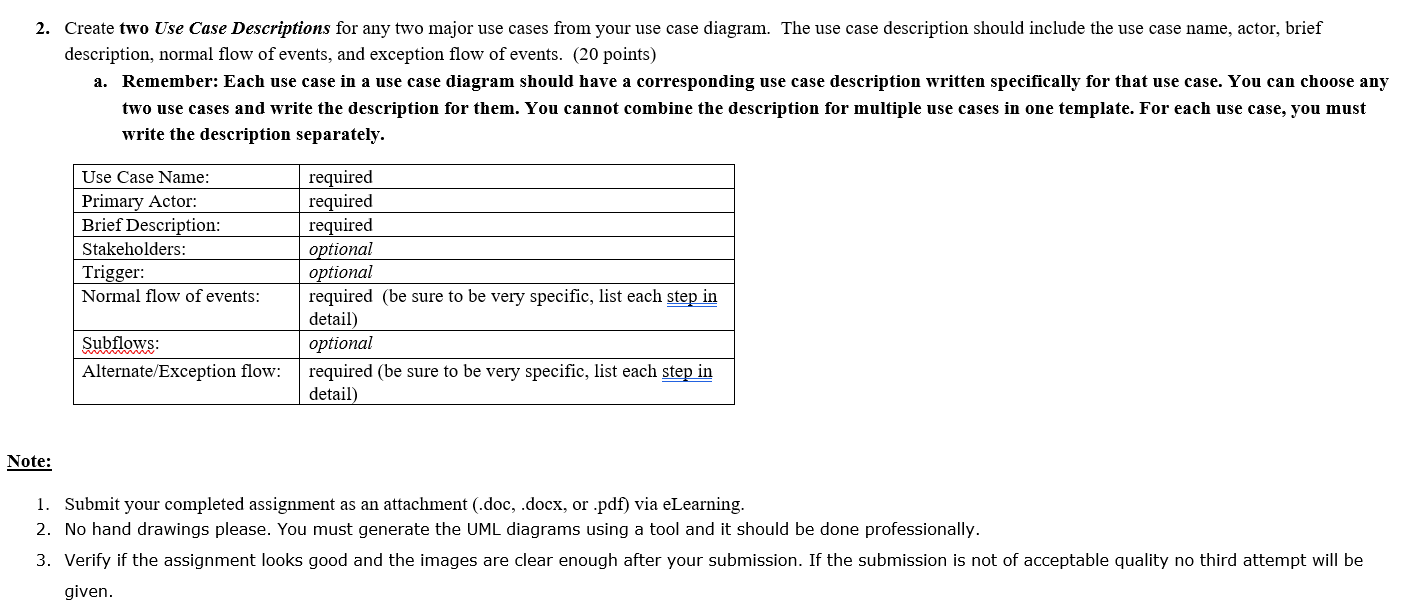
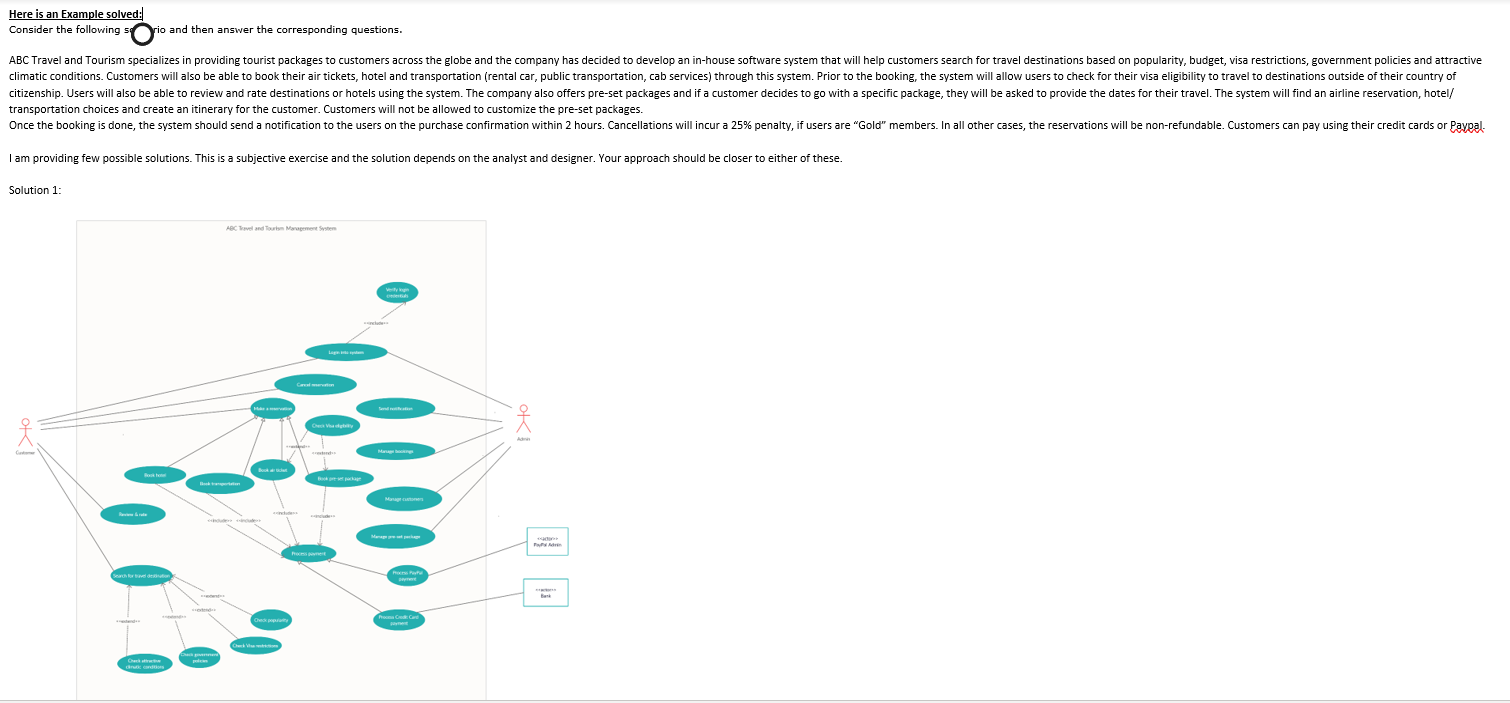
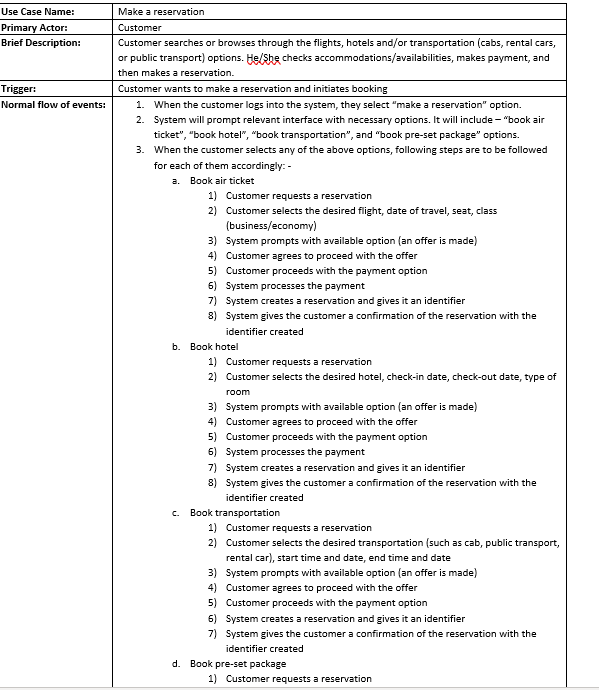
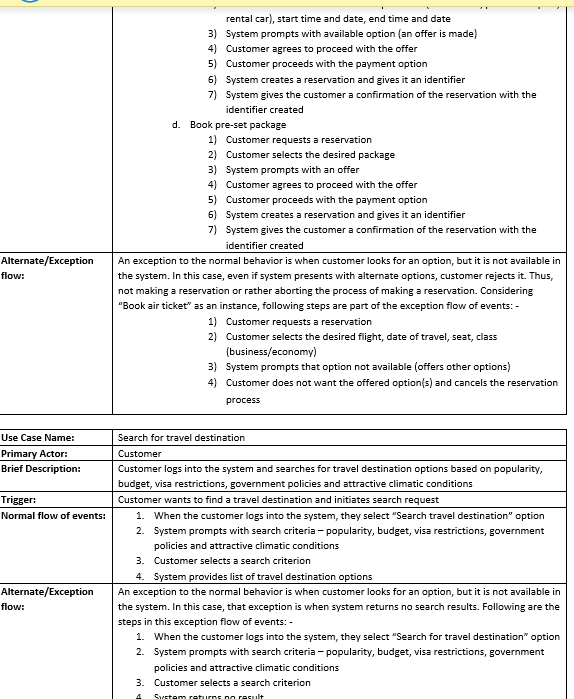
This is the problem. Example will be provided. Consider the following scenario then complete the exercises below: AirBird is a domestic airline company that is building a Customer Relationship Management (CRM) system that focuses on providing a personalized experience to all customers. The system would be deployed on mobile phones, tablets and desktop. Customers will be allowed to search for flights, view flight routes and itineraries, filter flights based on price, destination, duration, number of stops, class (basic economy, economy, business and first class). Customers will need an account with AirBird to book a trip or purchase flights. They should be able to view past trips, print the itinerary for an upcoming trip and modify or cancel trips. If a customer wants to modify a flight, there is no service charge, except that the customer will have to pay a price difference if the prices on the new date are higher. If the prices have gone down, the customer will receive a gift card from AirBird called "AirBird Wallet. The wallet has no expiry and the money in the wallet can be used for future purchases. AirBird also has a rewards program based on flyer miles and miles expire after 5 years since they were accrued. Both the wallet and the rewards can be used to purchase tickets, make upgrades (economy to business class), avail discounts at lounges and purchase in-flight items. The main difference is that the wallet has no expiry and the miles expire after 5 years. The CRM system will allow the customer to select preferences on seating, food and drinks. The system should include the 'Language Change' functionality that allows the customer to Ooose the preferred language. Customer should get promotional emails based on their search history. The system should allow the customer to make payments via credit cards, PayPal and AirBird wallet. Exercises: 1. Develop a Use Case diagram for the scenario covering all major and important supporting use cases from the above case. No hand drawings please. (15 points) a. User cases should be features of the system and the name should indicate an action or feature. For example, Transaction is a thing. It is an entitiy and not an action. You should state it as Perform Transaction or Record Transaction clearly indicating the meaning of the use case. When someone sees your use case diagram, they should clearly understand what you are referring to. Use case names should be a verb and indicate a feature of the system or an action it performs when invoked. b. You should identify all major use cases for this case and try to create other use cases as relevant (supporting use cases). Use cases should be linked using extends and includes where applicable. Remember, this is not a flow chart. c. Where can I go wrong? - Wrong names for use cases, wrong use of extends and includes, incorrect notations used, use cases not linked to an actor or another use case and sticking alone in the diagram, not performing exhaustive analysis to cover other supporting use cases, not marking actors properly, using includes/ extends between an actor and a usecase, etc. 2. Create two Use Case Descriptions for any two major use cases from your use case diagram. The use case description should include the use case name, actor, brief description, normal flow of events, and exception flow of events. (20 points) a. Remember: Each use case in a use case diagram should have a corresponding use case description written specifically for that use case. You can choose any two use cases and write the description for them. You cannot combine the description for multiple use cases in one template. For each use case, you must write the description separately. Use Case Name: Primary Actor: Brief Description: Stakeholders: Trigger: Normal flow of events: required required required optional optional required (be sure to be very specific, list each step in detail) optional required (be sure to be very specific, list each step in detail) Subflows: Alternate/Exception flow: Note: 1. Submit your completed assignment as an attachment (.doc, .docx, or .pdf) via eLearning. 2. No hand drawings please. You must generate the UML diagrams using a tool and it should be done professionally. 3. Verify if the assignment looks good and the images are clear enough after your submission. If the submission is not of acceptable quality no third attempt will be given. Here is an Example solved: Consider the following serio and then answer the corresponding questions, ABC Travel and Tourism specializes in providing tourist packages to customers across the globe and the company has decided develop an in-house software system that will help customers search for travel destinations based on popularity, budget, visa restrictions, government policies and attractive climatic conditions. Customers will also be able to book their air tickets, hotel and transportation (rental car, public transportation, cab services) through this system. Prior to the booking, the system will allow users to check for their visa eligibility to travel to destinations outside of their country of citizenship. Users will also be able to review and rate destinations or hotels using the system. The company also offers pre-set packages and if a customer decides to go with a specific package, they will be asked to provide the dates for their travel. The system will find an airline reservation, hotel/ transportation choices and create an itinerary for the customer. Customers will not be allowed to customize the pre-set packages. Once the booking is done, the system should send a notification to the users on the purchase confirmation within 2 hours. Cancellations will incur a 25% penalty, if users are "Gold" members. In all other cases, the reservations will be non-refundable. Customers can pay using their credit cards or Paypal I am providing few possible solutions. This is a subjective exercise and the solution depends on the analyst and designer. Your approach should be closer to either f these Solution 1: ABC Travel and Tour wer Use Case Name: Primary Actor: Brief Description: Trigger: Normal flow of events: Make a reservation Customer Customer searches or browses through the flights, hotels and/or transportation (cabs, rental cars, or public transport) options. He/she checks accommodations/availabilities, makes payment, and then makes a reservation. Customer wants to make a reservation and initiates booking 1. When the customer logs into the system, they select "make a reservation" option. 2. System will prompt relevant interface with necessary options. It will include - "book air ticket", "book hotel", "book transportation", and "book pre-set package" options. 3. When the customer selects any of the above options, following steps are to be followed for each of them accordingly:- a. Book air ticket 1) Customer requests a reservation 2) Customer selects the desired flight, date of travel, seat, class (business/economy) 3) System prompts with available option (an offer is made) 4) Customer agrees to proceed with the offer 5) Customer proceeds with the payment option 6) System processes the payment 7) System creates a reservation and gives it an identifier 8) System gives the customer a confirmation of the reservation with the identifier created b. Book hotel 1) Customer requests a reservation 2) Customer selects the desired hotel, check-in date, check-out date, type of room 3) System prompts with available option (an offer is made) 4) Customer agrees to proceed with the offer 5) Customer proceeds with the payment option 6) System processes the payment 7) System creates a reservation and gives it an identifier 8) System gives the customer a confirmation of the reservation with the identifier created Book transportation 1) Customer requests a reservation 2) Customer selects the desired transportation (such as cab, public transport, rental car), start time and date, end time and date 3) System prompts with available option (an offer is made) 4) Customer agrees to proceed with the offer 5) Customer proceeds with the payment option 6) System creates a reservation and gives it an identifier 7) System gives the customer a confirmation of the reservation with the identifier created d. Book pre-set package 1) Customer requests a reservation C. rental car), start time and date, end time and date 3) System prompts with available option (an offer is made) 4) Customer agrees to proceed with the offer 5) Customer proceeds with the payment option 6) System creates a reservation and gives it an identifier 7) System gives the customer a confirmation of the reservation with the identifier created d. Book pre-set package 1) Customer requests a reservation 2) Customer selects the desired package 3) System prompts with an offer 4) Customer agrees to proceed with the offer 5) Customer proceeds with the payment option 6) System creates a reservation and gives it an identifier 7) System gives the customer a confirmation of the reservation with the identifier created An exception to the normal behavior is when customer looks for an option, but it is not available in the system. In this case, even if system presents with alternate options, customer rejects it. Thus, not making a reservation or rather aborting the process of making a reservation. Considering "Book air ticket" as an instance, following steps are part of the exception flow of events:- 1) Customer requests a reservation 2) Customer selects the desired flight, date of travel, seat, class (business/economy) 3) System prompts that option not available (offers other options) 4) Customer does not want the offered option(s) and cancels the reservation process Alternate/Exception flow: Use Case Name: Primary Actor: Brief Description: Trigger: Normal flow of events: Search for travel destination Customer Customer logs into the system and searches for travel destination options based on popularity, budget, visa restrictions, government policies and attractive climatic conditions Customer wants to find a travel destination and initiates search request 1. When the customer logs into the system, they select "Search travel destination" option 2. System prompts with search criteria - popularity, budget, visa restrictions, government policies and attractive climatic conditions 3. Customer selects a search criterion 4. System provides list of travel destination options An exception to the normal behavior is when customer looks for an option, but it is not available in the system. In this case, that exception is when system returns no search results. Following are the steps in this exception flow of events:- 1. When the customer logs into the system, they select "Search for travel destination" option 2. System prompts with search criteria - popularity, budget, visa restrictions, government policies and attractive climatic conditions 3. Customer selects a search criterion Alternate/Exception flow: System returns no result This is the problem. Example will be provided. Consider the following scenario then complete the exercises below: AirBird is a domestic airline company that is building a Customer Relationship Management (CRM) system that focuses on providing a personalized experience to all customers. The system would be deployed on mobile phones, tablets and desktop. Customers will be allowed to search for flights, view flight routes and itineraries, filter flights based on price, destination, duration, number of stops, class (basic economy, economy, business and first class). Customers will need an account with AirBird to book a trip or purchase flights. They should be able to view past trips, print the itinerary for an upcoming trip and modify or cancel trips. If a customer wants to modify a flight, there is no service charge, except that the customer will have to pay a price difference if the prices on the new date are higher. If the prices have gone down, the customer will receive a gift card from AirBird called "AirBird Wallet. The wallet has no expiry and the money in the wallet can be used for future purchases. AirBird also has a rewards program based on flyer miles and miles expire after 5 years since they were accrued. Both the wallet and the rewards can be used to purchase tickets, make upgrades (economy to business class), avail discounts at lounges and purchase in-flight items. The main difference is that the wallet has no expiry and the miles expire after 5 years. The CRM system will allow the customer to select preferences on seating, food and drinks. The system should include the 'Language Change' functionality that allows the customer to Ooose the preferred language. Customer should get promotional emails based on their search history. The system should allow the customer to make payments via credit cards, PayPal and AirBird wallet. Exercises: 1. Develop a Use Case diagram for the scenario covering all major and important supporting use cases from the above case. No hand drawings please. (15 points) a. User cases should be features of the system and the name should indicate an action or feature. For example, Transaction is a thing. It is an entitiy and not an action. You should state it as Perform Transaction or Record Transaction clearly indicating the meaning of the use case. When someone sees your use case diagram, they should clearly understand what you are referring to. Use case names should be a verb and indicate a feature of the system or an action it performs when invoked. b. You should identify all major use cases for this case and try to create other use cases as relevant (supporting use cases). Use cases should be linked using extends and includes where applicable. Remember, this is not a flow chart. c. Where can I go wrong? - Wrong names for use cases, wrong use of extends and includes, incorrect notations used, use cases not linked to an actor or another use case and sticking alone in the diagram, not performing exhaustive analysis to cover other supporting use cases, not marking actors properly, using includes/ extends between an actor and a usecase, etc. 2. Create two Use Case Descriptions for any two major use cases from your use case diagram. The use case description should include the use case name, actor, brief description, normal flow of events, and exception flow of events. (20 points) a. Remember: Each use case in a use case diagram should have a corresponding use case description written specifically for that use case. You can choose any two use cases and write the description for them. You cannot combine the description for multiple use cases in one template. For each use case, you must write the description separately. Use Case Name: Primary Actor: Brief Description: Stakeholders: Trigger: Normal flow of events: required required required optional optional required (be sure to be very specific, list each step in detail) optional required (be sure to be very specific, list each step in detail) Subflows: Alternate/Exception flow: Note: 1. Submit your completed assignment as an attachment (.doc, .docx, or .pdf) via eLearning. 2. No hand drawings please. You must generate the UML diagrams using a tool and it should be done professionally. 3. Verify if the assignment looks good and the images are clear enough after your submission. If the submission is not of acceptable quality no third attempt will be given. Here is an Example solved: Consider the following serio and then answer the corresponding questions, ABC Travel and Tourism specializes in providing tourist packages to customers across the globe and the company has decided develop an in-house software system that will help customers search for travel destinations based on popularity, budget, visa restrictions, government policies and attractive climatic conditions. Customers will also be able to book their air tickets, hotel and transportation (rental car, public transportation, cab services) through this system. Prior to the booking, the system will allow users to check for their visa eligibility to travel to destinations outside of their country of citizenship. Users will also be able to review and rate destinations or hotels using the system. The company also offers pre-set packages and if a customer decides to go with a specific package, they will be asked to provide the dates for their travel. The system will find an airline reservation, hotel/ transportation choices and create an itinerary for the customer. Customers will not be allowed to customize the pre-set packages. Once the booking is done, the system should send a notification to the users on the purchase confirmation within 2 hours. Cancellations will incur a 25% penalty, if users are "Gold" members. In all other cases, the reservations will be non-refundable. Customers can pay using their credit cards or Paypal I am providing few possible solutions. This is a subjective exercise and the solution depends on the analyst and designer. Your approach should be closer to either f these Solution 1: ABC Travel and Tour wer Use Case Name: Primary Actor: Brief Description: Trigger: Normal flow of events: Make a reservation Customer Customer searches or browses through the flights, hotels and/or transportation (cabs, rental cars, or public transport) options. He/she checks accommodations/availabilities, makes payment, and then makes a reservation. Customer wants to make a reservation and initiates booking 1. When the customer logs into the system, they select "make a reservation" option. 2. System will prompt relevant interface with necessary options. It will include - "book air ticket", "book hotel", "book transportation", and "book pre-set package" options. 3. When the customer selects any of the above options, following steps are to be followed for each of them accordingly:- a. Book air ticket 1) Customer requests a reservation 2) Customer selects the desired flight, date of travel, seat, class (business/economy) 3) System prompts with available option (an offer is made) 4) Customer agrees to proceed with the offer 5) Customer proceeds with the payment option 6) System processes the payment 7) System creates a reservation and gives it an identifier 8) System gives the customer a confirmation of the reservation with the identifier created b. Book hotel 1) Customer requests a reservation 2) Customer selects the desired hotel, check-in date, check-out date, type of room 3) System prompts with available option (an offer is made) 4) Customer agrees to proceed with the offer 5) Customer proceeds with the payment option 6) System processes the payment 7) System creates a reservation and gives it an identifier 8) System gives the customer a confirmation of the reservation with the identifier created Book transportation 1) Customer requests a reservation 2) Customer selects the desired transportation (such as cab, public transport, rental car), start time and date, end time and date 3) System prompts with available option (an offer is made) 4) Customer agrees to proceed with the offer 5) Customer proceeds with the payment option 6) System creates a reservation and gives it an identifier 7) System gives the customer a confirmation of the reservation with the identifier created d. Book pre-set package 1) Customer requests a reservation C. rental car), start time and date, end time and date 3) System prompts with available option (an offer is made) 4) Customer agrees to proceed with the offer 5) Customer proceeds with the payment option 6) System creates a reservation and gives it an identifier 7) System gives the customer a confirmation of the reservation with the identifier created d. Book pre-set package 1) Customer requests a reservation 2) Customer selects the desired package 3) System prompts with an offer 4) Customer agrees to proceed with the offer 5) Customer proceeds with the payment option 6) System creates a reservation and gives it an identifier 7) System gives the customer a confirmation of the reservation with the identifier created An exception to the normal behavior is when customer looks for an option, but it is not available in the system. In this case, even if system presents with alternate options, customer rejects it. Thus, not making a reservation or rather aborting the process of making a reservation. Considering "Book air ticket" as an instance, following steps are part of the exception flow of events:- 1) Customer requests a reservation 2) Customer selects the desired flight, date of travel, seat, class (business/economy) 3) System prompts that option not available (offers other options) 4) Customer does not want the offered option(s) and cancels the reservation process Alternate/Exception flow: Use Case Name: Primary Actor: Brief Description: Trigger: Normal flow of events: Search for travel destination Customer Customer logs into the system and searches for travel destination options based on popularity, budget, visa restrictions, government policies and attractive climatic conditions Customer wants to find a travel destination and initiates search request 1. When the customer logs into the system, they select "Search travel destination" option 2. System prompts with search criteria - popularity, budget, visa restrictions, government policies and attractive climatic conditions 3. Customer selects a search criterion 4. System provides list of travel destination options An exception to the normal behavior is when customer looks for an option, but it is not available in the system. In this case, that exception is when system returns no search results. Following are the steps in this exception flow of events:- 1. When the customer logs into the system, they select "Search for travel destination" option 2. System prompts with search criteria - popularity, budget, visa restrictions, government policies and attractive climatic conditions 3. Customer selects a search criterion Alternate/Exception flow: System returns no result
Step by Step Solution
There are 3 Steps involved in it

Get step-by-step solutions from verified subject matter experts
 Study Help