







Question: This is the problem, need answers, show work 4) Assume Congress is considering a change to the SNAP (Food Stamps) program with the primary goal
This is the problem, need answers, show work
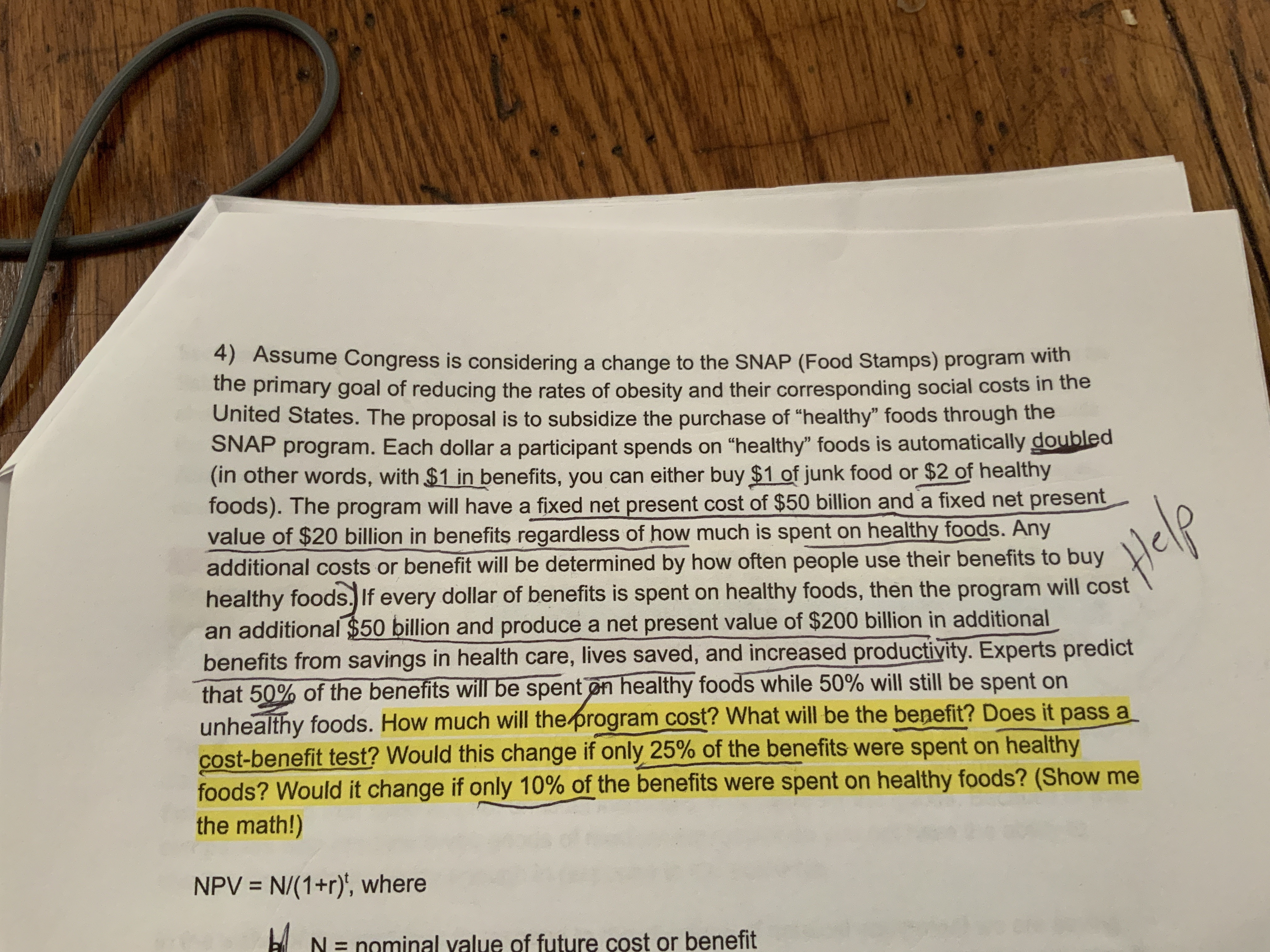
4) Assume Congress is considering a change to the SNAP (Food Stamps) program with the primary goal of reducing the rates of obesity and their corresponding social costs in the United States. The proposal is to subsidize the purchase of "healthy" foods through the SNAP program. Each dollar a participant spends on "healthy" foods is automatically doubled (in other words, with $1 in benefits, you can either buy $1 of junk food or $2 of healthy foods). The program will have a fixed net present cost of $50 billion and a fixed net present value of $20 billion in benefits regardless of how much is spent on healthy foods. Any additional costs or benefit will be determined by how often people use their benefits to buy Help healthy foods. If every dollar of benefits is spent on healthy foods, then the program will cost an additional $50 billion and produce a net present value of $200 billion in additional benefits from savings in health care, lives saved, and increased productivity. Experts predict that 50% of the benefits will be spent on healthy foods while 50% will still be spent on unhealthy foods. How much will the program cost? What will be the benefit? Does it pass a cost-benefit test? Would this change if only 25% of the benefits were spent on healthy foods? Would it change if only 10% of the benefits were spent on healthy foods? (Show me the math!) NPV = N/(1+r), where ominal value of future cost or benefit
Step by Step Solution
There are 3 Steps involved in it

Get step-by-step solutions from verified subject matter experts
 Study Help