







Question: this is the question and the answer but i did not understand it so can you please solve it again and explain for me how
this is the question and the answer but i did not understand it so can you please solve it again and explain for me how to final answer
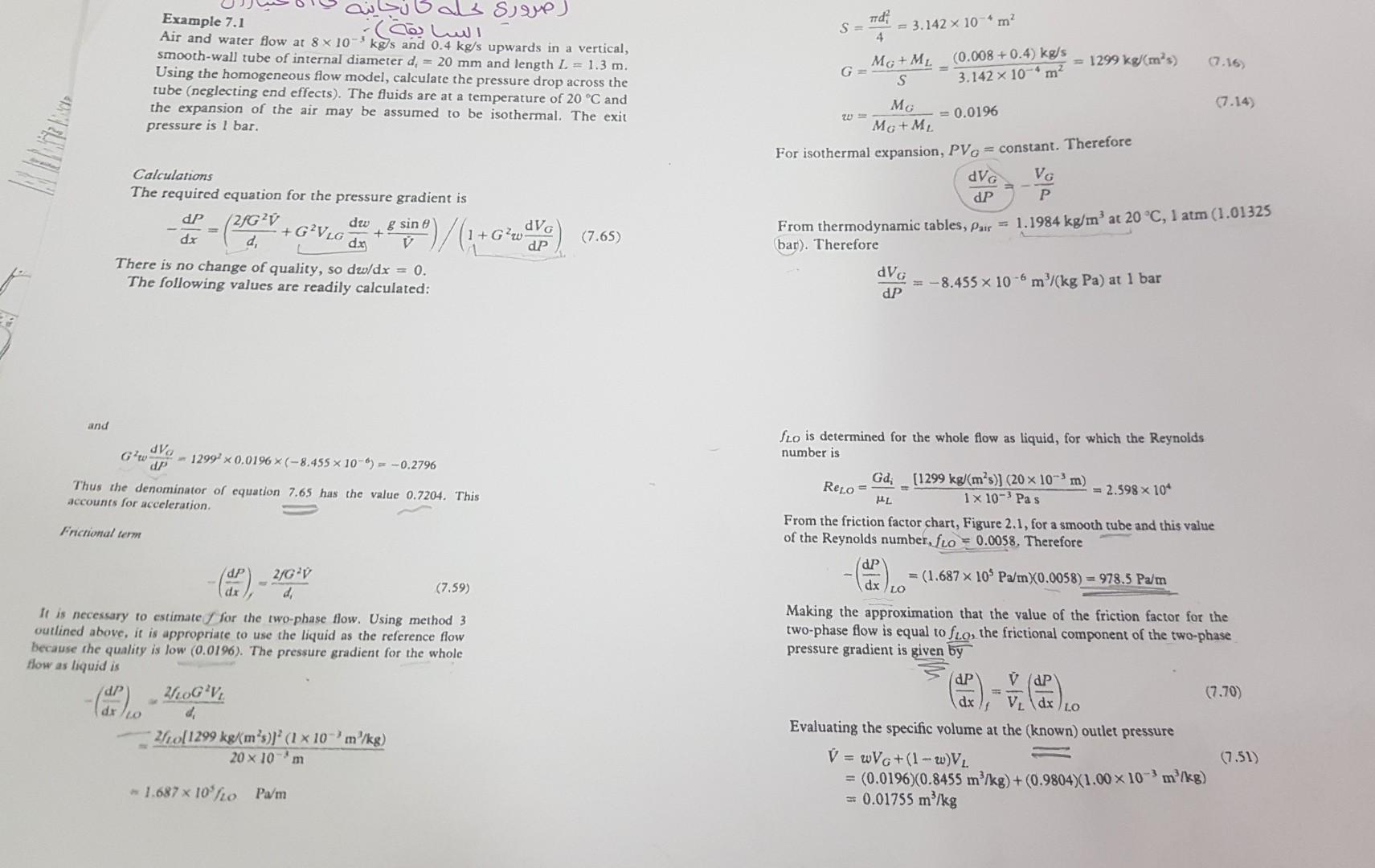
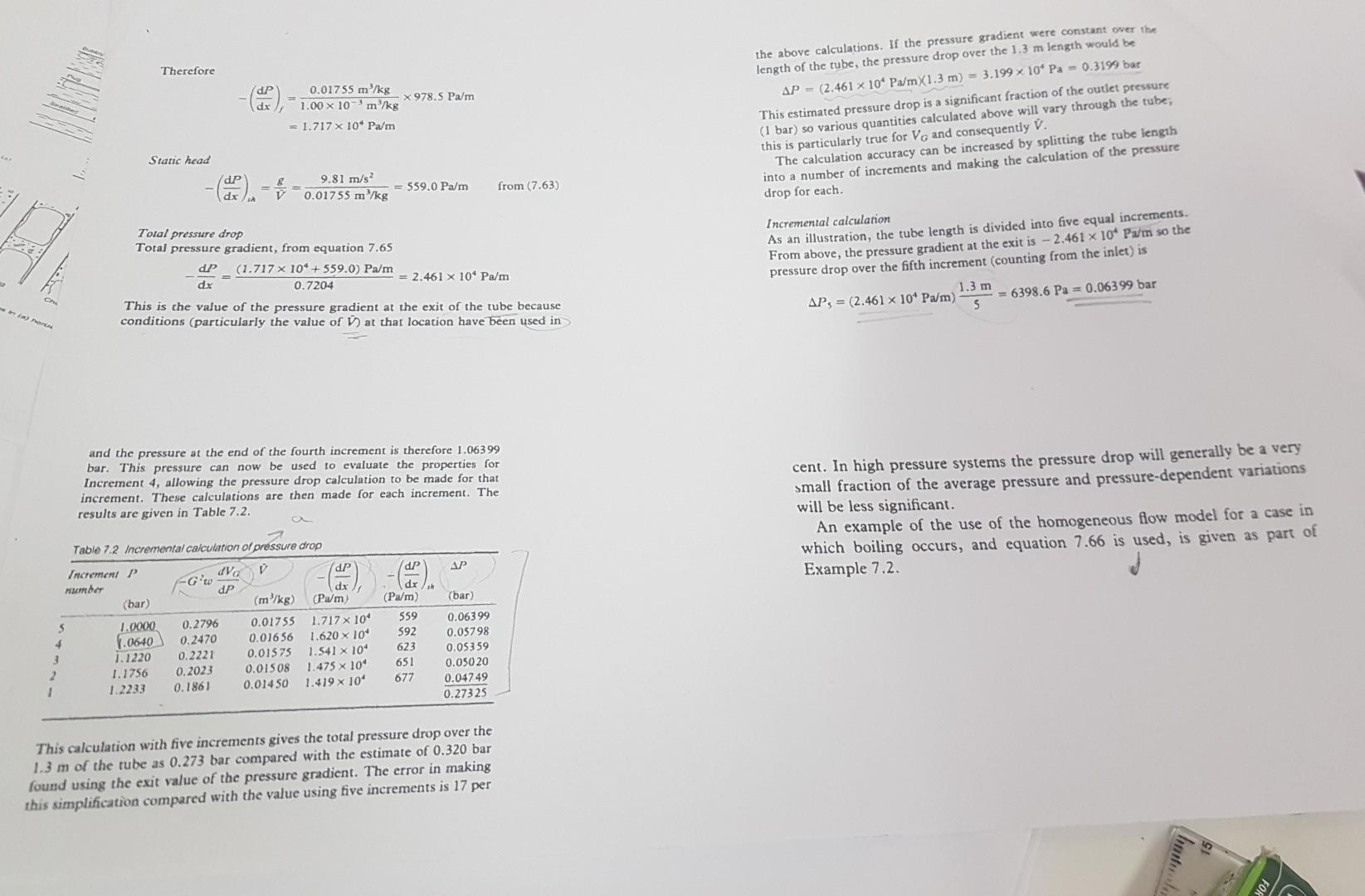
Example 7.1 Air and water flow at 8103kg s and 0.4kg/s upwards in a vertical, smooth-wall tube of internal diameter di=20mm and length L=1.3m. Using the homogeneous flow model, calculate the pressure drop across the tube (neglecting end effects). The fluids are at a temperature of 20C and the expansion of the air may be assumed to be isothermal. The exit pressure is 1 bar. S=4d12=3.142104m2 Calculations The required equation for the pressure gradient is dxdP=(d12fG2V^+G2VLGdxdw+Vgsin)/(1+G2wdPdVG)1 From thermodynamic tables, air=1.1984kg/m3 at 20C,1atm(1.01325 There is no change of quality, so dw/dx=0. The following values are readily calculated: (bar). Therefore dPdVG=8.455106m3/(kgPa) at 1 bar and G2wdP3dVG129920.0196(8.455106)=0.2796 fLO is determined for the whole flow as liquid, for which the Reynolds number is Thus the denominator of equation 7.65 has the value 0.7204. This ReLO=LGdi=1103Pas[1299kg/(m2s)](20103m)=2.598104 accounts for acceleration. Fricrional term From the friction factor chart, Figure 2.1, for a smooth tube and this value of the Reynolds number, fLO=0.0058. Therefore (dxdP)g=d2/G2V^ (dxdP)LO=(1.687105Pa/m)(0.0058)=978.5Pa/m It is necessary to estimate for the two-phase flow. Using method 3 outlined above, it is appropriate to use the liquid as the reference flow because the quality is low (0.0196). The pressure gradient for the whole How as liquid is (dxdP)10=d2/LOG2Vt=20103m2/16[1299kg/(m2s)]2(1103m3/kg)=1.687105/20Pa/m (dxdP)f=VLV(dxdP)LO Evaluating the specific volume at the (known) outlet pressure V~=wVG+(1w)VL=(0.0196)(0.8455m3/kg)+(0.9804)(1.00103m3/kg)=0.01755m3/kg Therefore (dxdP)f=1.00103m3/kg0.01755m3/kg978.5Pa/m=1.717104Pa/m Static head (dxdP)st=Vg=0.01755m3/kg9.81m/s2=559.0Pa/mfrom(7.63) This estimated pressure drop is a significant fraction of the outiet pressure this is particularly true for Vg and consequently V. The calculation accuracy can be increased by splitting the tube length into a number of increments and making the calculation of the pressure drop for each. Total pressure drop Incremental calcularion Total pressure gradient, from equation 7.65 dxdP=0.7204(1.717104+559.0)Pa/m=2.461104Pa/m As an illustration, the tube length is divided into five equal increments. This is the value of the pressure gradient at the exit of the tube because conditions (particularly the value of V^ at that location have been used in (counting from the inlet) is P5=(2.461104Pa/m)51.3m=6398.6Pa=0.06399bar and the pressure at the end of the fourth increment is therefore 1.06399 bar. This pressure can now be used to evaluate the properties for Increment 4 , allowing the pressure drop calculation to be made for that increment. These calculations are then made for each increment. The results are given in Table 7.2. cent. In high pressure systems the pressure drop will generally be a very small fraction of the average pressure and pressure-dependent variations will be less significant. An example of the use of the homogeneous flow model for a case in which boiling occurs, and equation 7.66 is used, is given as part of Example 7.2. This calculation with five increments gives the total pressure drop over the 1.3m of the rube as 0.273 bar compared with the estimate of 0.320 bar found using the exit value of the pressure gradient. The error in making this simplification compared with the value using five increments is 17 per
Step by Step Solution
There are 3 Steps involved in it

Get step-by-step solutions from verified subject matter experts
 Study Help