this is the question. other is course article questions should be answered from.
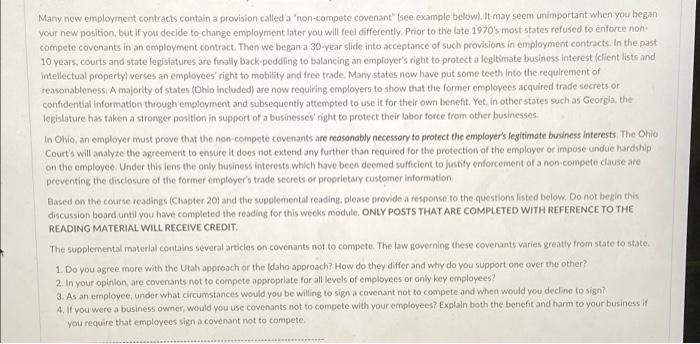
Hope to Work For a Rival? Avoid Idaho BYLINE: By CONOR DOUGHERTY; Doris Burke contributed research. SECTION: Section A; Column 0; National Desk: Pg. 1 LENGTH: 1883 words BOISE, Idaho -- Idaho achieved a notable distinction last year. It became one of the hardest places in America for someone to quit a job for a better one. The state did this by making it easier for companies to enforce noncompete agreements, which prevent employees from leaving their company for a competitor. While its economy is known for agriculture -- potatoes are among the state's biggest exports -- Idaho has a long history as a technology hub. And the new law landed in the middle of the tech world, causing a clash between hungry start-ups looking to poach employees and more established companies that want to lock their people in place. "We're trying to build the tech ecosystem in Boise," said George Mulhern, chief executive of Cradlepoint, a company here that makes routers and other networking equipment. "And anything that would make somebody not want to move here or start a company here is going to slow down our progress." Alex LaBeau, president of the Idaho Association of Commerce and Industry, a trade group that represents many of the state's biggest employers, countered: "This is about companies protecting their assets in a competitive marketplace." Versions of this clash have played out nationwide, as state lawmakers consider whether to make it easier or harder for companies to block workers from jumping to competitors. Both sides in the debate, which bridges party lines, say they are trying to create an environment in which local businesses can thrive. For the most part, states have been moving toward making it easier for people to switch teams, but Idaho went the other direction with legislation that was friendlier to employers. The resulting law was particularly strict because it put the onus on employees to prove that they would not harm their former employers by taking the new jobs. Proponents note that the statute applies only to "key employees" who tend to have more responsibility and better pay. But employment lawyers say Idaho companies tie down all levels of workers, not just top executives, with tough employment contracts. And indeed, the new law has roots in a yearslong fight waged by a woman who never finished high school but built a career selling tech-training services, only to be sued when she left for a better-paying job. The most extreme end of the spectrum is California, which prohibits noncompete agreements entirely. Economists say this was a crucial factor behind Silicon Valley's rise, because it made it easier for people to start and staff new businesses. But as states like Utah and Massachusetts have tried to move closer to this approach, legislators have run into mature companies trying to hold onto their best employees. When Mike Schultz, a Republican state representative in Utah, introduced an ultimately successful bill last year to make such agreements harder to enforce, incumbent businesses were his biggest opponents. "But then you had the new entrepreneurs, and most of those guys were in favor of doing away with noncompetes," he said. "Those are the guys out there growing and trying to hire people." A recent survey showed that one in five American workers is bound by a noncompete clause. They cover workers up and down the economic spectrum, from executives to hairdressers. Despite their widespread use, these agreements often catch departing workers off guard because they are rarely highlighted during interviews and are usually tucked inside employment contracts that are full of impenetrable legalese few people can understand. The growth of restrictive employment contracts dovetails with a broad pattern in the labor market: People don't quit their jobs as much as they used to. The share of workers changing jobs has been on a long-run decrease since 2000, according to research by the economists Steven J. Davis at the University of Chicago's Booth School of Business and John Haltiwanger at the University of Maryland. One explanation offered by economists is that a bloat of regulations has made it harder for employees to change careers or move across state lines. The barriers include employment contracts and occupational licensing laws that cover a third of the work force and require people to spend months or years training to do even basic service jobs. The impact has fallen disproportionately on start-ups and high-growth companies, which tend to be against strict employment agreements because they are primarily concerned with growth. "The noncompete is a two-edged sword," said Matthew Marx, a professor at Boston University's Questrom School of Business. "Although it enables companies to retain their employees, it makes it harder for them to recruit workers with relevant experience." It also ends up hurting wages, because most people get raises when they switch jobs. This goes far beyond defectors to the economy more broadly, and Idaho's tech scene shows why. An Answer to Poaching Boise is one of America's most remote metropolitan areas. Despite its Rocky Mountain setting, or perhaps because of it, the city and surrounding suburbs grew to prominence and affluence thanks to homegrown businesses like the semiconductor giant Micron Technology, a former start-up itself, as well as the J. R. Simplot Company and the Albertsons grocery chain. Over the past several decades, these companies got so big that the city gained a reputation as a hub for Fortune 500 headquarters. Today, however, a new group of entrepreneurs is building on Idaho's tradition of homespun growth. Matt Rissell is one of them. Mr. Rissell is a founder and the chief executive of TSheets, which makes time-management software. Mr. Rissell started his entrepreneurial career as the owner of three Cartridge World stores. It was a tough, low-margin business and he was losing a lot of money from employees who fudged their time sheets for extra hours. Mr. Rissell enlisted an engineer friend to help him fix the problem with software. When his stores saved $2,400 the first month, Mr. Rissell realized he had found a much better business than selling printer cartridges. according to Mr. Haltiwanger's research, a relative handful of high-growth companies -- most of them youngish companies like TSheets -- account for about half of new jobs created. They also play an outsize role in raising wages, because people quit their jobs to join them, During a recent interview in his office, Mr. Rissell said that one of his main challenges was simply finding enough people. TSheets has about 70 employees on its engineering and product team, and almost all moved there from jobs at local companies "The ability to recruit from the local area has been extraordinary for us," he said. Two years ago, TSheets hired a pair of engineers from a smaller software company called Zenware. Jody Sedrick, Zenware's chief executive, was hurt and disappointed. He contacted a lawyer to see if it was possible to prevent his employees from leaving for a rival, but instead of spending money on legal costs, he decided to try something else: He gave each of his remaining employees a raise. "I said, 'You know what, we're going to double down internally," he said in a recent interview. The result for the Idaho economy was that TSheets hired two people -- but in doing so got 12 other people a raise. Had Mr. Sedrick decided to sue his two departing employees, something Idaho's new law made easier, those raises might never have happened. Trust No One For a law that would end up riling tech companies, Idaho's statute began with an unlikely character: Debbie Nolan, a 51-year-old saleswoman who never went to high school. Ms. Nolan is from the New York City borough of Queens. She left school at 13 but through decades of work experience managed to carve out a middle-class career selling technology-training classes for office workers. She moved from New York to California to Nevada and finally to Idaho, where she worked at a company called LeapFox Learning. Ms. Nolan made $48.000 a year there, based on her extensive work history and little else. "I don't think I could get a job at Walmart without a high school diploma," she said in an interview. Three years ago Ms. Nolan quit and started working at Execu Train -- LeapFox's main competitor -- where she negotiated a $65,000 salary. LeapFox sued her for violating her exit agreement, setting off a three-year legal battle that was settled out of court but inspired Ms. Nolan to get a tattoo that sits just under her collarbone and reads: "Trust No One." After Ms. Nolan's defection, Codi Galloway, who owns LeapFox with her husband, Scott, became an outspoken advocate for amending state law to make it less expensive for businesses to block an employee from going to work for a rival. The result was a bill that shifted the burden from companies to employees, who must now prove they have "no ability to adversely affect the employer's legitimate business interests." The bar for that is so high that Brian Kane, an assistant chief deputy in the Idaho attorney general's office, wrote that this would be difficult if not impossible" for an employee to do. a Many new employment contracts contain a provision called a 'non-compete covenant" see example below). It may seem unimportant when you began your new position, but if you decide to change employment later you will feel differently. Prior to the late 1970's most states refused to enforce non compete covenants in an employment contract. Then we began a 30-year slide into acceptance of such provisions in employment contracts. In the past 10 years, courts and state legislatures are finally back peddling to balancing an employer's right to protect a legitimate business interest (client lists and Intellectual property) verses an employees' right to mobility and free trade. Many states now have put some teeth into the requirement of reasonableness. A majority of states (Ohio included) are now requiring employers to show that the former employees acquired trade secrets or confidential information through employment and subsequently attempted to use it for their own benefit. Yet, In other states such as Georgia, the legislature has taken a stronger position in support of a businesses right to protect their labor force from other businesses In Ohio, an employer must prove that the non-compete covenants are reasonably necessary to protect the employer's legitimate business Interests. The Ohio Court's will analyze the agreement to ensure it does not extend any further than required for the protection of the employer or impose undue hardship on the employee. Under this lens the only business interests which have been deemed sufficient to justify enforcement of a non compete clause are preventing the disclosure of the former employer's trade secrets or proprietary customer information Based on the course readines (Chapter 20) and the supplemental reading. pleme provide a response to the questions listed below. Do not begin this discussion board until you have completed the reading for this weeks module. ONLY POSTS THAT ARE COMPLETED WITH REFERENCE TO THE READING MATERIAL WILL RECEIVE CREDIT The supplemental material contains several articles on covenants not to compete. The law governing these covenants varies greatly from state to state, 1. Do you agree more with the Utah approach or the Idaho approach? How do they differ and why do you support one over the other? 2. In your opinion, are covenants not to compete appropriate for all levels of employees or only key employees? 3. As an employee, under what circumstances would you be willing to sign a covenant not to compete and when would you decline to sign? 4. If you were a business owner, would you use covenants not to compete with your employees? Explain both the benefit and harm to your business if you require that employees sign a covenant not to compete