







Question: this is the question. Thank you (a) Consider the surface with the equation F (x, y, z) = 0, where F is continuously differentiable in
this is the question. Thank you
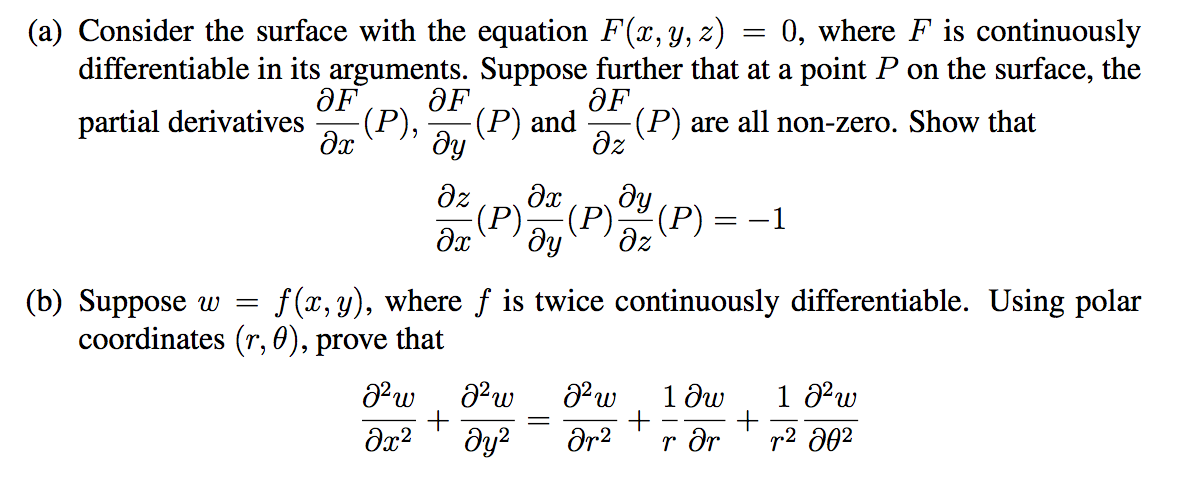
(a) Consider the surface with the equation F (x, y, z) = 0, where F is continuously differentiable in its arguments. Suppose further that at a point P on the surface, the partial derivatives (33+: (P), (2: (P) and 250\") are all non-zero. Show that 83 8:1: 83; _ %(P)8_y(P)$(P) 1 (b) Suppose w = f(:r, y), where f is twice continuously differentiable. Using polar coordinates (r, 9), prove that (9211) 62m _ 6210 18m 1 8210 6272 + 83/2 _ 8T2 + r 6?" +r2 662
Step by Step Solution
There are 3 Steps involved in it
1 Expert Approved Answer
Step: 1 Unlock

Question Has Been Solved by an Expert!
Get step-by-step solutions from verified subject matter experts
Step: 2 Unlock
Step: 3 Unlock
 Study Help