







Question: this is the question: The deviance residual associated with response y; is = sign(yi - Pi) 1 2 : log yi(mi - Pi) l mi
this is the question:
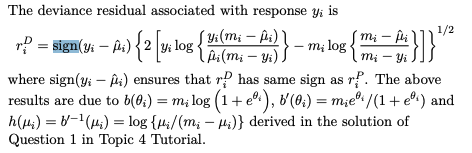
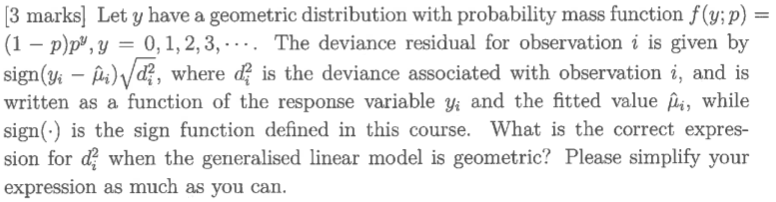
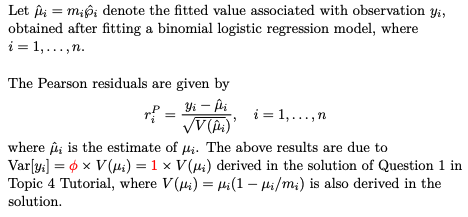
The deviance residual associated with response y; is = sign(yi - Pi) 1 2 : log yi(mi - Pi) l mi - li 1/2 - m; log LA(mi - yi) mi - yi where sign(yi - ;) ensures that ro 'has same sign as ". The above results are due to be;) = m; log ), b'(@ ) = me" /(1 + e) and h(m) = b'-(4) = log {m;/(m; -;)} derived in the solution of Question 1 in Topic 4 Tutorial.(3 marks| Let y have a geometric distribution with probability mass function f(y;p) = (1 -p)p,y = 0,1,2,3,---. The deviance residual for observation is given by sign(y; ,-)x/d_f, where d is the deviance associated with observation i, and is written as a function of the response variable y; and the fitted value f;, while sign(-) is the sign function defined in this course. What is the correct expres- sion for d> when the generalised linear model is geometric? Please simplify your expression as much as you can. Let [i; = m;p; denote the fitted value associated with observation ;, obtained after fitting a binomial logistic regression model, where i=1,...,n. The Pearson residuals are given by P Yi [ P, = T ) ! where [i; is the estimate of ;. The above results are due to Var[yi] = x V(i) = 1 % V() derived in the solution of Question 1 in Topic 4 Tutorial, where V() = pi(1 pi/m;) is also derived in the solution
Step by Step Solution
There are 3 Steps involved in it

Get step-by-step solutions from verified subject matter experts
 Study Help