







Question: This question is a compound true/false question with 6 questions. The answers to 3 of these are true and the answers to the other 3
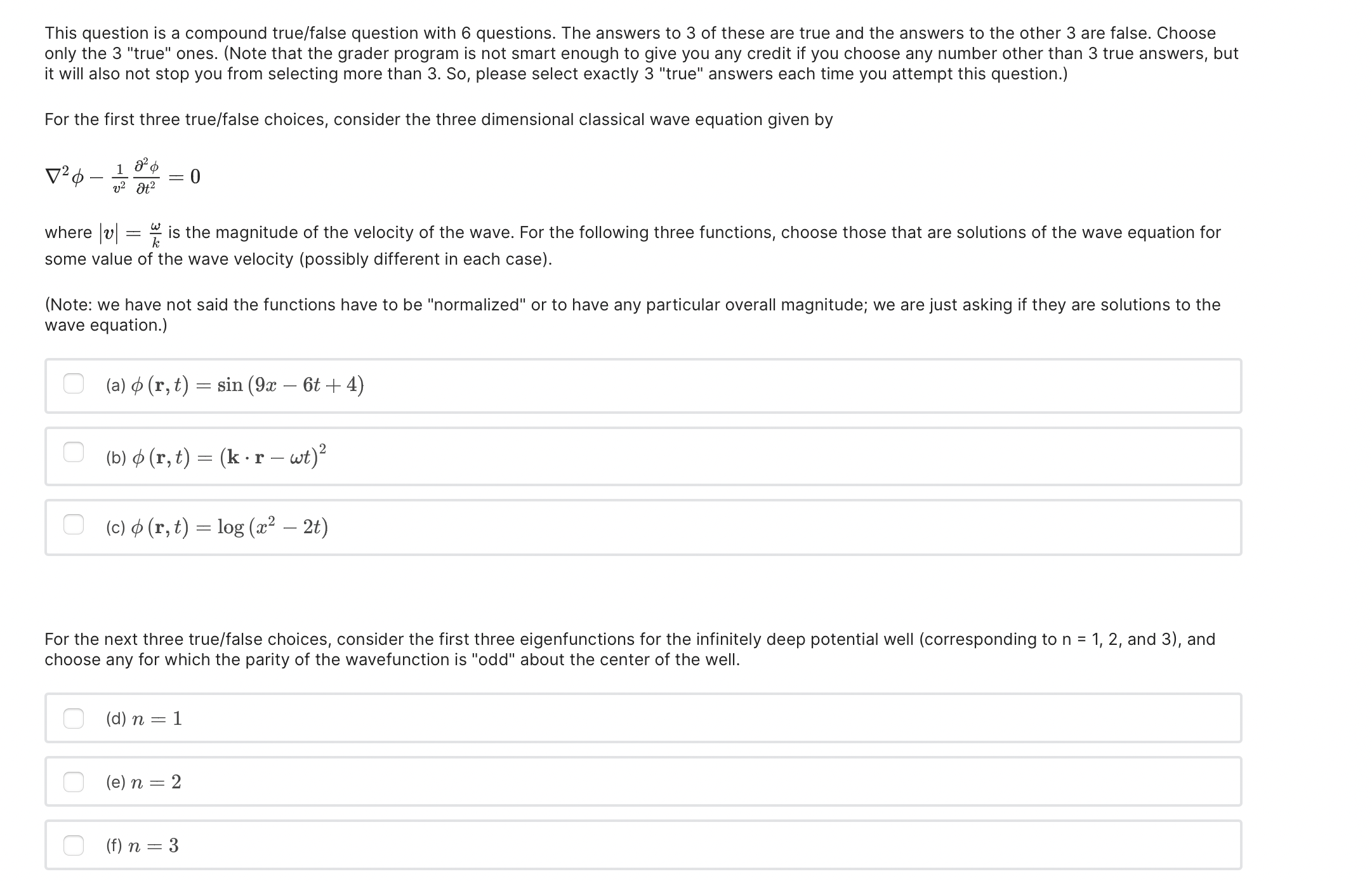
This question is a compound true/false question with 6 questions. The answers to 3 of these are true and the answers to the other 3 are false. Choose only the 3 "true" ones. (Note that the grader program is not smart enough to give you any credit if you choose any number other than 3 true answers, but it will also not stop you from selecting more than 3. So, please select exactly 3 "true" answers each time you attempt this question.) For the first three true/false choices, consider the three dimensional classical wave equation given by v2 vi2%=0 where |v| = % is the magnitude of the velocity of the wave. For the following three functions, choose those that are solutions of the wave equation for some value of the wave velocity (possibly different in each case). (Note: we have not said the functions have to be "normalized" or to have any particular overall magnitude; we are just asking if they are solutions to the wave equation.) (a) ()5 (r, t) = sin (9% 6t + 4) ib)(rat)=(k~Twt)2 (C)
This question is a compound true/false question with 6 questions. The answers to 3 of these are true and the answers to the other 3 are false. Choose only the 3 "true" ones. (Note that the grader program is not smart enough to give you any credit if you choose any number other than 3 true answers, but it will also not stop you from selecting more than 3. So, please select exactly 3 "true" answers each time you attempt this question.) For the first three true/false choices, consider the three dimensional classical wave equation given by 26- 1 a v t w k 0 where | | = 1 is the magnitude of the velocity of the wave. For the following three functions, choose those that are solutions of the wave equation for some value of the wave velocity (possibly different in each case). (Note: we have not said the functions have to be "normalized" or to have any particular overall magnitude; we are just asking if they are solutions to the wave equation.) (a) (r,t) = sin (9x 6t + 4) (b) (r,t) = (k r wt) (c) (r,t) = log (x - 2t) For the next three true/false choices, consider the first three eigenfunctions for the infinitely deep potential well (corresponding to n = 1, 2, and 3), and choose any for which the parity of the wavefunction is "odd" about the center of the well. (d) n = 1 (e) n = = 2 (f) n = 3
Step by Step Solution
There are 3 Steps involved in it
To determine which functions satisfy the threedimensional wave equation and which of the eigenfunctions have odd parity about the center of the well w... View full answer

Get step-by-step solutions from verified subject matter experts
 Study Help