







Question: This is the Reading Assignment (RA) based on the following article: Alipitta Paul l). {9009} Julian Simon and 1er I [mils 10 Growth N00 Mallhusianism
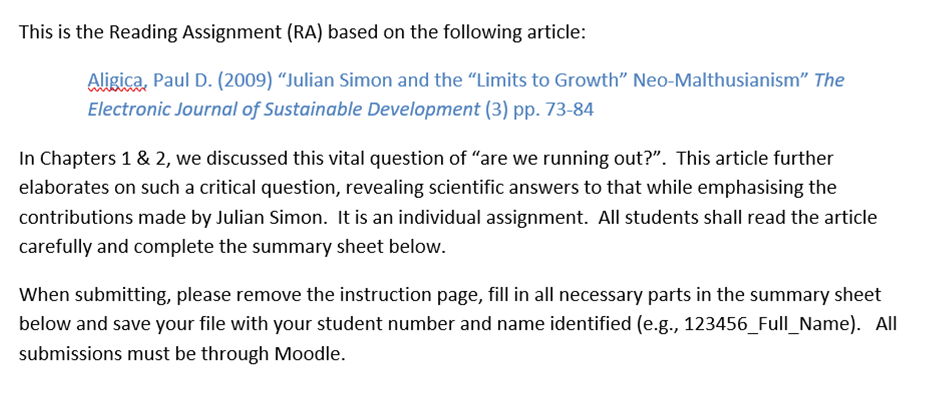
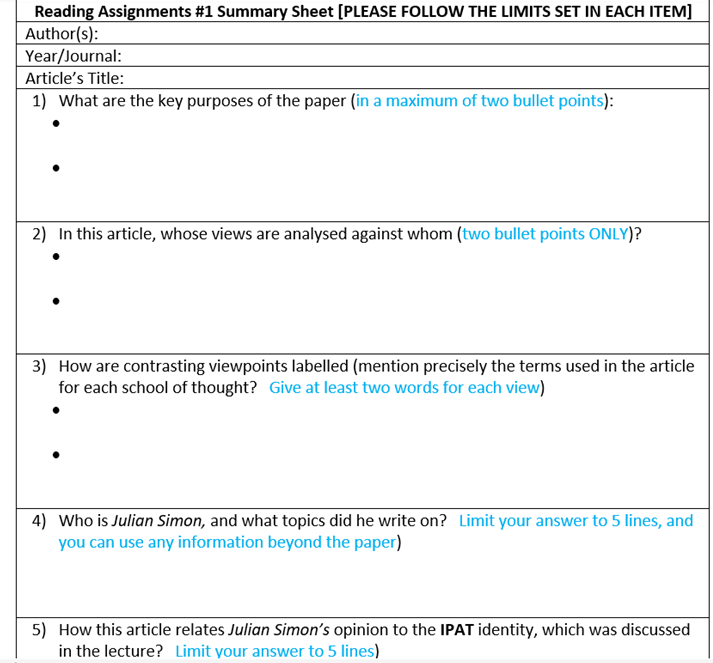
This is the Reading Assignment (RA) based on the following article: Alipitta Paul l). {9009} \"Julian Simon and 1er \"I [mils 10 Growth" N00 Mallhusianism" The Electronic Journal ofSustor'noble Development [3} pp. 13 8/1 In Chapters 1 & 2, we discussed this vital question of "are we running out?\". This article further elaborates on such a critical question, revealing scientific answers to that while emphasising the contributions made by Julian Simon. It is an individual assignment. All students shall read the article carefully and complete the summary sheet below. When submitting, please remove the instruction page, fill in all necessary parts in the summary sheet below and save your file with your student number and name identified (e.g., 123456_Fu||_Name). All submissions must be through Moodle. Reading Assignments #1 Summary Sheet [PLEASE FOLLOW THE LIMITS SET IN EACH ITEM] Author(s): Year/Journal: Article's Title: 1) What are the key purposes of the paper (in a maximum of two bullet points): 2) In this article, whose views are analysed against whom (two bullet points ONLY)? 3) How are contrasting viewpoints labelled (mention precisely the terms used in the article for each school of thought? Give at least two words for each view) 4) Who is Julian Simon, and what topics did he write on? Limit your answer to 5 lines, and you can use any information beyond the paper) 5) How this article relates Julian Simon's opinion to the IPAT identity, which was discussed in the lecture? Limit your answer to 5 lines)
Step by Step Solution
There are 3 Steps involved in it

Get step-by-step solutions from verified subject matter experts
 Study Help