



Question: This is the reply to the above article. In my opinion, Steve Jobs made the right decision when opting for a projectized organization structure for
This is the reply to the above article.
In my opinion, Steve Jobs made the right decision when opting for a projectized organization structure for his development teams. This structure allows the project team to focus only on the project and so they do not get distracted by other tasks unrelated to the project. Members of the project become thoroughly devoted to it that these projects can be completed more quickly, which is important because Apple products tend to revolutionize the market and the company must work fast to release their product before other companies do. Steve Jobs opted to give the Mac project team many benefits not given to other employees within the company. Many employees within the company not associated with the project would undoubtedly find such treatment unfair. However, if we were to look at this situation through Jobs point of view, it would be completely justified to give his project team special treatment. The Mac team comprises of the best talents within the company and are most suited to driving the project towards success. Steve Jobs needed to shower his team with these benefits to make them feel needed and appreciated as the task they are taking on would be monumental. He could not risk losing these talents to his competitors. Looking at it from the point of view of the employees not associated with the Mac team opens another can of worms. It is completely normal for an employee to feel unneeded when they see their peers receiving special treatment. From my personal experience, I have encountered many situations where my colleagues have received perks that were not offered to me. But when it comes to work and business, we must think of the bigger picture. Companies thrive off profit and certain means will inevitably be brought about to achieve that.
Question based on the reply to the article:
Did the reply provide enough explanation to help you understand their point(s) of view?
Did they provide strong evidence to support their viewpoint(s)?
What argument(s) or counter-argument(s) could you use to respond to their position(s)?
Does all this make sense together?
Have you ever considered the same views? Are you agreeable to their position(s)?
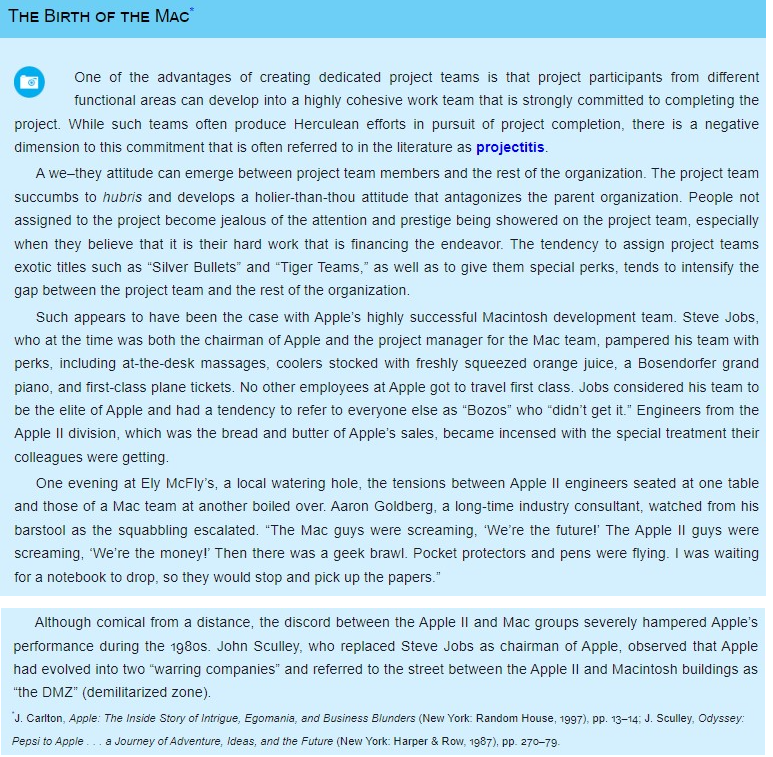
THE BIRTH OF THE MAC* One of the advantages of creating dedicated project teams is that project participants from different functional areas can develop into a highly cohesive work team that is strongly committed to completing the project. While such teams often produce Herculean efforts in pursuit of project completion, there is a negative dimension to this commitment that is often referred to in the literature as projectitis. A we-they attitude can emerge between project team members and the rest of the organization. The project team succumbs to hubris and develops a holier-than-thou attitude that antagonizes the parent organization. People not assigned to the project become jealous of the attention and prestige being showered on the project team, especially when they believe that it is their hard work that is financing the endeavor. The tendency to assign project teams exotic titles such as "Silver Bullets" and "Tiger Teams," as well as to give them special perks, tends to intensify the gap between the project team and the rest of the organization. Such appears to have been the case with Apple's highly successful Macintosh development team. Steve Jobs, who at the time was both the chairman of Apple and the project manager for the Mac team, pampered his team with perks, including at-the-desk massages, coolers stocked with freshly squeezed orange juice, a Bosendorfer grand piano, and first-class plane tickets. No other employees at Apple got to travel first class. Jobs considered his team to be the elite of Apple and had a tendency to refer to everyone else as "Bozos" who "didn't get it." Engineers from the Apple II division, which was the bread and butter of Apple's sales, became incensed with the special treatment their colleagues were getting. One evening at Ely McFly's, a local watering hole, the tensions between Apple II engineers seated at one table and those of a Mac team at another boiled over. Aaron Goldberg, a long-time industry consultant, watched from his barstool as the squabbling escalated. "The Mac guys were screaming, 'We're the future!' The Apple II guys were screaming, 'We're the money!' Then there was a geek brawl. Pocket protectors and pens were flying. I was waiting for a notebook to drop, so they would stop and pick up the papers." Although comical from a distance, the discord between the Apple II and Mac groups severely hampered Apple's performance during the 1980 s. John Sculley, who replaced Steve Jobs as chairman of Apple, observed that Apple had evolved into two "warring companies" and referred to the street between the Apple II and Macintosh buildings as "the DMZ" (demilitarized zone). 'J. Carlton, Apple: The Inside Story of Intrigue, Egomania, and Business Blunders (New York: Random House, 1997), pp. 13-14; J. Sculley, Odyssey: Pepsi to Apple... a Journey of Adventure, Ideas, and the Future (New York: Harper \& Row, 1987), pp. 270-79Step by Step Solution
There are 3 Steps involved in it

Get step-by-step solutions from verified subject matter experts