







Question: This is the solution for the lab. You will need it to solve this homework. clear clc f=@(t,P)P-(P*P)/12-4; h=.01; t=0:h:10; P=zeros(size(t)); P(1)=20; for i=2:length(P) P(i)=P(i-1)+h*(f(t(i-1),P(i-1)));
This is the solution for the lab. You will need it to solve this homework.
clear clc f=@(t,P)P-(P*P)/12-4; h=.01; t=0:h:10; P=zeros(size(t)); P(1)=20; for i=2:length(P) P(i)=P(i-1)+h*(f(t(i-1),P(i-1))); end Neg=find(P
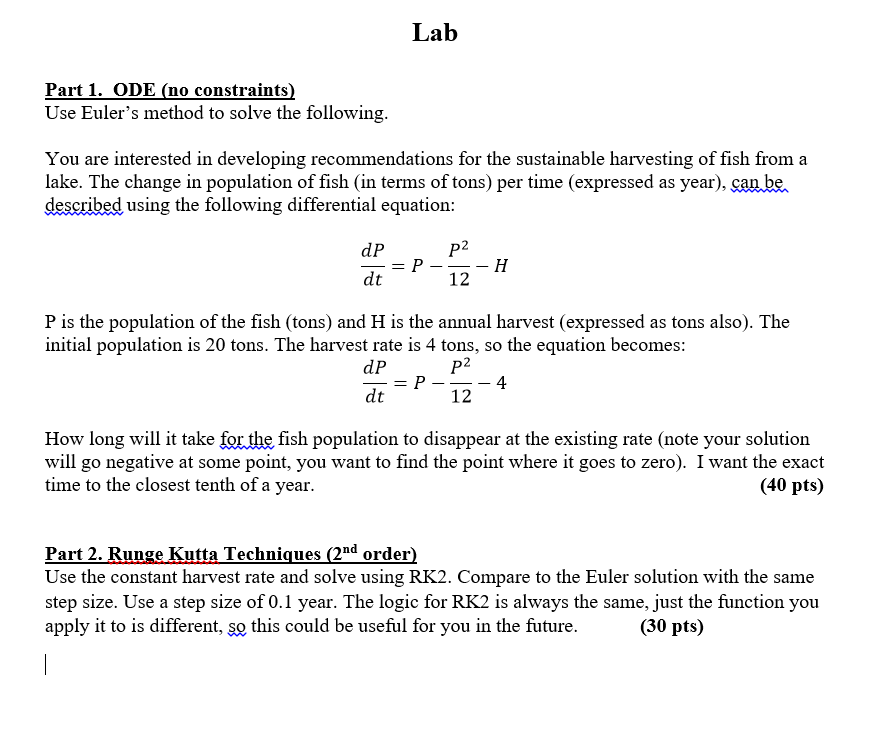
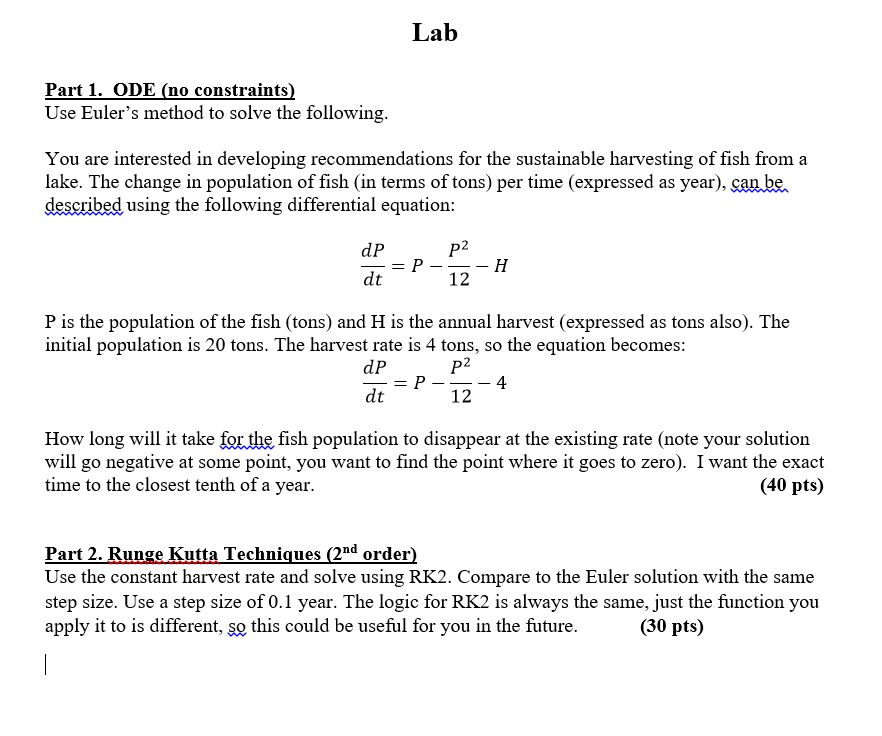
Lab Part 1. ODE (no constraints Use Euler's method to solve the following You are interested in developing recommendations for the sustainable harvesting of fish from a lake. The change in population of fish (in terms of tons) per time (expressed as year), san be described using the following differential equation dP 12 P is the population of the fish (tons) and H is the annual harvest (expressed as tons also). The initial population is 20 tons. The harvest rate is 4 tons, so the equation become:s dP dt 4 12 How long will it take for the fish population to disappear at the existing rate (note your solution will go negative at some point, you want to find the point where it goes to zero). I want the exact time to the closest tenth of a vear (40 pts) Part 2. Runge Kutta Techniaues (2nd order Use the constant harvest rate and solve using RK2. Compare to the Euler solution with the same step size. Use a step size of 0.1 year. The logic for RK2 is always the same, just the function you apply it to is different, so this could be useful for you in the future. (30 pts) Lab Part 1. ODE (no constraints Use Euler's method to solve the following You are interested in developing recommendations for the sustainable harvesting of fish from a lake. The change in population of fish (in terms of tons) per time (expressed as year), san be described using the following differential equation dP 12 P is the population of the fish (tons) and H is the annual harvest (expressed as tons also). The initial population is 20 tons. The harvest rate is 4 tons, so the equation become:s dP dt 4 12 How long will it take for the fish population to disappear at the existing rate (note your solution will go negative at some point, you want to find the point where it goes to zero). I want the exact time to the closest tenth of a vear (40 pts) Part 2. Runge Kutta Techniaues (2nd order Use the constant harvest rate and solve using RK2. Compare to the Euler solution with the same step size. Use a step size of 0.1 year. The logic for RK2 is always the same, just the function you apply it to is different, so this could be useful for you in the future. (30 pts)
Step by Step Solution
There are 3 Steps involved in it

Get step-by-step solutions from verified subject matter experts
 Study Help