







Question: This is the task: Implement theGraphMST()function inGraph.cwhich takes in a graph and returns a minimum spanning tree of the graph as a new graph. If
This is the task:
Implement theGraphMST()function inGraph.cwhich takes in a graph and returns a minimum spanning tree of the graph as a new graph. If the given graph has no minimum spanning tree, the function should return NULL. If the graph has multiple minimum spanning trees, you can return any of them.
You may use any minimum spanning tree algorithm you like. You can (and are encouraged to) make use of the priority queue ADT that we've supplied.
I'm not sure how to start and do what it says. This is Graph.c and I attached the #include .h files :
//ImplementationoftheUndirectedWeightedGraphADT
//Usesanadjacencymatrix
#include
#include
#include
#include
#include"Graph.h"
#include"PQ.h"
structgraph{
intnV;//#vertices
intnE;//#edges
double**edges;//adjacencymatrixstoringpositiveweights
//0ifnodesnotadjacent
};
staticbooldoHasCycle(Graphg,Vertexv,Vertexprev,bool*visited);
staticintvalidVertex(Graphg,Vertexv);
////////////////////////////////////////////////////////////////////////
GraphGraphNew(intnV){
assert(nV>0);
Graphg=malloc(sizeof(*g));
if(g==NULL){
fprintf(stderr,"error:outofmemory ");
exit(EXIT_FAILURE);
}
g->nV=nV;
g->nE=0;
g->edges=malloc(nV*sizeof(double*));
if(g->edges==NULL){
fprintf(stderr,"error:outofmemory ");
exit(EXIT_FAILURE);
}
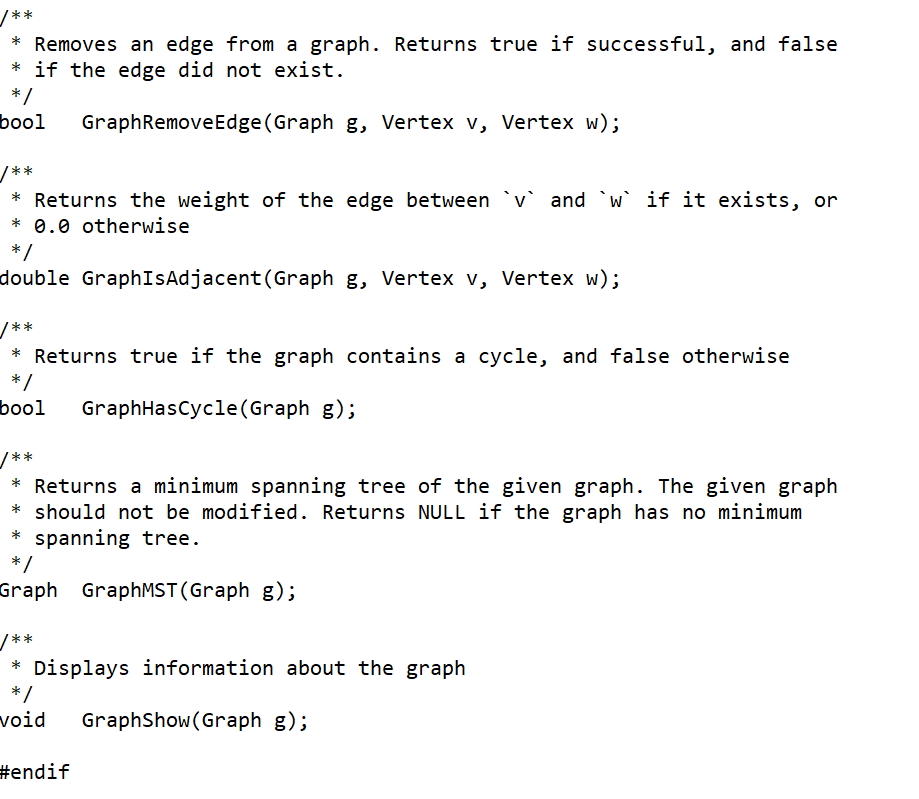
for(inti=0;i g->edges[i]=calloc(nV,sizeof(double)); if(g->edges[i]==NULL){ fprintf(stderr,"error:outofmemory "); exit(EXIT_FAILURE); } } returng; } voidGraphFree(Graphg){ for(inti=0;i free(g->edges[i]); } free(g->edges); free(g); } //////////////////////////////////////////////////////////////////////// intGraphNumVertices(Graphg){ returng->nV; } boolGraphInsertEdge(Graphg,Edgee){ assert(validVertex(g,e.v)); assert(validVertex(g,e.w)); assert(e.v!=e.w); assert(e.weight>0.0); if(g->edges[e.v][e.w]==0.0){ g->edges[e.v][e.w]=e.weight; g->edges[e.w][e.v]=e.weight; g->nE++; returntrue; }else{ returnfalse; } } boolGraphRemoveEdge(Graphg,Vertexv,Vertexw){ assert(validVertex(g,v)); assert(validVertex(g,w)); if(g->edges[v][w]!=0.0){//edgeeingraph g->edges[v][w]=0.0; g->edges[w][v]=0.0; g->nE--; returntrue; }else{ returnfalse; } } doubleGraphIsAdjacent(Graphg,Vertexv,Vertexw){ assert(validVertex(g,v)); assert(validVertex(g,w)); returng->edges[v][w]; } voidGraphShow(Graphg){ printf("Numberofvertices:%d ",g->nV); printf("Numberofedges:%d ",g->nE); for(intv=0;v for(intw=v+1;w if(g->edges[v][w]!=0.0){ printf("Edge%d-%d:%lf ",v,w,g->edges[v][w]); } } } } boolGraphHasCycle(Graphg){ bool*visited=calloc(g->nV,sizeof(bool)); assert(visited!=NULL);//lazyerrorchecking for(intv=0;v if(!visited[v]&&doHasCycle(g,v,v,visited)){ free(visited); returntrue; } } free(visited); returnfalse; } staticbooldoHasCycle(Graphg,Vertexv,Vertexprev,bool*visited){ visited[v]=true; for(intw=0;w if(g->edges[v][w]!=0.0){ if(!visited[w]){ if(doHasCycle(g,w,v,visited)){ returntrue; } }elseif(w!=prev){ returntrue; } } } returnfalse; } GraphGraphMST(Graphg){ returng; } staticintvalidVertex(Graphg,Vertexv){ returnv>=0&&v } ----------------------------------------------------------------------------------------------------------------------------------------------------------- PQ.h: //Priorityqueueofedges //Edgeswithsmallerweighthavehigherpriority #ifndefPQ_H #definePQ_H #include #include"Graph.h" typedefstructPQRep*PQ; /** *Createsanewpriorityqueue *Complexity:O(1) */ PQPQNew(void); /** *Freesallmemoryassociatedwiththegivenpriorityqueue *Complexity:O(1) */ voidPQFree(PQpq); /** *Addsanedgetothepriorityqueue *Averagecomplexity:O(logn) */ voidPQInsert(PQpq,Edgee); /** *Removesandreturnstheedgewiththesmallestweightfromthe *priorityqueue.Ifmultipleedgeshavethesamesmallestweight,one *ofthemwillberemoved. *Complexity:O(logn) */ EdgePQExtract(PQpq); /** *Returnstrueifthegivenpriorityqueueisempty,orfalseotherwise *Complexity:O(1) */ boolPQIsEmpty(PQpq); /** *Printsthegivenpriorityqueuetostdoutfordebuggingpurposes */ voidPQShow(PQpq); #endif ------------------------------------------------------------------------------------------------------------------------------------------------------------------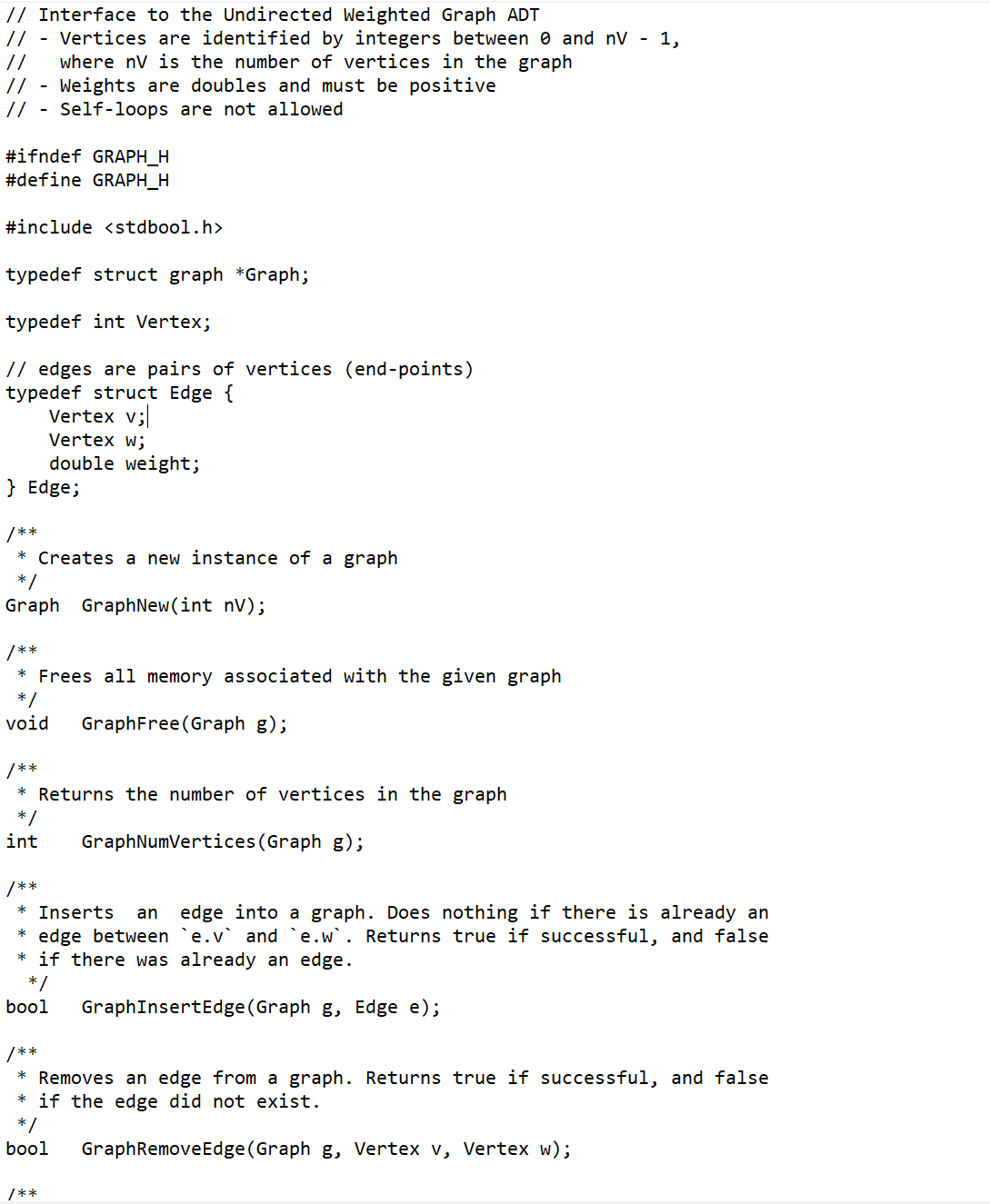
Step by Step Solution
There are 3 Steps involved in it

Get step-by-step solutions from verified subject matter experts
 Study Help