







Question: this is the whole Case Study there are 3 questions we need to Answer for each and I need total Words limit around 2000 words
this is the whole Case Study
there are 3 questions we need to Answer for each and I need total Words limit around 2000 words with headings and good explanation for Answers

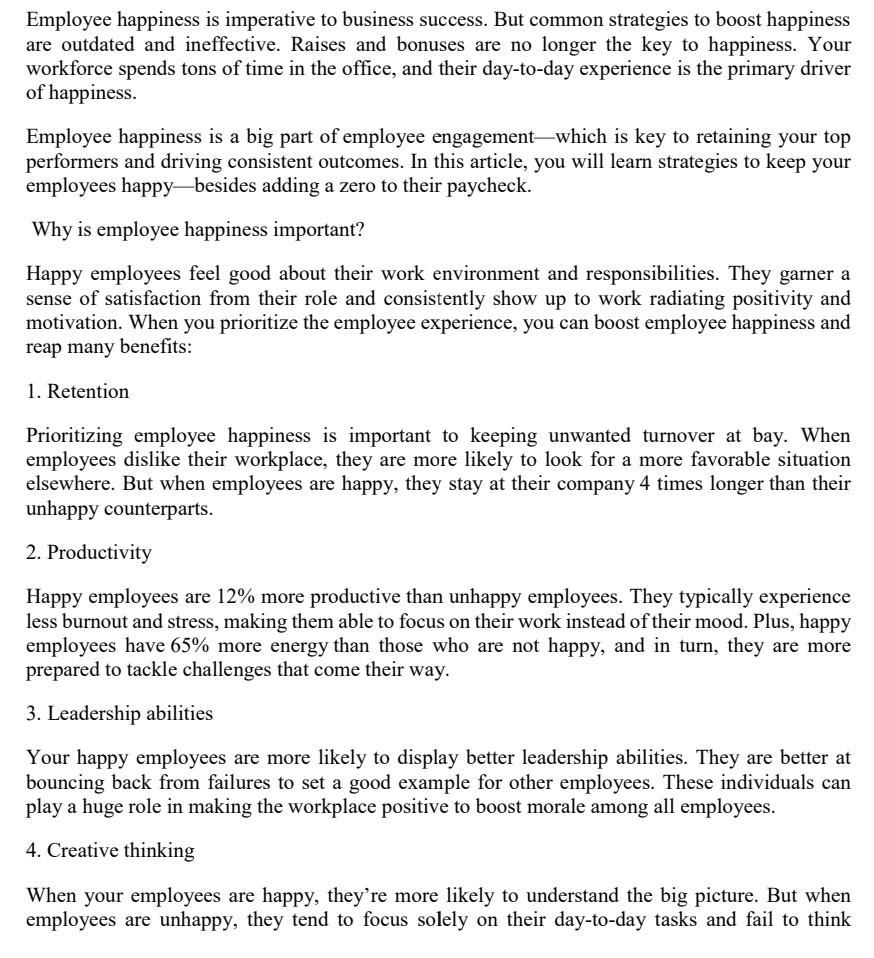
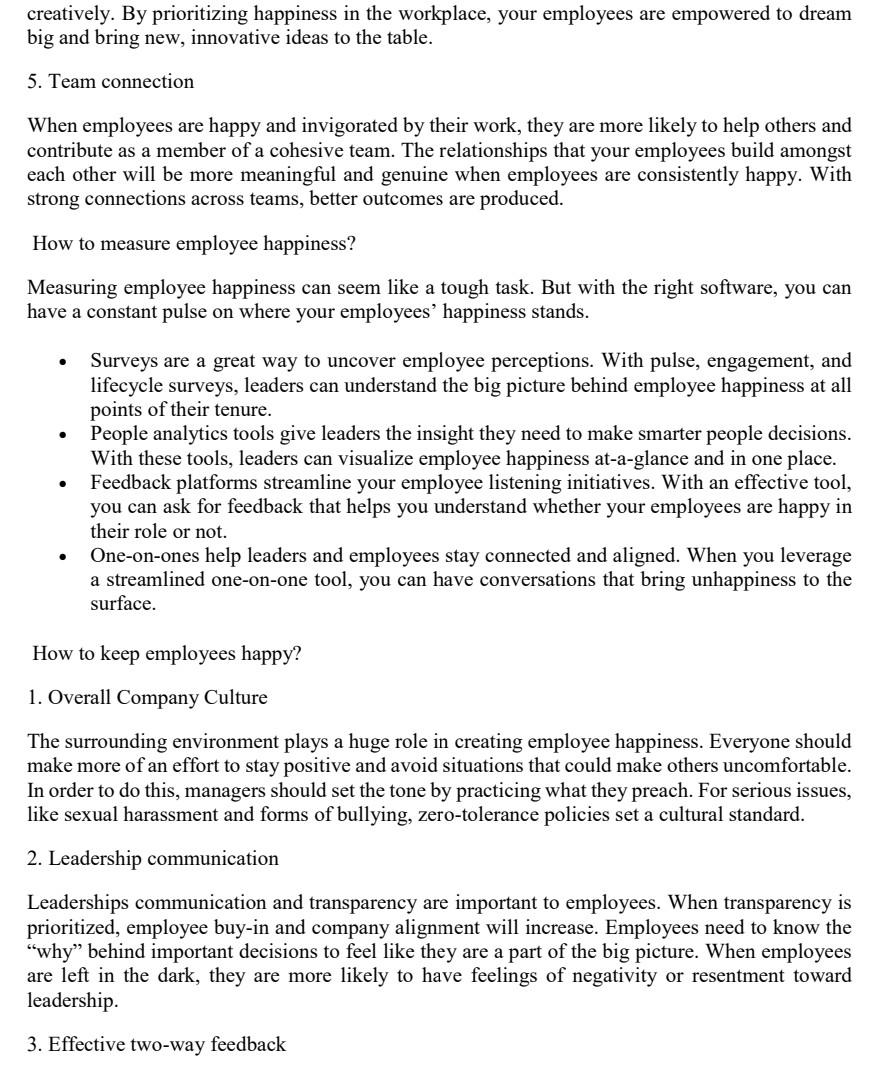
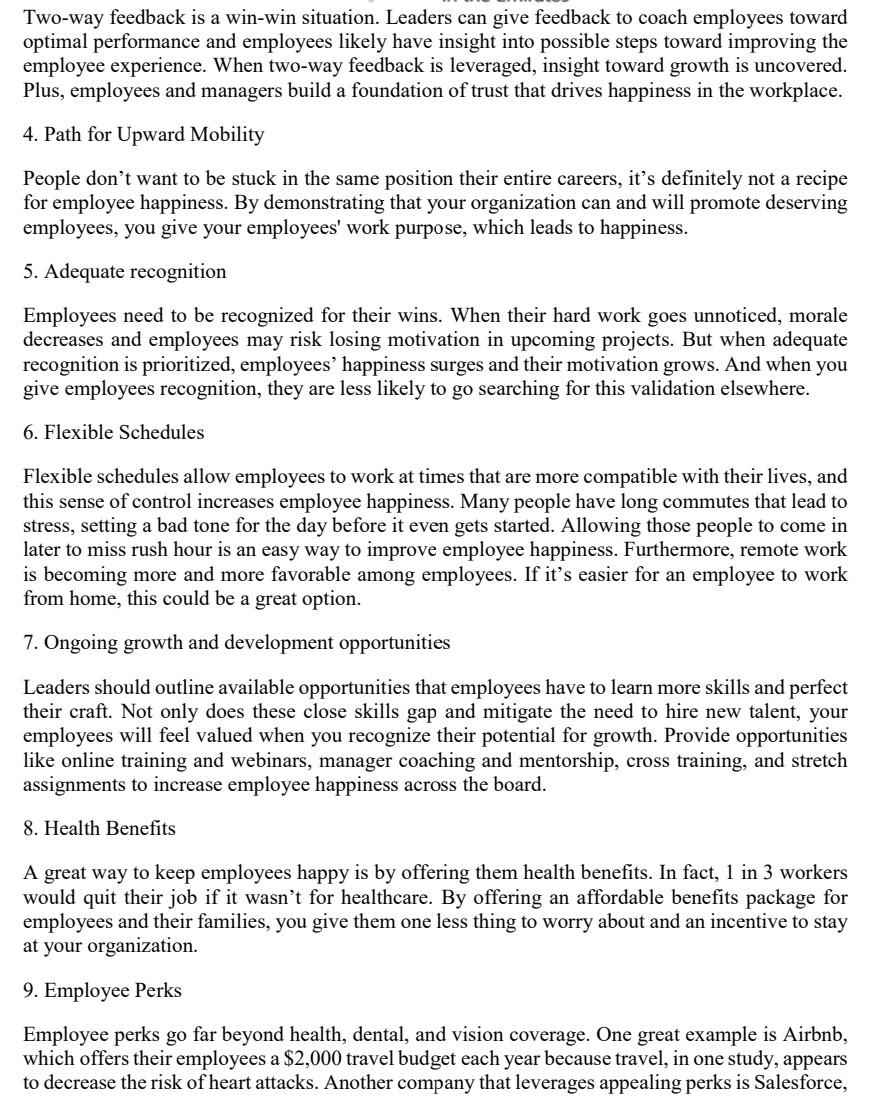
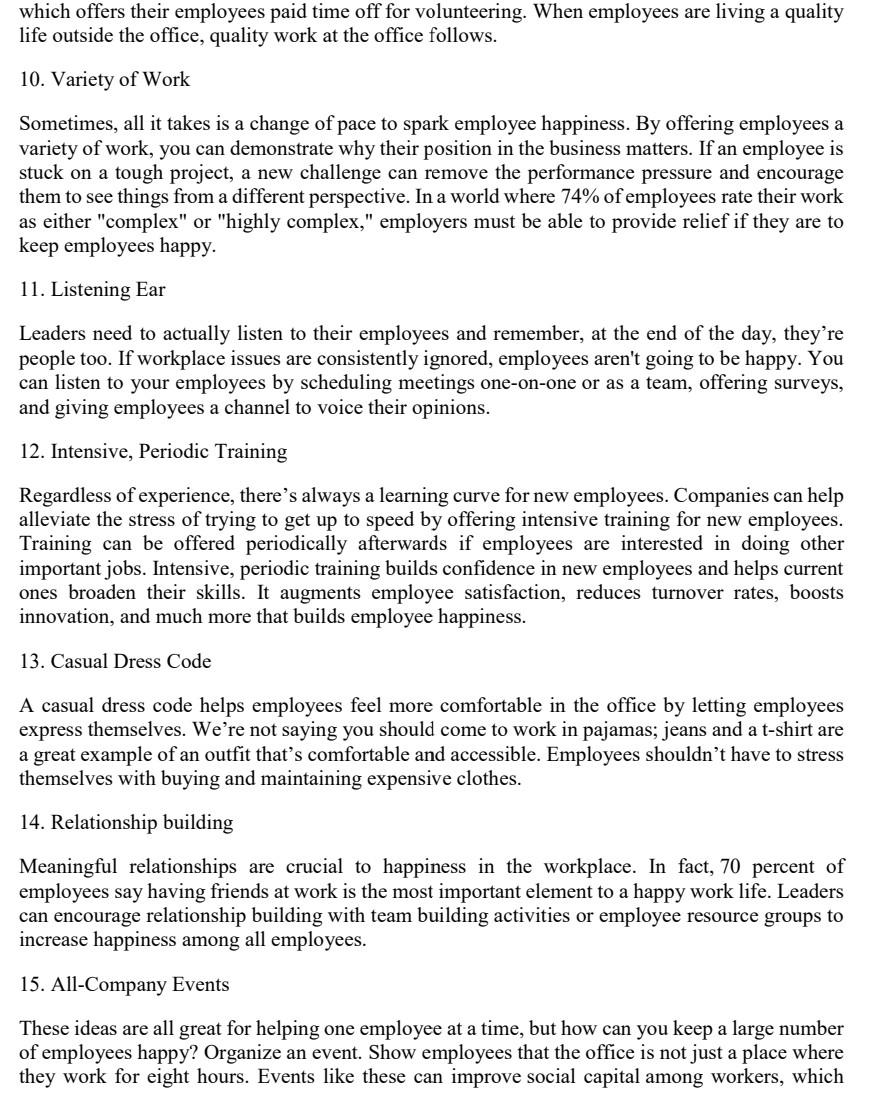
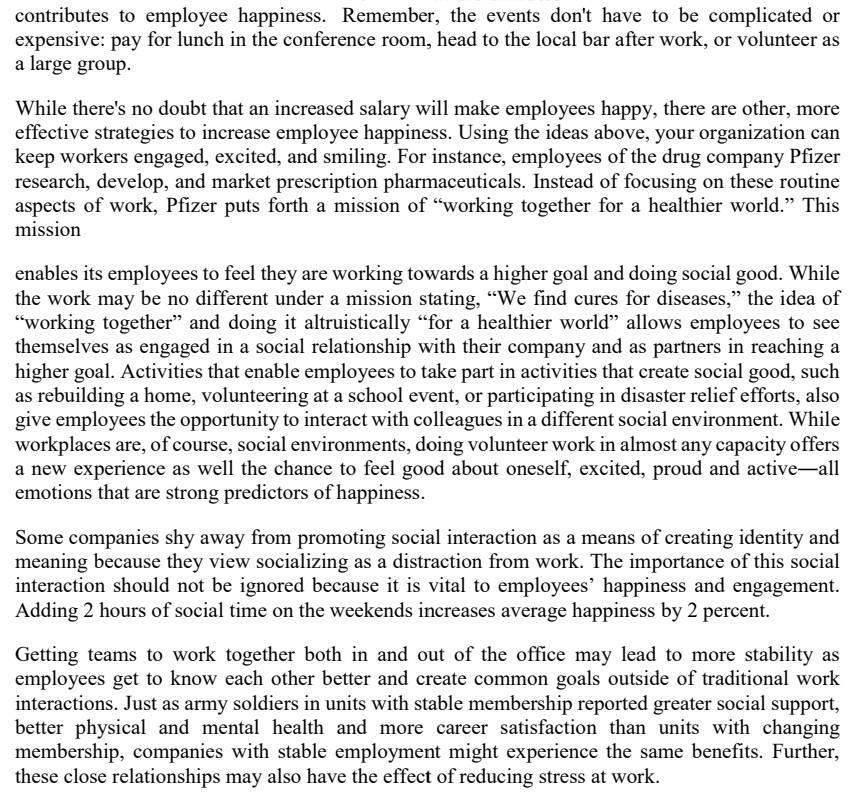
Employee happiness is imperative to business success. But common strategies to boost happiness are outdated and ineffective. Raises and bonuses are no longer the key to happiness. Your workforce spends tons of time in the office, and their day-to-day experience is the primary driver of happiness. Employee happiness is a big part of employee engagement-which is key to retaining your top performers and driving consistent outcomes. In this article, you will learn strategies to keep your employees happy - besides adding a zero to their paycheck. Why is employee happiness important? Happy employees feel good about their work environment and responsibilities. They garner a sense of satisfaction from their role and consistently show up to work radiating positivity and motivation. When you prioritize the employee experience, you can boost employee happiness and reap many benefits: 1. Retention Prioritizing employee happiness is important to keeping unwanted turnover at bay. When employees dislike their workplace, they are more likely to look for a more favorable situation elsewhere. But when employees are happy, they stay at their company 4 times longer than their unhappy counterparts. 2. Productivity Happy employees are 12% more productive than unhappy employees. They typically experience less burnout and stress, making them able to focus on their work instead of their mood. Plus, happy employees have 65% more energy than those who are not happy, and in turn, they are more prepared to tackle challenges that come their way. 3. Leadership abilities Your happy employees are more likely to display better leadership abilities. They are better at bouncing back from failures to set a good example for other employees. These individuals can play a huge role in making the workplace positive to boost morale among all employees. 4. Creative thinking When your employees are happy, they're more likely to understand the big picture. But when employees are unhappy, they tend to focus solely on their day-to-day tasks and fail to think creatively. By prioritizing happiness in the workplace, your employees are empowered to dream big and bring new, innovative ideas to the table. 5. Team connection When employees are happy and invigorated by their work, they are more likely to help others and contribute as a member of a cohesive team. The relationships that your employees build amongst each other will be more meaningful and genuine when employees are consistently happy. With strong connections across teams, better outcomes are produced. How to measure employee happiness? Measuring employee happiness can seem like a tough task. But with the right software, you can have a constant pulse on where your employees' happiness stands. - Surveys are a great way to uncover employee perceptions. With pulse, engagement, and lifecycle surveys, leaders can understand the big picture behind employee happiness at all points of their tenure. - People analytics tools give leaders the insight they need to make smarter people decisions. With these tools, leaders can visualize employee happiness at-a-glance and in one place. - Feedback platforms streamline your employee listening initiatives. With an effective tool, you can ask for feedback that helps you understand whether your employees are happy in their role or not. - One-on-ones help leaders and employees stay connected and aligned. When you leverage a streamlined one-on-one tool, you can have conversations that bring unhappiness to the surface. How to keep employees happy? 1. Overall Company Culture The surrounding environment plays a huge role in creating employee happiness. Everyone should make more of an effort to stay positive and avoid situations that could make others uncomfortable. In order to do this, managers should set the tone by practicing what they preach. For serious issues, like sexual harassment and forms of bullying, zero-tolerance policies set a cultural standard. 2. Leadership communication Leaderships communication and transparency are important to employees. When transparency is prioritized, employee buy-in and company alignment will increase. Employees need to know the "why" behind important decisions to feel like they are a part of the big picture. When employees are left in the dark, they are more likely to have feelings of negativity or resentment toward leadership. 3. Effective two-way feedback Two-way feedback is a win-win situation. Leaders can give feedback to coach employees toward optimal performance and employees likely have insight into possible steps toward improving the employee experience. When two-way feedback is leveraged, insight toward growth is uncovered. Plus, employees and managers build a foundation of trust that drives happiness in the workplace. 4. Path for Upward Mobility People don't want to be stuck in the same position their entire careers, it's definitely not a recipe for employee happiness. By demonstrating that your organization can and will promote deserving employees, you give your employees' work purpose, which leads to happiness. 5. Adequate recognition Employees need to be recognized for their wins. When their hard work goes unnoticed, morale decreases and employees may risk losing motivation in upcoming projects. But when adequate recognition is prioritized, employees' happiness surges and their motivation grows. And when you give employees recognition, they are less likely to go searching for this validation elsewhere. 6. Flexible Schedules Flexible schedules allow employees to work at times that are more compatible with their lives, and this sense of control increases employee happiness. Many people have long commutes that lead to stress, setting a bad tone for the day before it even gets started. Allowing those people to come in later to miss rush hour is an easy way to improve employee happiness. Furthermore, remote work is becoming more and more favorable among employees. If it's easier for an employee to work from home, this could be a great option. 7. Ongoing growth and development opportunities Leaders should outline available opportunities that employees have to learn more skills and perfect their craft. Not only does these close skills gap and mitigate the need to hire new talent, your employees will feel valued when you recognize their potential for growth. Provide opportunities like online training and webinars, manager coaching and mentorship, cross training, and stretch assignments to increase employee happiness across the board. 8. Health Benefits A great way to keep employees happy is by offering them health benefits. In fact, 1 in 3 workers would quit their job if it wasn't for healthcare. By offering an affordable benefits package for employees and their families, you give them one less thing to worry about and an incentive to stay at your organization. 9. Employee Perks Employee perks go far beyond health, dental, and vision coverage. One great example is Airbnb, which offers their employees a $2,000 travel budget each year because travel, in one study, appears to decrease the risk of heart attacks. Another company that leverages appealing perks is Salesforce, which offers their employees paid time off for volunteering. When employees are living a quality life outside the office, quality work at the office follows. 10. Variety of Work Sometimes, all it takes is a change of pace to spark employee happiness. By offering employees a variety of work, you can demonstrate why their position in the business matters. If an employee is stuck on a tough project, a new challenge can remove the performance pressure and encourage them to see things from a different perspective. In a world where 74% of employees rate their work as either "complex" or "highly complex," employers must be able to provide relief if they are to keep employees happy. 11. Listening Ear Leaders need to actually listen to their employees and remember, at the end of the day, they're people too. If workplace issues are consistently ignored, employees aren't going to be happy. You can listen to your employees by scheduling meetings one-on-one or as a team, offering surveys, and giving employees a channel to voice their opinions. 12. Intensive, Periodic Training Regardless of experience, there's always a learning curve for new employees. Companies can help alleviate the stress of trying to get up to speed by offering intensive training for new employees. Training can be offered periodically afterwards if employees are interested in doing other important jobs. Intensive, periodic training builds confidence in new employees and helps current ones broaden their skills. It augments employee satisfaction, reduces turnover rates, boosts innovation, and much more that builds employee happiness. 13. Casual Dress Code A casual dress code helps employees feel more comfortable in the office by letting employees express themselves. We're not saying you should come to work in pajamas; jeans and a t-shirt are a great example of an outfit that's comfortable and accessible. Employees shouldn't have to stress themselves with buying and maintaining expensive clothes. 14. Relationship building Meaningful relationships are crucial to happiness in the workplace. In fact, 70 percent of employees say having friends at work is the most important element to a happy work life. Leaders can encourage relationship building with team building activities or employee resource groups to increase happiness among all employees. 15. All-Company Events These ideas are all great for helping one employee at a time, but how can you keep a large number of employees happy? Organize an event. Show employees that the office is not just a place where they work for eight hours. Events like these can improve social capital among workers, which contributes to employee happiness. Remember, the events don't have to be complicated or expensive: pay for lunch in the conference room, head to the local bar after work, or volunteer as a large group. While there's no doubt that an increased salary will make employees happy, there are other, more effective strategies to increase employee happiness. Using the ideas above, your organization can keep workers engaged, excited, and smiling. For instance, employees of the drug company Pfizer research, develop, and market prescription pharmaceuticals. Instead of focusing on these routine aspects of work, Pfizer puts forth a mission of "working together for a healthier world." This mission enables its employees to feel they are working towards a higher goal and doing social good. While the work may be no different under a mission stating, "We find cures for diseases," the idea of "working together" and doing it altruistically "for a healthier world" allows employees to see themselves as engaged in a social relationship with their company and as partners in reaching a higher goal. Activities that enable employees to take part in activities that create social good, such as rebuilding a home, volunteering at a school event, or participating in disaster relief efforts, also give employees the opportunity to interact with colleagues in a different social environment. While workplaces are, of course, social environments, doing volunteer work in almost any capacity offers a new experience as well the chance to feel good about oneself, excited, proud and active-all emotions that are strong predictors of happiness. Some companies shy away from promoting social interaction as a means of creating identity and meaning because they view socializing as a distraction from work. The importance of this social interaction should not be ignored because it is vital to employees' happiness and engagement. Adding 2 hours of social time on the weekends increases average happiness by 2 percent. Getting teams to work together both in and out of the office may lead to more stability as employees get to know each other better and create common goals outside of traditional work interactions. Just as army soldiers in units with stable membership reported greater social support, better physical and mental health and more career satisfaction than units with changing membership, companies with stable employment might experience the same benefits. Further, these close relationships may also have the effect of reducing stress at work. Q 1. What are the goals of companies that make their employees happy? Explain how these goals help in spreading happiness among its employees and all over the world. Q 2. Through some companies' model in the article, how do you prove that make employees happy? USE explanation from motivations theory. Q 3. Pfizer puts forth a mission of "working together for a healthier world.". Explain Pfizer strategies with the worker to increase happiness, and use an evidence to support your answers
Step by Step Solution
There are 3 Steps involved in it
1 Expert Approved Answer
Step: 1 Unlock

Question Has Been Solved by an Expert!
Get step-by-step solutions from verified subject matter experts
Step: 2 Unlock
Step: 3 Unlock
 Study Help