



Question: This is the whole question and it is from Numerical Computing textbook. The growth of populations of organisms has many engineering and scientific applications. One
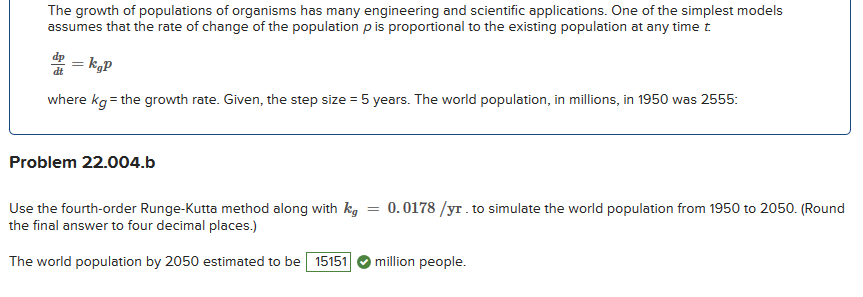
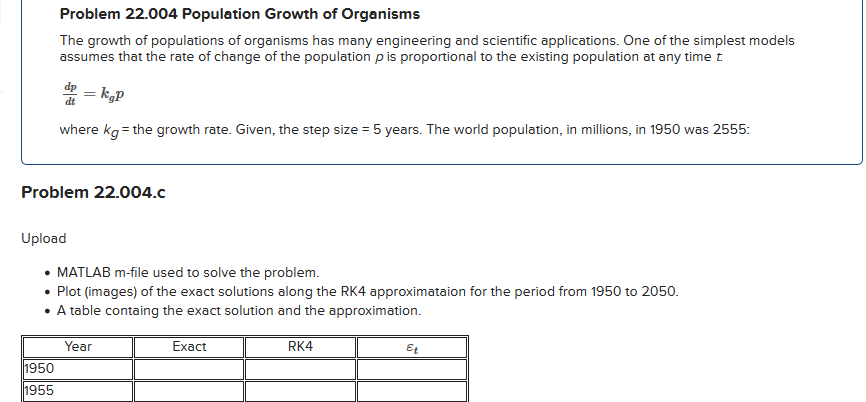
The growth of populations of organisms has many engineering and scientific applications. One of the simplest models assumes that the rate of change of the population pis proportional to the existing population at any time t kgP dt where kg = the growth rate. Given the step size = 5 years. The world population, in millions, in 1950 was 2555: Problem 22.004.b Use the fourth-order Runge-Kutta method along with kg the final answer to four decimal places.) 0.0178 /yr. to simulate the world population from 1950 to 2050. (Round The world population by 2050 estimated to be 15151 million people. Problem 22.004 Population Growth of Organisms The growth of populations of organisms has many engineering and scientific applications. One of the simplest models assumes that the rate of change of the population p is proportional to the existing population at any time t = kgP where kg=the growth rate. Given, the step size = 5 years. The world population, in millions, in 1950 was 2555: Problem 22.004.c Upload MATLAB m-file used to solve the problem. Plot (images) of the exact solutions along the RK4 approximataion for the period from 1950 to 2050. A table containg the exact solution and the approximation. . Year Exact RK4 Et |1950 |1955 The growth of populations of organisms has many engineering and scientific applications. One of the simplest models assumes that the rate of change of the population pis proportional to the existing population at any time t kgP dt where kg = the growth rate. Given the step size = 5 years. The world population, in millions, in 1950 was 2555: Problem 22.004.b Use the fourth-order Runge-Kutta method along with kg the final answer to four decimal places.) 0.0178 /yr. to simulate the world population from 1950 to 2050. (Round The world population by 2050 estimated to be 15151 million people. Problem 22.004 Population Growth of Organisms The growth of populations of organisms has many engineering and scientific applications. One of the simplest models assumes that the rate of change of the population p is proportional to the existing population at any time t = kgP where kg=the growth rate. Given, the step size = 5 years. The world population, in millions, in 1950 was 2555: Problem 22.004.c Upload MATLAB m-file used to solve the problem. Plot (images) of the exact solutions along the RK4 approximataion for the period from 1950 to 2050. A table containg the exact solution and the approximation. . Year Exact RK4 Et |1950 |1955
Step by Step Solution
There are 3 Steps involved in it

Get step-by-step solutions from verified subject matter experts