







Question: This is to be all done in java. print out the game score after each point, and display which player wins each game, set and
This is to be all done in java.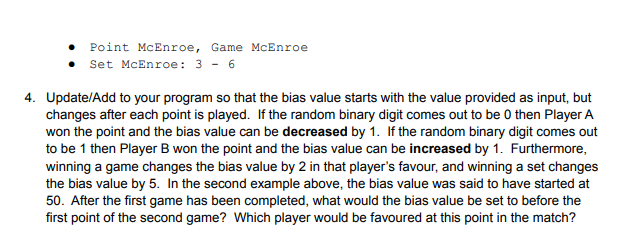
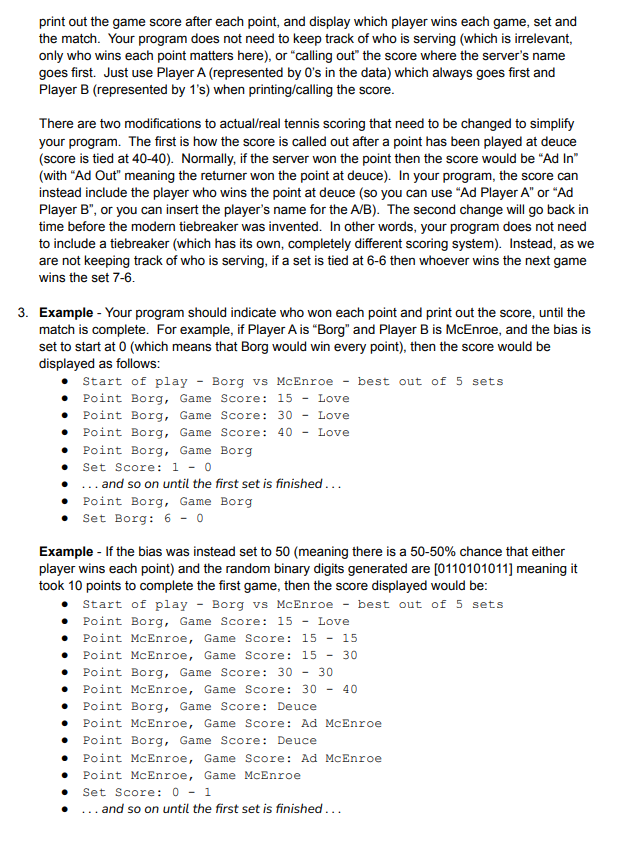
print out the game score after each point, and display which player wins each game, set and the match. Your program does not need to keep track of who is serving (which is irrelevant, only who wins each point matters here), or "calling out the score where the server's name goes first. Just use Player A (represented by O's in the data) which always goes first and Player B (represented by 1's) when printing/calling the score. There are two modifications to actual/real tennis scoring that need to be changed to simplify your program. The first is how the score is called out after a point has been played at deuce (score is tied at 40-40). Normally, if the server won the point then the score would be "Ad In" (with "Ad Out" meaning the returner won the point at deuce). In your program, the score can instead include the player who wins the point at deuce (so you can use "Ad Player A" or "Ad Player B", or you can insert the player's name for the A/B). The second change will go back in time before the modern tiebreaker was invented. In other words, your program does not need to include a tiebreaker (which has its own, completely different scoring system). Instead, as we are not keeping track of who is serving, if a set is tied at 6-6 then whoever wins the next game wins the set 7-6. 3. Example - Your program should indicate who won each point and print out the score, until the match is complete. For example, if Player A is Borg" and Player B is McEnroe, and the bias is set to start at 0 (which means that Borg would win every point), then the score would be displayed as follows: Start of play - Borg vs McEnroe - best out of 5 sets Point Borg, Game Score: 15 - Love Point Borg, Game Score: 30 Point Borg, Game Score: 40 Point Borg, Game Borg Set Score: 1 - 0 ... and so on until the first set is finished... Point Borg, Game Borg Set Borg: 6-0 Love Love . . Example - If the bias was instead set to 50 (meaning there is a 50-50% chance that either player wins each point) and the random binary digits generated are [0110101011] meaning it took 10 points to complete the first game, then the score displayed would be: Start of play Borg vs McEnroe - best out of 5 sets Point Borg, Game Score: 15 Love Point McEnroe, Game Score: 15 - 15 Point McEnroe, Game Score: 15 - 30 Point Borg, Game Score: 30 - 30 Point McEnroe, Game Score: 30 - 40 Point Borg, Game Score: Deuce Point McEnroe, Game Score: Ad McEnroe Point Borg, Game Score: Deuce Point McEnroe, Game Score: Ad McEnroe Point McEnroe, Game McEnroe Set Score: 0 - 1 ... and so on until the first set is finished... Point McEnroe, Game McEnroe Set McEnroe: 3 - 6 4. Update/Add to your program so that the bias value starts with the value provided as input, but changes after each point is played. If the random binary digit comes out to be then Player A won the point and the bias value can be decreased by 1. If the random binary digit comes out to be 1 then Player B won the point and the bias value can be increased by 1. Furthermore, winning a game changes the bias value by 2 in that player's favour, and winning a set changes the bias value by 5. In the second example above, the bias value was said to have started at 50. After the first game has been completed, what would the bias value be set to before the first point of the second game? Which player would be favoured at this point in the match
Step by Step Solution
There are 3 Steps involved in it

Get step-by-step solutions from verified subject matter experts
 Study Help