







Question: This is what I got down so far, but it doesn't run function Yint=LagrangeINT(x,y,Xint) %input variables: x=[-2,1,3,5] y=[0,-1.95,-1.25,-1.75] %Xint the x coordinate of the point
This is what I got down so far, but it doesn't run
function Yint=LagrangeINT(x,y,Xint)
%input variables:
x=[-2,1,3,5]
y=[0,-1.95,-1.25,-1.75]
%Xint the x coordinate of the point at which y is to be interplted
%out =put variable
%Yint the interpolated value of Xint
n=length(x)
for i=1:n
L(i)=1;
for j=1:n
if j~=i
L(i)=L(i)*(Xint-x(j))/(x(i)-x(j));
end
end
Yint=sum(y.*L);
end
end
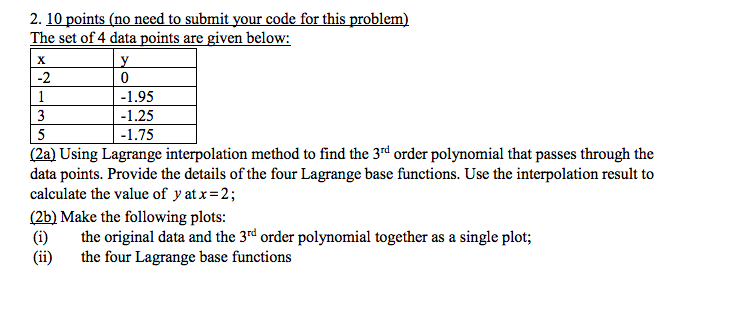
2. 10 points (no need to submit your code for this problem) The set of 4 data points are given below: -2 1.95 1.25 1.75 (2a) Using Lagrange interpolation method to find the 3rd order polynomial that passes through the data points. Provide the details of the four Lagrange base functions. Use the interpolation result to calculate the value of yatx-2; (2b) Make the following plots: (i) the original data and the 3rd order polynomial together as a single plot; (ii) the four Lagrange base functions 2. 10 points (no need to submit your code for this problem) The set of 4 data points are given below: -2 1.95 1.25 1.75 (2a) Using Lagrange interpolation method to find the 3rd order polynomial that passes through the data points. Provide the details of the four Lagrange base functions. Use the interpolation result to calculate the value of yatx-2; (2b) Make the following plots: (i) the original data and the 3rd order polynomial together as a single plot; (ii) the four Lagrange base functions
Step by Step Solution
There are 3 Steps involved in it

Get step-by-step solutions from verified subject matter experts
 Study Help