







Question: this is what I have so far #include #include using namespace std; int AND(int p, int q) { return p && q; } int OR(int
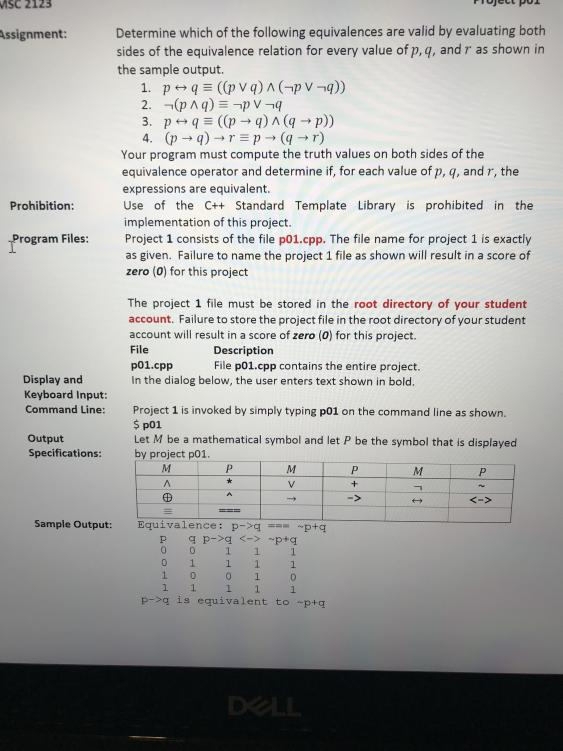
this is what I have so far
#include
#include
using namespace std;
int AND(int p, int q)
{
return p && q;
}
int OR(int p, int q)
{
return p || q;
}
int NOT(int p, int q)
{
return (!p);
}
int IMPLI(int p, int q)
{
if(p ==1 )
return q;
else
return 1;
}
int EQUIV(int p, int q)
{
if(p == q)
return 1;
else
return 0;
}
int main()
{
int p[] = {0, 0, 1, 1};
int q[] = {0, 1, 0, 1};
trying to use pointers and arrays help please?
MSC Determine which of the following equivalences are valid by evaluating both sides of the equivalence relation for every value of p,q, and r as shown in the sample output Assignment: Your program must compute the truth values on both sides of the equivalence operator and determine if, for each value of p, q, and r, the expressions are equivalent. Use of the Standard Template Library is prohibited in the Prohibition: implementation of this project. Program Files: Project 1 consists of the file p01.cpp. The file name for project 1 is exactly as given. Failure to name the project 1 file as shown will result in a score of zero (0) for this project The project 1 file must be stored in the root directory of your student account. Failure to store the project file in the root directory of your student account will result in a score of zero (0) for this project. File po1.cpp In the dialog below, the user enters text shown in boid Description File po1cpp contains the entire project. Display and Keyboard Input: Command Line: Project 1 is invoked by simply typing p01 on the command line as shown. $ p01 Let M be a mathematical symbol and let P be the symbol that is displayed by project po1. Output Specifications: Sample Output: Equivalence: p-tq p- is equivalent to p+
Step by Step Solution
There are 3 Steps involved in it

Get step-by-step solutions from verified subject matter experts
 Study Help