







Question: This is what I wrote the first time. I do not understand directions on how to create rough draft. Can AI rewrite this or you
This is what I wrote the first time. I do not understand directions on how to create rough draft. Can AI rewrite this or you to revise current document for assignment. Using IRAC method, Bluebook citations, conclusion to include court findings? I could not find any examples of rough draft PLG 103 Legal Research and Writing II week 3 on course hero. This is my 1st draft. But needs redone as a rough draft with those instructions. Thanks Victor
City of Indianapolis v. Edmond-531 U.S. 32, 121 S. Ct. 447 (2000)
Procedural History:In Indianapolis, IN. several drug checkpoints were set up throughout the city. Random vehicles were pulled over and the drivers of those vehicles were examined for impairment. While one officer would conduct an open view of the vehicle, another officer would walk around the vehicle with a K-9 drug sniffing canine. James Edmond and Joell Palmer in September of 1998 were stopped at one of these narcotics checkpoints and their vehicle was searched. They believed their Fourth Amendment right was violated along with other Defendants and moved the Court for a Class Action Certification. That Certification was granted.
Facts: The roadblock checkpoints at the completion of program stopped 1,161 automobiles and arrested 104 motorists. Of the 104 motorists 55 were for drug related crimes while the remaining 49 were offenses unrelated to drugs (Indianapolis v. Edmond, 531 U.S. 35). The United States Court of Appeals for the Seventh Circuit, reversed the denial of respondents' motion for a preliminary injunction. The court determined their city's checkpoint program with the primary purpose of prohibiting illegal drugs, violated the Fourth Amendment. "The United States Court of Appeals for the Seventh Circuit reversed on the grounds that the program was meant to intercept a completely random sample of drivers. Moreover, the appellate court held that there was neither probable cause nor articulable suspicion to stop any given driver, and that the program did not fit any of the exceptions allowed under the Fourth Amendment. The Supreme Court of the United States granted the City's petition for certiorari."
Issue: To rule if the drivers of the vehicles Fourth Amendment rights were violated during the search and seizure when stopped at the checkpoint to cut down on illegal drugs. Did the city's checkpoint program violate the Fourth Amendment? Whether "a highway checkpoint program whose primary purpose is the discovery and interdiction of illegal narcotics" is constitutional.
Rule: The nine Justices of the Supreme Court came to a 6 to 3 decision that was ruled down by Justice Sandra Day O'Conner. "We cannot sanction stops justified only by the generalized and ever-present possibility that interrogation and inspection may reveal that any given motorist has committed some crime," wrote Justice O'Connor. Chief Justice William H. Rehnquist and Justices Antonin Scalia and Clarence Thomas dissented, arguing that the reasonableness of the city's roadblocks depended on whether they served a "significant state interest with minimal intrusion on motorists." The three Justice's that opposed the ruling argued the checkpoints served as a common interest for the safety of all motorist(s) and provided binate protection for all citizens for the fight against crime. The court found that the checkpoints were set up to prevent crimes of transporting drugs but the majority of Supreme Court Judges ruled that process violated the Fourth Amendment. Also citing that the Supreme Court upheld Chandler V. Miller U.S. 305. "To be reasonable under the Fourth Amendment, a search ordinarily must be based on individualized suspicion of wrongdoing."
Analysis: Under the Fourth Amendment it states that no one should feel unprotected in "persons, houses, papers and effects." To unreasonable drug searches or seizures without a proper search warrant. The Fourth Amendment also states that with probable cause some search and seizures are valid. It is the duty of the court to determine when and for what purpose a search and seizure would be reasonable or not. A judge can issue a search warrant if the information is strong enough to support probable cause. The largest consideration for establishing sound reason at a checkpoint weighs the intent to ensure safety of the checkpoint and the individual's right to privacy.
Conclusion: The United States Court of Appeals for the Seventh Circuit, City of Indianapolis v. Edmond- 531 U.S. 32, 121 S. Ct. 447 (2000) 183 F.3d 659, affirmed their judgement that the checkpoint program violated the Fourth Amendment because it was not in the greater interest in preventing crime.The Supreme court affirmed the decision that the Indianapolis check point program was undistinguishable from interest in general crime control and the checkpoints violated the Fourth Amendment."The Supreme Court of the United States affirmed the determination that the checkpoints violated the Fourth Amendment because the primary purpose of the narcotics checkpoint program was to uncover evidence of ordinary criminal wrongdoing. According to the Court, because the authorities pursued primarily general crime control purposes at the checkpoints, the stops could only be justified by some quantum of individualized suspicion."
Compare and Contrast Gideon Goodtime
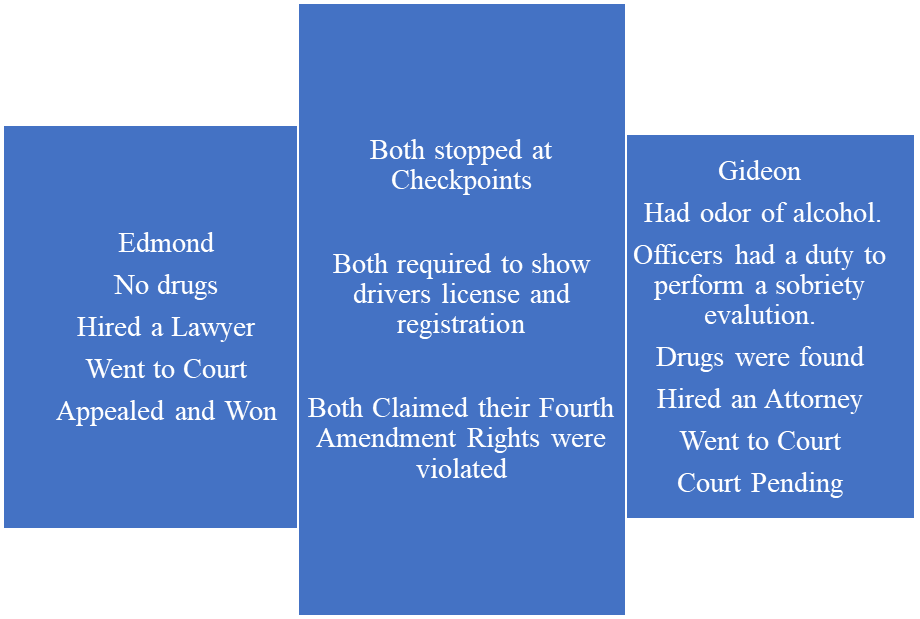
Both stopped at Checkpoints Gideon Had odor of alcohol. Edmond Both required to show Officers had a duty to No drugs drivers license and perform a sobriety Hired a Lawyer registration evalution. Went to Court Drugs were found Appealed and Won Both Claimed their Fourth Hired an Attorney Amendment Rights were Went to Court violated Court Pending
Step by Step Solution
There are 3 Steps involved in it

Get step-by-step solutions from verified subject matter experts
 Study Help