Question: this is what some one wrote on my discussion post, respond Jun 13 y:uzam Shatasha, thank you for your well-articulated discussion post. Your identification of
this is what some one wrote on my discussion post, respond
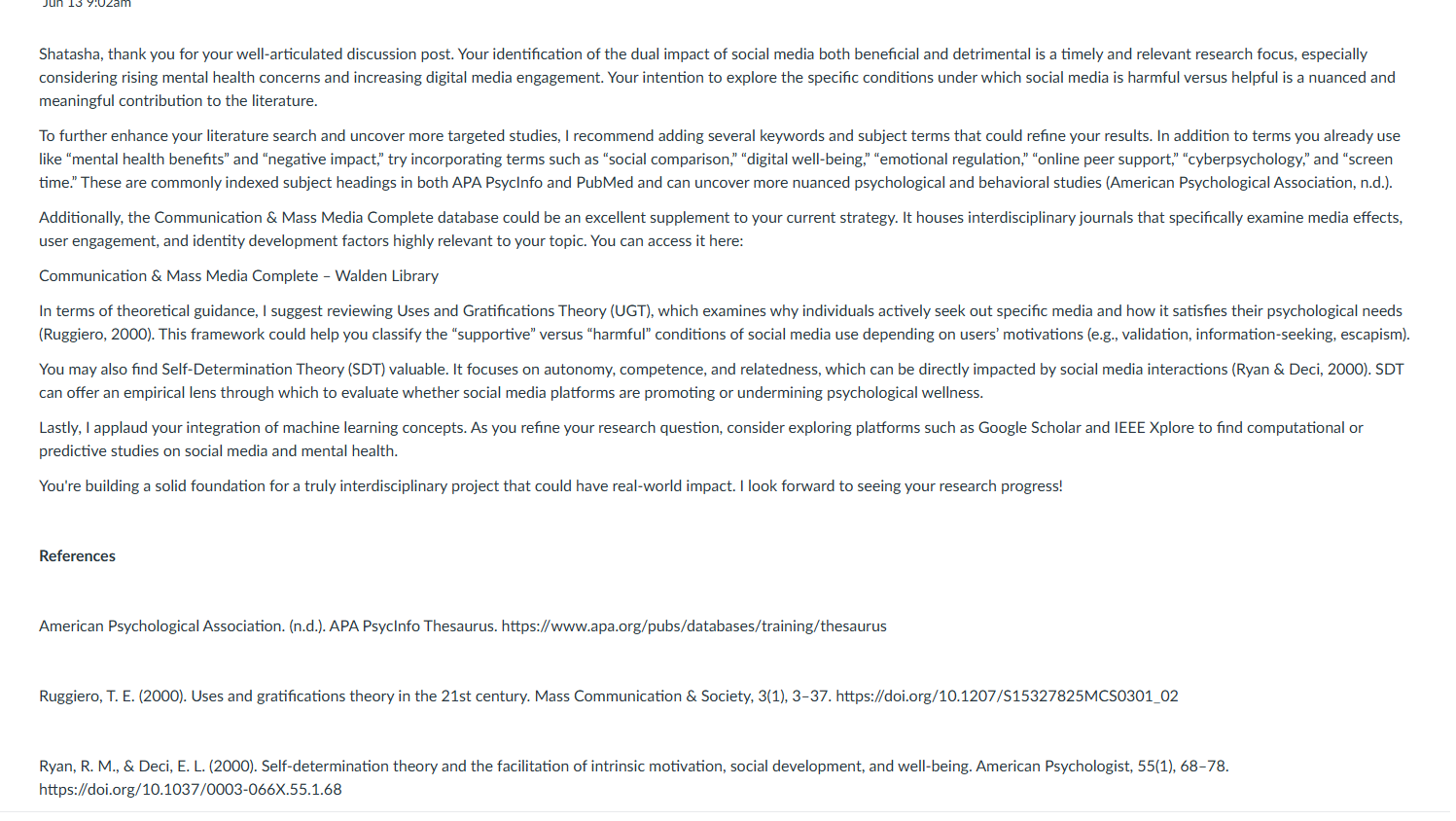
Jun 13 y:uzam Shatasha, thank you for your well-articulated discussion post. Your identification of the dual impact of social media both beneficial and detrimental is a timely and relevant research focus, especially considering rising mental health concerns and increasing digital media engagement. Your intention to explore the specific conditions under which social media is harmful versus helpful is a nuanced and meaningful contribution to the literature. To further enhance your literature search and uncover more targeted studies, | recommend adding several keywords and subject terms that could refine your results. In addition to terms you already use like \"mental health benefits\" and \"negative impact,\" try incorporating terms such as \"social comparison,\" \"digital well-being,\" \"emotional regulation, online peer support,\" \"cyberpsychology,' and \"screen time.\" These are commonly indexed subject headings in both APA PsyciInfo and PubMed and can uncover more nuanced psychological and behavioral studies (American Psychological Association, n.d.). Additionally, the Communication & Mass Media Complete database could be an excellent supplement to your current strategy. It houses interdisciplinary journals that specifically examine media effects, user engagement, and identity development factors highly relevant to your topic. You can access it here: Communication & Mass Media Complete - Walden Library In terms of theoretical guidance, | suggest reviewing Uses and Gratifications Theory (UGT), which examines why individuals actively seek out specific media and how it satisfies their psychological needs (Ruggiero, 2000). This framework could help you classify the \"supportive\" versus \"harmful\" conditions of social media use depending on users' motivations (e.g., validation, information-seeking, escapism). You may also find Self-Determination Theory (SDT) valuable. It focuses on autonomy, competence, and relatedness, which can be directly impacted by social media interactions (Ryan & Deci, 2000). SDT can offer an empirical lens through which to evaluate whether social media platforms are promoting or undermining psychological wellness. Lastly, | applaud your integration of machine learning concepts. As you refine your research question, consider exploring platforms such as Google Scholar and IEEE Xplore to find computational or predictive studies on social media and mental health. You're building a solid foundation for a truly interdisciplinary project that could have real-world impact. | look forward to seeing your research progress! References American Psychological Association. (n.d.). APA PsycInfo Thesaurus. https://www.apa.org/pubs/databases/training/thesaurus Ruggiero, T. E. (2000). Uses and gratifications theory in the 21st century. Mass Communication & Society, 3(1), 3-37. https://doi.org/10.1207/515327825MCS0301_02 Ryan, R. M., & Deci, E. L. (2000). Self-determination theory and the facilitation of intrinsic motivation, social development, and well-being. American Psychologist, 55(1), 68-78. https:/doi.org/10.1037/0003-066X.55.1.68









 Study Help