







Question: This is what the program should do : This program is designed to take a user-created chess validation dictionary and a chess board as inputs.
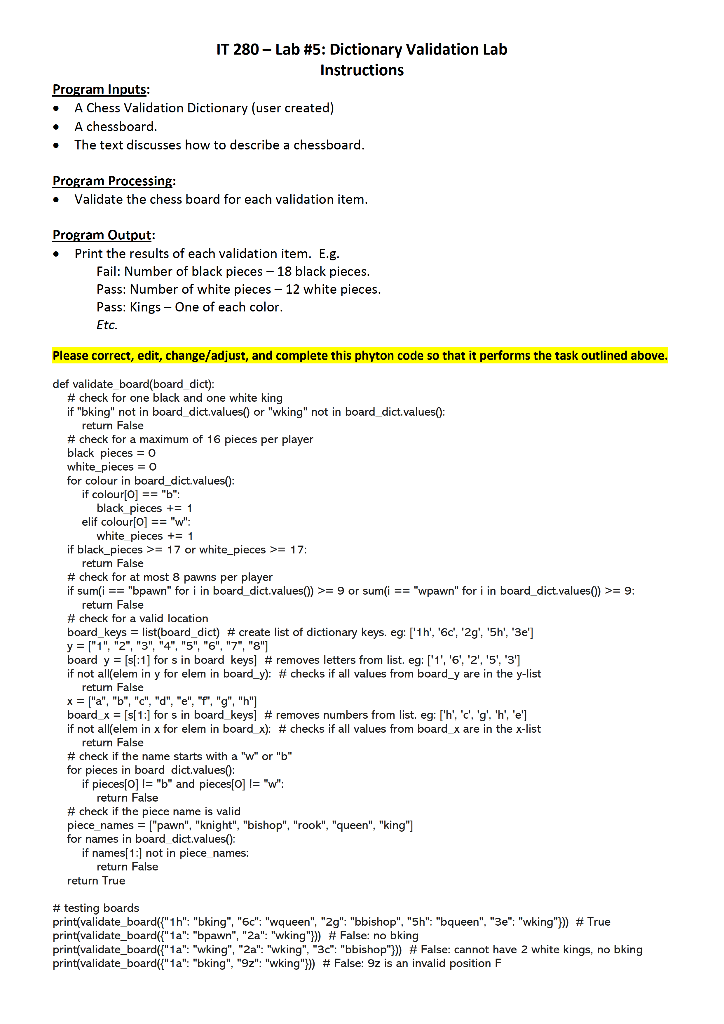
This is what the program should do:
This program is designed to take a user-created chess validation dictionary and a chess board as inputs. The program then uses the validation items in the dictionary to check the chess board for any errors or violations of the rules of chess. The program would print the results of each validation item, indicating whether the validation passed or failed and providing details about the specific issue if it failed. For example, if the number of black pieces on the board is incorrect, the program would print "Fail: Number of black pieces 18 black pieces" to indicate that the validation has failed and that there are 18 black pieces on the board instead of the expected number.
Adjust/correct the above python coding for A Chess Validation Dictionary (chess board), run the corrected coding in python, post a screenshot of the code in python and write the corrected codes on Chegg, plain, straightforward, and simple (using the appropriate python indentations).
Please correct, edit, change/adjust, and complete this phyton code so that it performs the task outlined above. def validate board(board dict): \# check for one black and one white king if "bking" not in board_dict.values() or "wking" not in board_dict.values(): return False \# check for a maximum of 16 pieces per player black pieces =0 white_pieces =0 for colour in board_dict.values(): if colour[0] == "b": black_pieces +=1 elif colour[0] = = " w ": white pieces +=1 if black_pieces >=17 or white_pieces >=17 : retum False \# check for at most 8 pawns per player if sum(i == "bpawn" for i in board_dict.values()) >=9 or sum(i == "wpawn" for i in board_dict.values()) >=9; return False \# check for a valid location board_keys = list(board_dict) \# create list of dictionary keys. eg: ['1h', '6c', '2g', '5h', '3e'] y= ["1", "2", "3", "4", "5", "6", "7", "8"] board y=[s[11] for s in board keys] \# removes letters from list. eg: ['1', '6', '2', ' '5', '3'] if not all(elem in y for elem in board_y): \# checks if all values from board_y are in the y-list retum False x= ["a", "b", "c", "d", "e", "ff, "g", "h"] board_x = [s[1;] for 5 in board_keys] \# removes numbers from list. eg: ['h', 'c', 'g', 'h', 'e'] if not all(elem in x for elem in board x ): \# checks if all values from board x are in the x-list return False \# check if the name starts with a "w" or "b" for pieces in board dictivalues[): if pieces[0] I= "b" and pieces[0] |= " w" ": return False \# check if the piece name is valid piece_names = ["pawn", "knight", "bishop", "rook", "queen", "king"] for names in board dict.values()): if names[1:] not in piece names: return False return True \# testing boards print(validate_board(\{"1h": "bking", "6c": "wqueen", "2g": "bbishop", "5h": "bqueen", "3e": "wking"\})) \# True print(validate_board(\{"1a": "bpawn", "2a": "wking"\})) \# False: no bking print(validate_board(\{"1a": "wking", "2a": "wking", "3c": "bbishop"\})) \# False: cannot have 2 white kings, no bking print(validate_board(\{"1a": "bking", "9z": "wking"\})) \# False: 9z is an invalid position F
Step by Step Solution
There are 3 Steps involved in it

Get step-by-step solutions from verified subject matter experts
 Study Help