







Question: This lab uses The Physics Aviary Force Buoyancy Simulation Lab: Force Buoyancy Lab (thephysicsaviary.com) Some Useful information: Density = mass/volume Weight = mass x gravitational
This lab uses The Physics Aviary Force Buoyancy Simulation Lab: Force Buoyancy Lab (thephysicsaviary.com) Some Useful information: Density = mass/volume
Weight = mass x gravitational acceleration
Weight of fluid = density x volume x gravitational acceleration
Density of water = 1,000 kg/m3 = 1.0 kg/L = 1.0 g/cm3
Archimedes Principal: The buoyant force, FB, on an object is equal t the weight of the fluid it displaces when it is submerged in the fluid
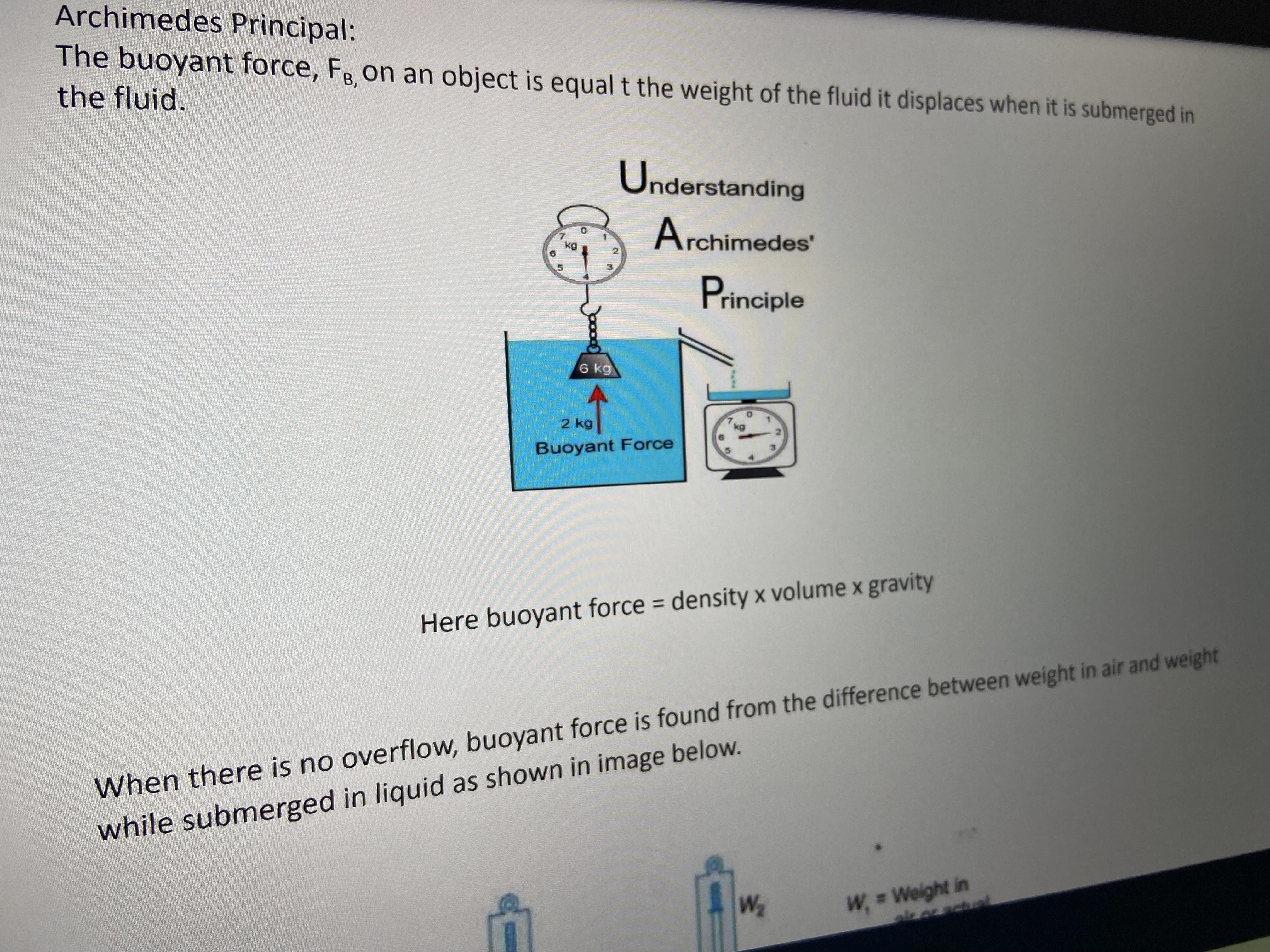
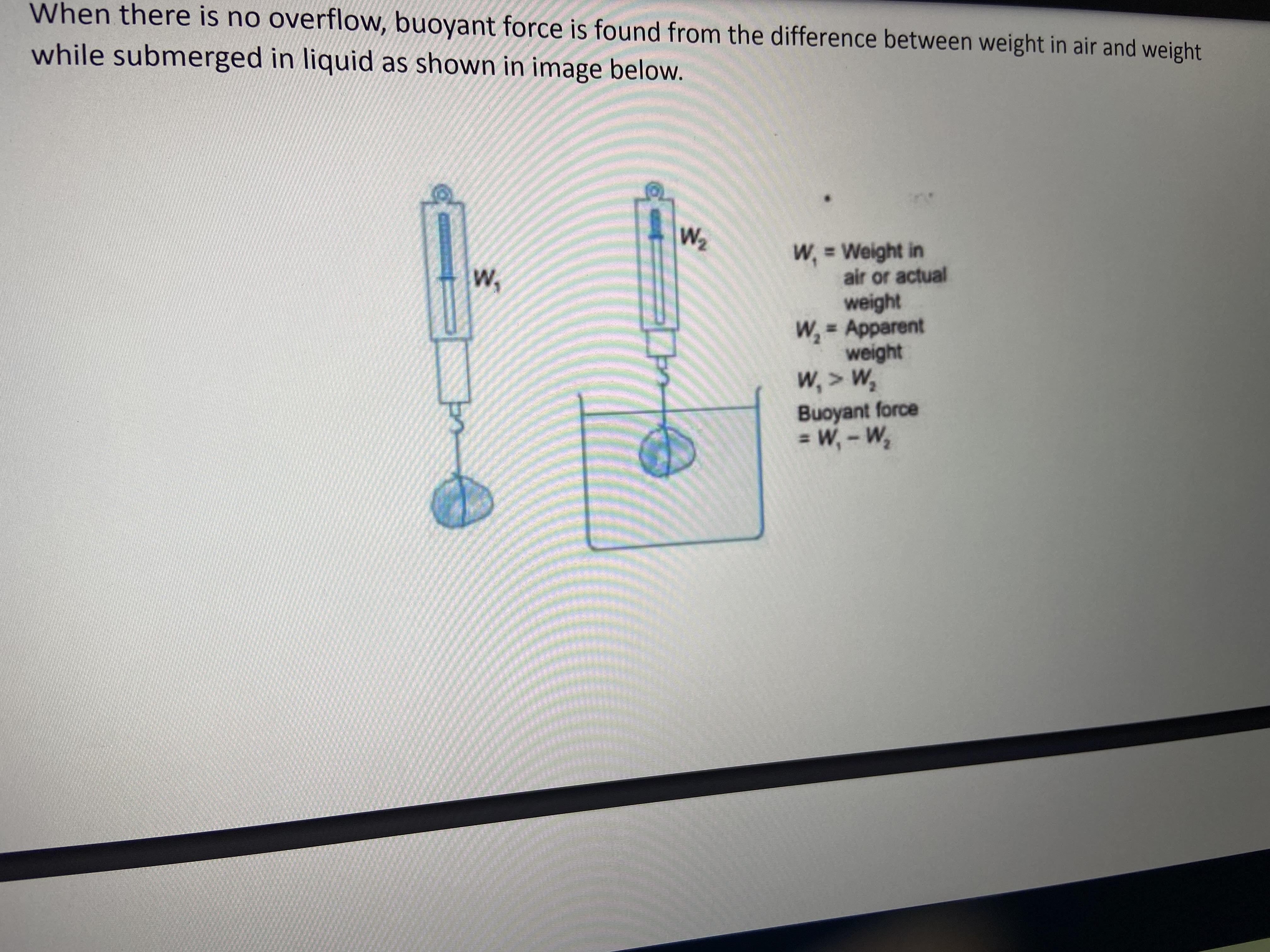
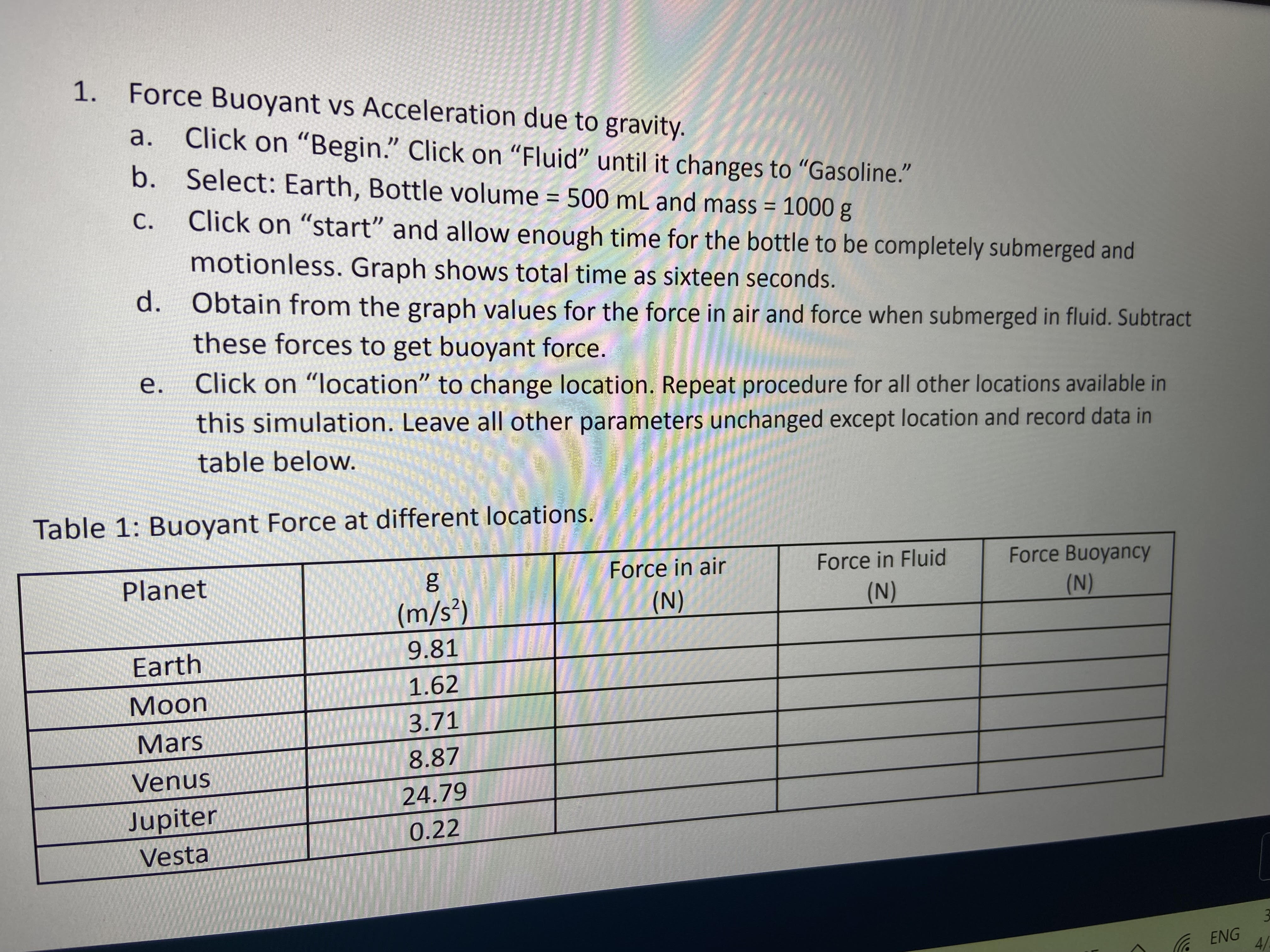
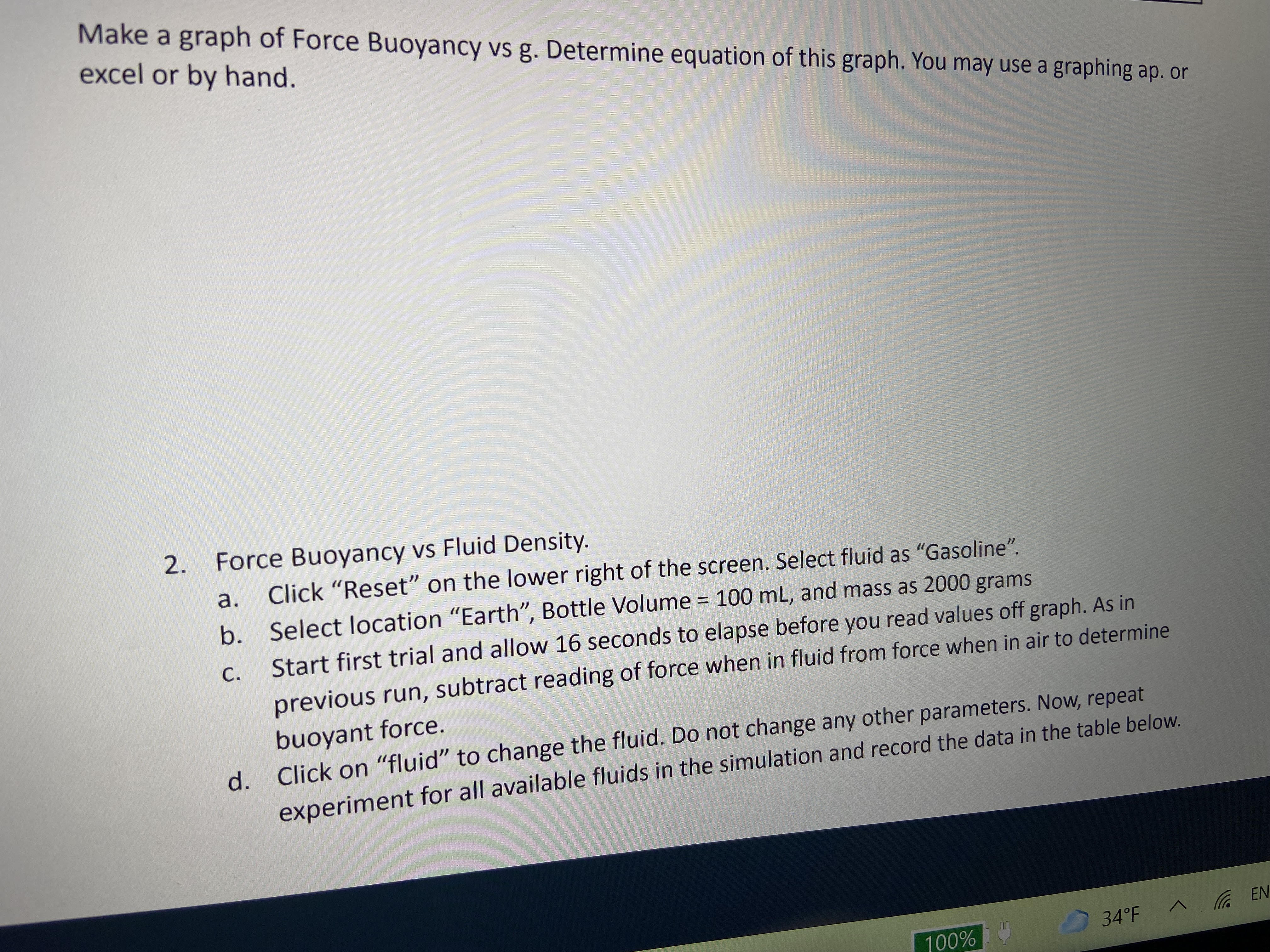
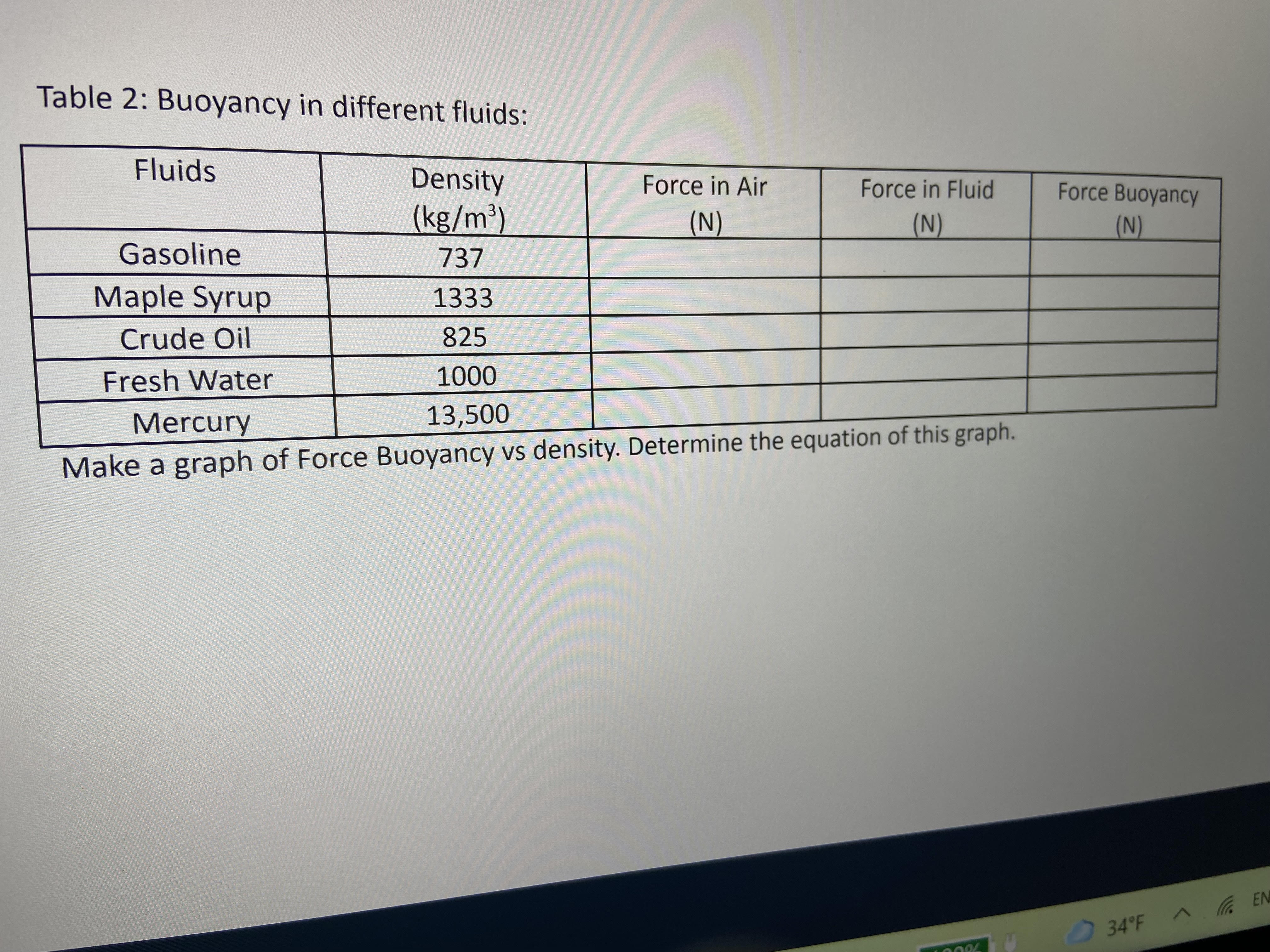
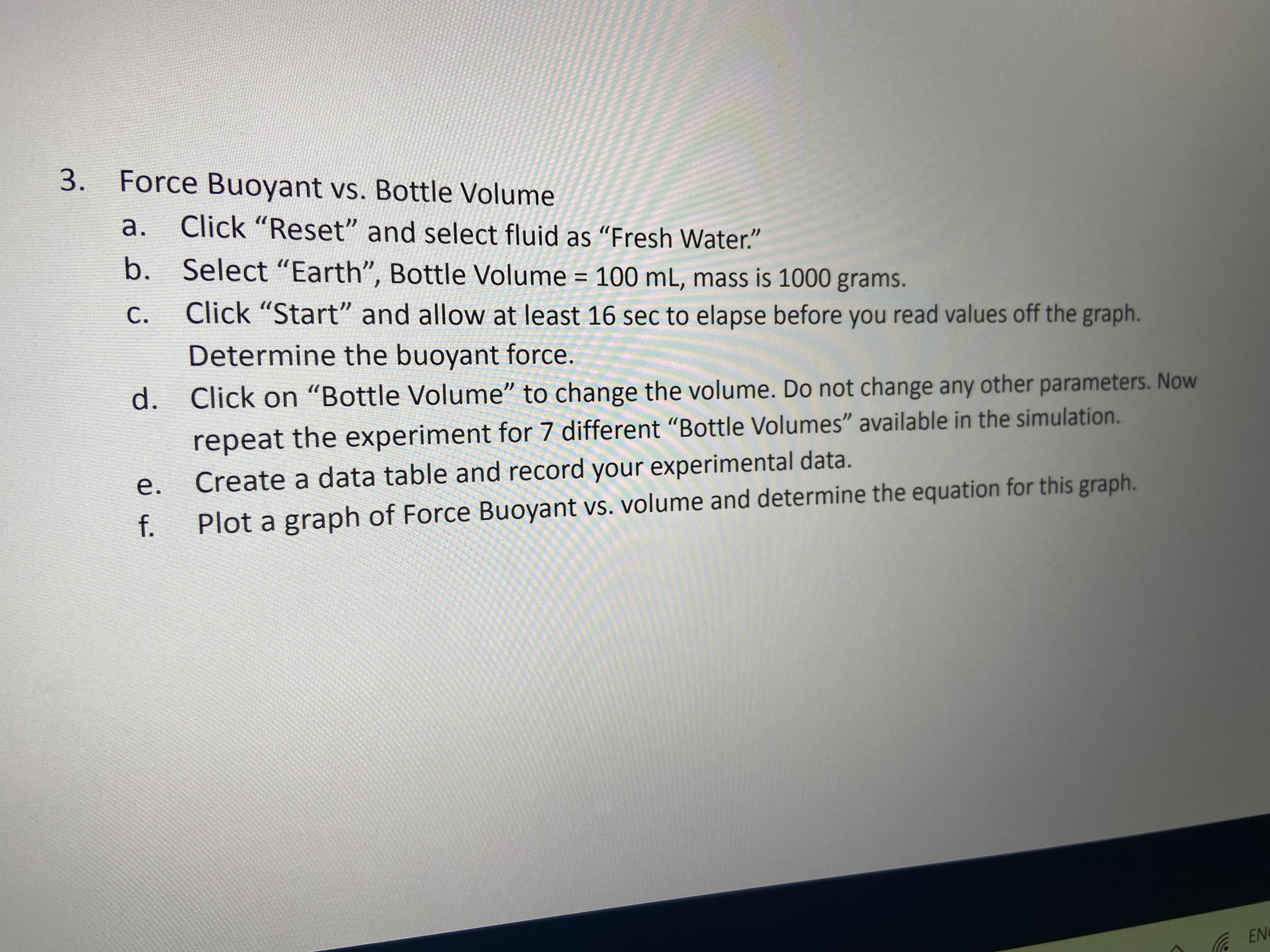
Archimedes Principal: the fluid. The buoyant force, FB, on an object is equal t the weight of the fluid it displaces when it is submerged in Understanding Archimedes Principle 6 kg 2 kg Buoyant Force Here buoyant force = density x volume x gravity When there is no overflow, buoyant force is found from the difference between weight in air and weight while submerged in liquid as shown in image below. W2 W. = Weight inWhen there is no overflow, buoyant force is found from the difference between weight in air and weight while submerged in liquid as shown in image below. W2 W. = Weight in W, air or actual weight W, = Apparent weight W , > W, Buoyant force = W - W,1. Force Buoyant vs Acceleration due to gravity. a. Click on "Begin." Click on "Fluid" until it changes to "Gasoline." b. Select: Earth, Bottle volume = 500 mL and mass = 1000 g c. Click on "start" and allow enough time for the bottle to be completely submerged and motionless. Graph shows total time as sixteen seconds. d. Obtain from the graph values for the force in air and force when submerged in fluid. Subtract these forces to get buoyant force. e. Click on "location" to change location. Repeat procedure for all other locations available in this simulation. Leave all other parameters unchanged except location and record data in table below. Table 1: Buoyant Force at different locations. Planet g Force in air Force in Fluid Force Buoyancy ( m/s2) (N) (N) (N) Earth 9.81 Moon 1.62 Mars 3.71 Venus 8.87 Jupiter 24.79 0.22 Vesta ENGexcel or by hand. Make a graph of Force Buoyancy vs g. Determine equation of this graph. You may use a graphing ap. or 2. Force Buoyancy vs Fluid Density. a. Click "Reset" on the lower right of the screen. Select fluid as "Gasoline". b. Select location "Earth", Bottle Volume = 100 ml, and mass as 2000 grams c. Start first trial and allow 16 seconds to elapse before you read values off graph. As in previous run, subtract reading of force when in fluid from force when in air to determine buoyant force. d. Click on "fluid" to change the fluid. Do not change any other parameters. Now, repeat experiment for all available fluids in the simulation and record the data in the table below. 34 OF ~ Ko EN 100%Table 2: Buoyancy in different fluids: Fluids Density Force in Air Force in Fluid Force Buoyancy (kg/m3 ) (N) (N) (N) Gasoline 737 Maple Syrup 1333 Crude Oil 825 Fresh Water 1000 Mercury 13,500 Make a graph of Force Buoyancy vs density. Determine the equation of this graph. 34 OF ~ : EN3. Force Buoyant vs. Bottle Volume a. Click "Reset" and select fluid as "Fresh Water." b. Select "Earth", Bottle Volume = 100 ml, mass is 1000 grams. c. Click "Start" and allow at least 16 sec to elapse before you read values off the graph. Determine the buoyant force. d. Click on "Bottle Volume" to change the volume. Do not change any other parameters. Now repeat the experiment for 7 different "Bottle Volumes" available in the simulation. e. Create a data table and record your experimental data. f. Plot a graph of Force Buoyant vs. volume and determine the equation for this graph
Step by Step Solution
There are 3 Steps involved in it

Get step-by-step solutions from verified subject matter experts
 Study Help