







Question: This mathematical problem is based on the assigned Barabasi Ch . 2 reading. Newman Ch . 6 is also relevant. It does require prior understanding
This mathematical problem is based on the assigned Barabasi Ch reading. Newman Ch is also
relevant. It does require prior understanding of matrix math, in particular multiplication and the trace
operator.
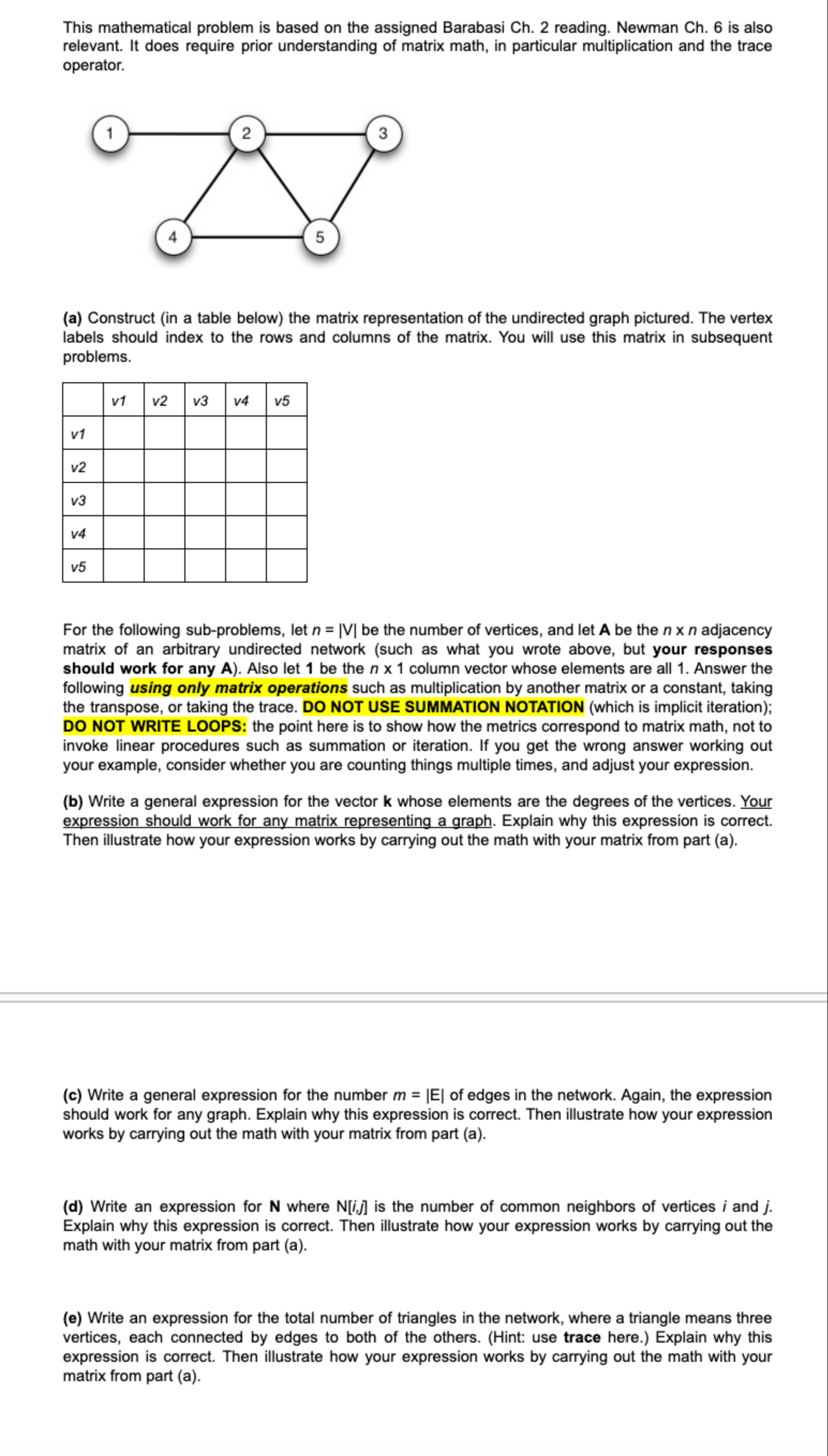
a Construct in a table below the matrix representation of the undirected graph pictured. The vertex
labels should index to the rows and columns of the matrix. You will use this matrix in subsequent
problems.
For the following subproblems, let be the number of vertices, and let be the adjacency
matrix of an arbitrary undirected network such as what you wrote above, but your responses
should work for any A Also let be the column vector whose elements are all Answer the
following using only matrix operations such as multiplication by another matrix or a constant, taking
the transpose, or taking the trace. DO NOT USE SUMMATION NOTATION which is implicit iteration;
DO NOT WRITE LOOPS: the point here is to show how the metrics correspond to matrix math, not to
invoke linear procedures such as summation or iteration. If you get the wrong answer working out
your example, consider whether you are counting things multiple times, and adjust your expression.
b Write a general expression for the vector whose elements are the degrees of the vertices. Your
expression should work for any matrix representing a graph. Explain why this expression is correct.
Then illustrate how your expression works by carrying out the math with your matrix from part a
c Write a general expression for the number of edges in the network. Again, the expression
should work for any graph. Explain why this expression is correct. Then illustrate how your expression
works by carrying out the math with your matrix from part a
d Write an expression for where is the number of common neighbors of vertices i and
Explain why this expression is correct. Then illustrate how your expression works by carrying out the
math with your matrix from part a
e Write an expression for the total number of triangles in the network, where a triangle means three
vertices, each connected by edges to both of the others. Hint: use trace here. Explain why this
expression is correct. Then illustrate how your expression works by carrying out the math with your
matrix from part a
Step by Step Solution
There are 3 Steps involved in it
1 Expert Approved Answer
Step: 1 Unlock

Question Has Been Solved by an Expert!
Get step-by-step solutions from verified subject matter experts
Step: 2 Unlock
Step: 3 Unlock
 Study Help