







Question: This needs theoretical answer. Coding is not required. Expert Q&A Done Consider the following simple game: we start with ten coins on the table, five
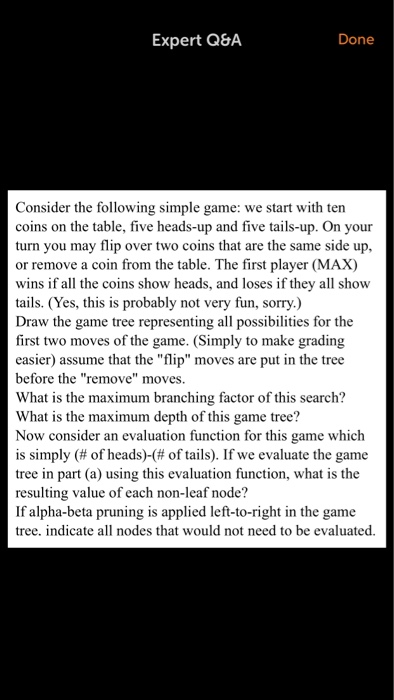
Expert Q&A Done Consider the following simple game: we start with ten coins on the table, five heads-up and five tails-up. On your turn you may flip over two coins that are the same side up, or remove a coin from the table. The first player (MAX) wins if all the coins show heads, and loses if they all show tails. (Yes, this is probably not very fun, sorry.) Draw the game tree representing all possibilities for the first two moves of the game. (Simply to make grading easier) assume that the "flip" moves are put in the tree before the "remove What is the maximum branching factor of this search? What is the maximum depth of this game tree? Now consider an evaluation function for this game which is simply (# of heads)-(# of tails). If we evaluate the game tree in part (a) using this evaluation function, what is the resulting value of each non-leaf node? If alpha-beta pruning is applied left-to-right in the game tree. indicate all nodes that would not need to be evaluated. " moves
Step by Step Solution
There are 3 Steps involved in it

Get step-by-step solutions from verified subject matter experts
 Study Help