







Question: This needs to be done in MATLAB code (1) A colony of bacteria grows rapidly with time at a rate of: dN Where N is
This needs to be done in MATLAB code
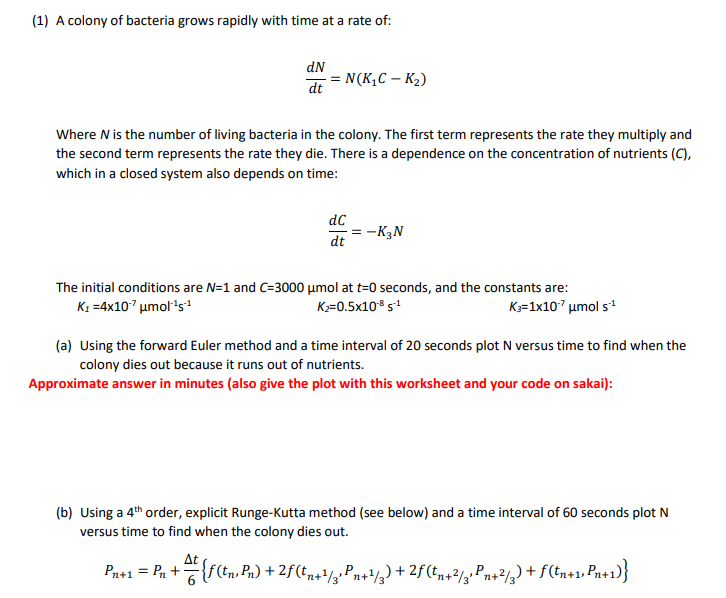
(1) A colony of bacteria grows rapidly with time at a rate of: dN Where N is the number of living bacteria in the colony. The first term represents the rate they multiply and the second term represents the rate they die. There is a dependence on the concentration of nutrients (C), which in a closed system also depends on time: The initial conditions are N-1 and C-3000 umol at t-0 seconds, and the constants are: K2-0.5x10⁸ s K,-1x10⁻⁷ ?mol s-1 (a) Using the forward Euler method and a time interval of 20 seconds plot N versus time to find when the colony dies out because it runs out of nutrients. Approximate answer in minutes (also give the plot with this worksheet and your code on sakai) (b) Using a 4th order, explicit Runge-Kutta method (see below) and a time interval of 60 seconds plot N versus time to find when the colony dies out. At (1) A colony of bacteria grows rapidly with time at a rate of: dN Where N is the number of living bacteria in the colony. The first term represents the rate they multiply and the second term represents the rate they die. There is a dependence on the concentration of nutrients (C), which in a closed system also depends on time: The initial conditions are N-1 and C-3000 umol at t-0 seconds, and the constants are: K2-0.5x10⁸ s K,-1x10⁻⁷ ?mol s-1 (a) Using the forward Euler method and a time interval of 20 seconds plot N versus time to find when the colony dies out because it runs out of nutrients. Approximate answer in minutes (also give the plot with this worksheet and your code on sakai) (b) Using a 4th order, explicit Runge-Kutta method (see below) and a time interval of 60 seconds plot N versus time to find when the colony dies out. At
Step by Step Solution
There are 3 Steps involved in it

Get step-by-step solutions from verified subject matter experts
 Study Help