





Question: this one? Example 16.12. If i? = 1, then the set Z[i] = {m+ ni: m,n Z} forms aring known as the Gaussian integers. |t

this one?
this one? Example 16.12. If i? = 1, then the set
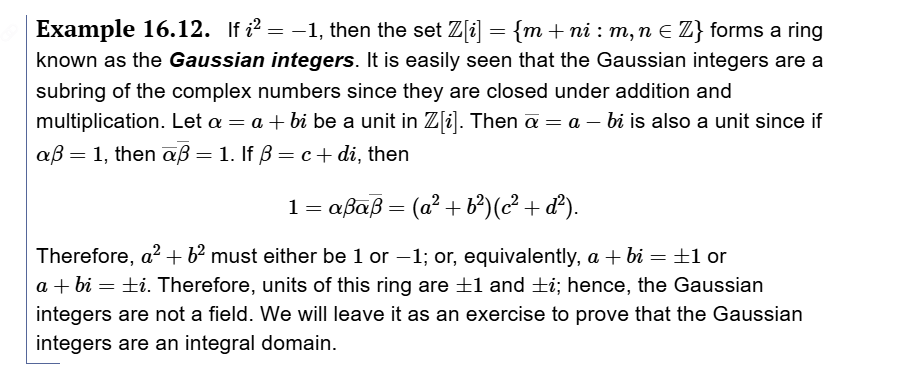
Example 16.12. If i? = 1, then the set Z[i] = {m+ ni: m,n Z} forms aring known as the Gaussian integers. |t is easily seen that the Gaussian integers are a subring of the complex numbers since they are closed under addition and multiplication. Let a = a + bi be a unit in Z[i|. Then @ = a bi is also a unit since if af = 1, then a6 = 1. If 8 =c+ di, then 1 = afap = (a' + b*)(c? + d?). Therefore, a? + b* must either be 1 or 1; or, equivalently, a + bi = +1 or a+ bi = +i. Therefore, units of this ring are +1 and +i; hence, the Gaussian integers are not a field. We will leave it as an exercise to prove that the Gaussian integers are an integral domain

Step by Step Solution

There are 3 Steps involved in it

1 Expert Approved Answer
Step: 1 Unlock blur-text-image

Question Has Been Solved by an Expert!

Get step-by-step solutions from verified subject matter experts

Step: 2 Unlock
Step: 3 Unlock

Students Have Also Explored These Related Accounting Questions!