







Question: this pose as 1 question hopefully get an answer by today 11/4/18 topic: SUPERCOMP AND VISUALIZATION 1. [40 points] In scientific visualization, use is made
this pose as 1 question
hopefully get an answer by today 11/4/18
topic: SUPERCOMP AND VISUALIZATION
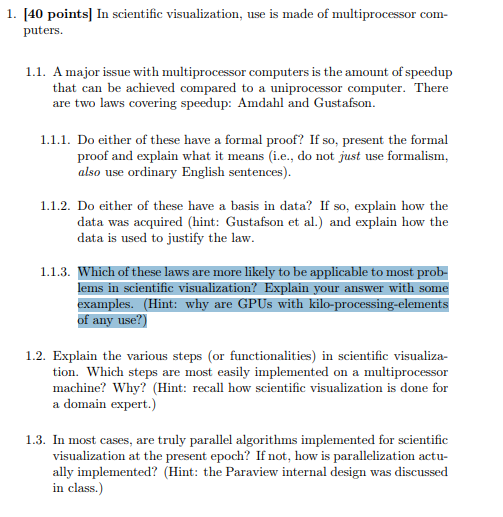
1. [40 points] In scientific visualization, use is made of multiprocessor com- puters. 1.1. A major issue with multiprocessor computers is the amount of speedup that can be achieved compared to a uniprocessor computer. There are two laws covering speedup: Amdahl and Gustafson 1.1.1. Do either of these have a formal proof? If so, present the formal proof and explain what it means i.e., do not just use formalism, also use ordinary English sentences) 1.1.2. Do either of these have a basis in data? If so, explain how the data was acquired (hint: Gustafson et al.) and explain how the data is used to justify the law 1.1.3. Which of these laws are more likely to be applicable to most prob- lems in scientific visualization? Explain your answer with some examples. Hint: why are GPUs with kilo-processing-elements of any use?) 1.2. Explain the various steps (or functionalities) in scientific visualiza- tion. Which steps are most easily implemented on a multiprocessor machine? Why? (Hint: recall how scientific visualization is done for a domain expert.) 1.3. In most cases, are truly parallel algorithms implemented for scientific visualization at the present epoch? If not, how is parallelization actu- ally implemented? (Hint: the Paraview internal design was discussed in class.) 1. [40 points] In scientific visualization, use is made of multiprocessor com- puters. 1.1. A major issue with multiprocessor computers is the amount of speedup that can be achieved compared to a uniprocessor computer. There are two laws covering speedup: Amdahl and Gustafson 1.1.1. Do either of these have a formal proof? If so, present the formal proof and explain what it means i.e., do not just use formalism, also use ordinary English sentences) 1.1.2. Do either of these have a basis in data? If so, explain how the data was acquired (hint: Gustafson et al.) and explain how the data is used to justify the law 1.1.3. Which of these laws are more likely to be applicable to most prob- lems in scientific visualization? Explain your answer with some examples. Hint: why are GPUs with kilo-processing-elements of any use?) 1.2. Explain the various steps (or functionalities) in scientific visualiza- tion. Which steps are most easily implemented on a multiprocessor machine? Why? (Hint: recall how scientific visualization is done for a domain expert.) 1.3. In most cases, are truly parallel algorithms implemented for scientific visualization at the present epoch? If not, how is parallelization actu- ally implemented? (Hint: the Paraview internal design was discussed in class.)
Step by Step Solution
There are 3 Steps involved in it

Get step-by-step solutions from verified subject matter experts
 Study Help